
Homework Answers
Program:
name=input("\nEnter a name: ")
age=int(input("Enter an age: "))
Quiz1=float(input("Enter Quiz1: "))
print("\n")
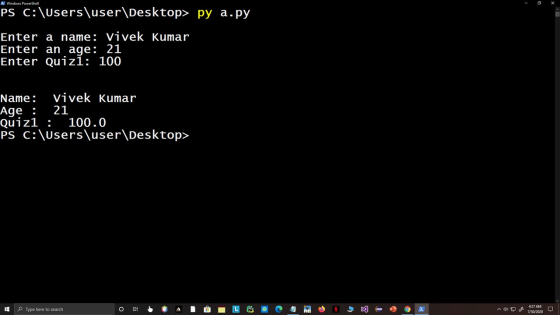
print("Name: ",name,"\nAge : ",age,"\nQuiz1 : ",Quiz1)
Output:
Add Answer to:
an integer value, and your quiz 1 score as a float value. as a string value,...
In Python, please change this function so if someone inputs an invalid age (string, float, number...
In Python, please change this function so if someone inputs an invalid age (string, float, number below 0), print "wrong". Use the "isdigit()" function -------------------------- def age_name(): name = input("Enter name:") age = int(input("Enter age:")) print("Hello", name) if(age <= 18): print("Child") elif(age <= 64): print("Adult") else: print("Senior")
1) Write a program that: program starts; declares and initializes to zero an integer variable score;...
1) Write a program that: program starts; declares and initializes to zero an integer variable score; declares and initializes to zero a float variable total; uses a for loop statement with integer x initialized to 1 going 5 iterations hence x<5 incremented by 0; input from keyboard integer score in range of 0 to 99; print on new line input value; adds score to total; switch x equals 3 break default x++; after exiting the loop calculate the average score;...
Write a function in Go that takes as input a float variable and returns two integer...
Write a function in Go that takes as input a float variable and returns two integer values. One integer value which is the floor of the float value and the second integer value which is the ceiling of the float value. Print the result to console.
C++ Write a function parseScores which takes a single input argument, a file name, as a string. Your function should read each line from the given filename, parse and process the data, and print the r...
C++ Write a function parseScores which takes a single input argument, a file name, as a string. Your function should read each line from the given filename, parse and process the data, and print the required information. Your function should return the number of student entries read from the file. Empty lines do not count as entries, and should be ignored. If the input file cannot be opened, return -1 and do not print anything. Your function should be named...
// PLACE YOUR NAME HERE #include <iostream> using namespace std; float findAverage (int [], int); //...
// PLACE YOUR NAME HERE #include <iostream> using namespace std; float findAverage (int [], int); // finds average of all //grades int findHighest (int [], int); // finds highest of all //grades int findFirstFail( int[]); int main() { int grades[100]; // the array holding 100 grades. int numberOfGrades; // the number of grades read. int pos; // index to the array. float avgOfGrades; // contains the average of the grades. int highestGrade; // contains the highest grade. int inderOfFail; //...
1 2 3 #include <iostream> #include <string> using namespace std; float getAmount (float & pricep, string...
 1 2 3 #include <iostream> #include <string> using namespace std; float getAmount (float & pricep, string item, int & howmany) 4 5 6 7 8 9 10 11 12 13 14 15 16 = float total priceP; if (item != "book" && price > 200) itemP = "book"; else if (item == "birthday card" && howmanyP >= 10) priceP priceP + 10 / 5; total += priceP; if (price <= 12) itemP = "pencil"; howmany = 50; return total; ب...
1 2 3 #include <iostream> #include <string> using namespace std; float getAmount (float & pricep, string...
 1 2 3 #include <iostream> #include <string> using namespace std; float getAmount (float & pricep, string item, int & howmany) 4 5 6 7 8 9 10 11 12 13 14 15 16 = float total priceP; if (item != "book" && price > 200) itemP = "book"; else if (item == "birthday card" && howmanyP >= 10) priceP priceP + 10 / 5; total += priceP; if (price <= 12) itemP = "pencil"; howmany = 50; return total; ب...
1 2 3 #include <iostream> #include <string> using namespace std; float getAmount (float & pricep, string...
 1 2 3 #include <iostream> #include <string> using namespace std; float getAmount (float & pricep, string item, int & howmany) 4 5 6 7 8 9 10 11 12 13 14 15 16 = float total priceP; if (item != "book" && price > 200) itemP = "book"; else if (item == "birthday card" && howmanyP >= 10) priceP priceP + 10 / 5; total += priceP; if (price <= 12) itemP = "pencil"; howmany = 50; return total; ب...
1. Assume that cases is the name of a variable with a float value that you...
1. Assume that cases is the name of a variable with a float value that you want to convert to an integer value. Write a Python expression that converts cases to an integer (throwing away any fractional part) 2. Assume that courseNum is an integer that represents the numeric part of a course number (e.g. 3, 8, 130, 16, 24). Write a Python expression that converts courseNum to an string (i.e. <class 'str'> in Python)
 1 2 3 #include <iostream> #include <string> using namespace std; float getAmount (float & pricep, string item, int & howmany) 4 5 6 7 8 9 10 11 12 13 14 15 16 = float total priceP; if (item != "book" && price > 200) itemP = "book"; else if (item == "birthday card" && howmanyP >= 10) priceP priceP + 10 / 5; total += priceP; if (price <= 12) itemP = "pencil"; howmany = 50; return total; ب...
 1 2 3 #include <iostream> #include <string> using namespace std; float getAmount (float & pricep, string item, int & howmany) 4 5 6 7 8 9 10 11 12 13 14 15 16 = float total priceP; if (item != "book" && price > 200) itemP = "book"; else if (item == "birthday card" && howmanyP >= 10) priceP priceP + 10 / 5; total += priceP; if (price <= 12) itemP = "pencil"; howmany = 50; return total; ب...
 1 2 3 #include <iostream> #include <string> using namespace std; float getAmount (float & pricep, string item, int & howmany) 4 5 6 7 8 9 10 11 12 13 14 15 16 = float total priceP; if (item != "book" && price > 200) itemP = "book"; else if (item == "birthday card" && howmanyP >= 10) priceP priceP + 10 / 5; total += priceP; if (price <= 12) itemP = "pencil"; howmany = 50; return total; ب...
Most questions answered within 3 hours.
-
Where is the error in this code sequence?
String s1 = "Hello";
String s2 = "ello";...
asked 11 months ago -
Financial data for Joel de Paris, Inc., for last year
follow:
Joel de Paris, Inc.
Balance...
asked 11 months ago -
Consider this reaction:
Al2(SO4)3 (aq)+ BaCl3
(aq) Al2Cl6 (aq)- +
3BaSO4(s) . What is the...
asked 11 months ago -
Suppose that Savneet is considering increasing her
recent random sample from 20 car rentals to 40...
asked 11 months ago -
Trucks arrive at an unloading terminal at an average rate of 120
per hour.
Trucks arrive...
asked 11 months ago -
Why are methanol and ethanol completely soluble in water while
octanol is not very little soluble....
asked 11 months ago -
A facilities manager at a university reads in a research report
that the mean amount of...
asked 11 months ago -
When the CuSO4 is rehydrated by adding water to the anhydrous
compound, is this an endothermic...
asked 11 months ago -
A ray of sunlight is passing from diamond into crown glass; the
angle of incidence is...
asked 11 months ago -
A block of mass 0.249 kg is placed on top of a light, vertical
spring of...
asked 11 months ago -
how do the kidneys compensate in the presences of acidosis
a) trigger hyperventilate
b) reserve acid...
asked 11 months ago -
Question 501 pts
The rental rate of capital to the firm increases. Which of the
following...
asked 11 months ago