
Homework Answers
Add Answer to:
if you have two capacitors but you want to create a single drout using a capacitor...
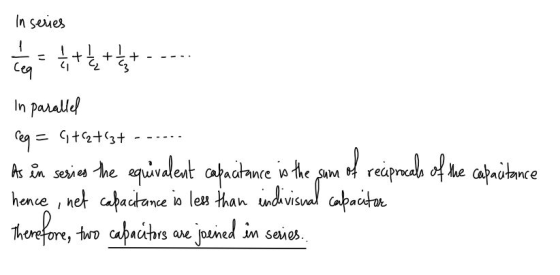
If you have two capacitors but you want to create a single circuit using a capacitor...
 If you have two capacitors but you want to create a single circuit using a capacitor that has less capacitance than either of the two that you have, how should you arrange the capacitors in your circuit? A. Put the capacitors in series. B. Put the capacitors in parallel. C. Put one before and one after the battery. D. Change the direction of one of the capacitors. E. It is not possible to have an equivalent capacitance less than any...
When do magnetic fields affect charges? A. Only when charges are moving. B. Only when charges...
 When do magnetic fields affect charges? A. Only when charges are moving. B. Only when charges are moving in a circle. C. Only when charges are stationary. OD. Only when the charge's sign is opposite to the sign of the magnetic field. O E. Magnetic fields never affect charges. If you have two capacitors but you want to create a single circuit using a capacitor that has less capacitance than either of the two that you have, how should you...
You have two capacitors, one is 6. 0 mu F the other is 3. 0 mu...
 You have two capacitors, one is 6. 0 mu F the other is 3. 0 mu F. You also have some wires and a 9. 0 V battery. Using the schematic symbols shown later in the lab, draw a diagram of a circuit with the two capacitors connected in series with the battery. Draw a diagram of a circuit using the same battery and capacitors with the capacitors now connected in parallel. Find the equivalent capacitance for each circuit. For...
The circuit in the figure below contains a 90.0 V battery and four capacitors. In the...
The circuit in the figure below contains a 90.0 V battery and four capacitors. In the top parallel branch, there are two capacitors, one with a capacitance of C1 = 3.00 µF and another with a capacitance of 6.00 µF. In the bottom parallel branch, there are two more capacitors, one with a capacitance of 2.00 µF and another with a capacitance of C2 = 6.00 µF. A circuit consists of a 90.0 V battery and four capacitors. The wire...
A You have two capacitors, one with a larger capacitance than the other. You connect them...
 A You have two capacitors, one with a larger capacitance than the other. You connect them in series. The total capacitance will be: The same as the larger capacitance B. - The same as the capacitance of the smaller capacitor Greater than the larger capacitance D. Less than the capacitance of the smaller capacitor E. Between the smaller and larger capacitances C.
You have two capacitors, one with a larger capacitance than the other. You connect them in...
You have two capacitors, one with a larger capacitance than the other. You connect them in series. The total capacitance will be: A. The same as the capacitance of the smaller capacitor B. Greater than the larger capacitance C. Between the smaller and larger capacitances D. The same as the larger capacitance E. Less than the capacitance of the smaller capacitor
OA You have two capacitors, one with a larger capacitance than the other. You connect them...
 OA You have two capacitors, one with a larger capacitance than the other. You connect them in series. The total capacitance will be: Between the smaller and larger capacitances The same as the larger capacitance OC. The same as the capacitance of the smaller capacitor Greater than the larger capacitance E. Less than the capacitance of the smaller capacitor
B. You have two capacitors, one with a larger capacitance than the other. You connect them...
 B. You have two capacitors, one with a larger capacitance than the other. You connect them in series. The total capacitance will be: O A. Less than the capacitance of the smaller capacitor Greater than the larger capacitance The same as the capacitance of the smaller capacitor Between the smaller and larger capacitances O E. The same as the larger capacitance D.
1. Two capacitors, one with a capacitance of 1 microFarad and the other with a capacitance...
1. Two capacitors, one with a capacitance of 1 microFarad and the other with a capacitance of 0.47 microFarads, are connected in series. A. What is the equivalent capacitance of this setup? B. If you connect a 9 Volt battery across the capacitors connected in series, how much charge will be on each plate of each capacitor? C. With the 9 Volt battery connected, what is the potential difference across each capacitor?
16.14 Two capacitors are connected in series with an 30 V battery. The capacitance of capacitor...
16.14 Two capacitors are connected in series with an 30 V battery. The capacitance of capacitor C1 is 12 µF and the capacitor C2 is unknown. The charge on capacitor C2 is 140 µC. a) What is the equivalent capacitance? b) What is the capacitance of capacitor C2? c) What is the voltage of each capacitor?
 If you have two capacitors but you want to create a single circuit using a capacitor that has less capacitance than either of the two that you have, how should you arrange the capacitors in your circuit? A. Put the capacitors in series. B. Put the capacitors in parallel. C. Put one before and one after the battery. D. Change the direction of one of the capacitors. E. It is not possible to have an equivalent capacitance less than any...
 When do magnetic fields affect charges? A. Only when charges are moving. B. Only when charges are moving in a circle. C. Only when charges are stationary. OD. Only when the charge's sign is opposite to the sign of the magnetic field. O E. Magnetic fields never affect charges. If you have two capacitors but you want to create a single circuit using a capacitor that has less capacitance than either of the two that you have, how should you...
 You have two capacitors, one is 6. 0 mu F the other is 3. 0 mu F. You also have some wires and a 9. 0 V battery. Using the schematic symbols shown later in the lab, draw a diagram of a circuit with the two capacitors connected in series with the battery. Draw a diagram of a circuit using the same battery and capacitors with the capacitors now connected in parallel. Find the equivalent capacitance for each circuit. For...
 A You have two capacitors, one with a larger capacitance than the other. You connect them in series. The total capacitance will be: The same as the larger capacitance B. - The same as the capacitance of the smaller capacitor Greater than the larger capacitance D. Less than the capacitance of the smaller capacitor E. Between the smaller and larger capacitances C.
 OA You have two capacitors, one with a larger capacitance than the other. You connect them in series. The total capacitance will be: Between the smaller and larger capacitances The same as the larger capacitance OC. The same as the capacitance of the smaller capacitor Greater than the larger capacitance E. Less than the capacitance of the smaller capacitor
 B. You have two capacitors, one with a larger capacitance than the other. You connect them in series. The total capacitance will be: O A. Less than the capacitance of the smaller capacitor Greater than the larger capacitance The same as the capacitance of the smaller capacitor Between the smaller and larger capacitances O E. The same as the larger capacitance D.
Most questions answered within 3 hours.
-
Where is the error in this code sequence?
String s1 = "Hello";
String s2 = "ello";...
asked 11 months ago -
Financial data for Joel de Paris, Inc., for last year
follow:
Joel de Paris, Inc.
Balance...
asked 11 months ago -
Consider this reaction:
Al2(SO4)3 (aq)+ BaCl3
(aq) Al2Cl6 (aq)- +
3BaSO4(s) . What is the...
asked 11 months ago -
Suppose that Savneet is considering increasing her
recent random sample from 20 car rentals to 40...
asked 11 months ago -
Trucks arrive at an unloading terminal at an average rate of 120
per hour.
Trucks arrive...
asked 11 months ago -
Why are methanol and ethanol completely soluble in water while
octanol is not very little soluble....
asked 11 months ago -
A facilities manager at a university reads in a research report
that the mean amount of...
asked 11 months ago -
When the CuSO4 is rehydrated by adding water to the anhydrous
compound, is this an endothermic...
asked 11 months ago -
A ray of sunlight is passing from diamond into crown glass; the
angle of incidence is...
asked 11 months ago -
A block of mass 0.249 kg is placed on top of a light, vertical
spring of...
asked 11 months ago -
how do the kidneys compensate in the presences of acidosis
a) trigger hyperventilate
b) reserve acid...
asked 11 months ago -
Question 501 pts
The rental rate of capital to the firm increases. Which of the
following...
asked 11 months ago