Problem Nine A test for a certain disease was given to 1,000 subjects, 8% of whom...
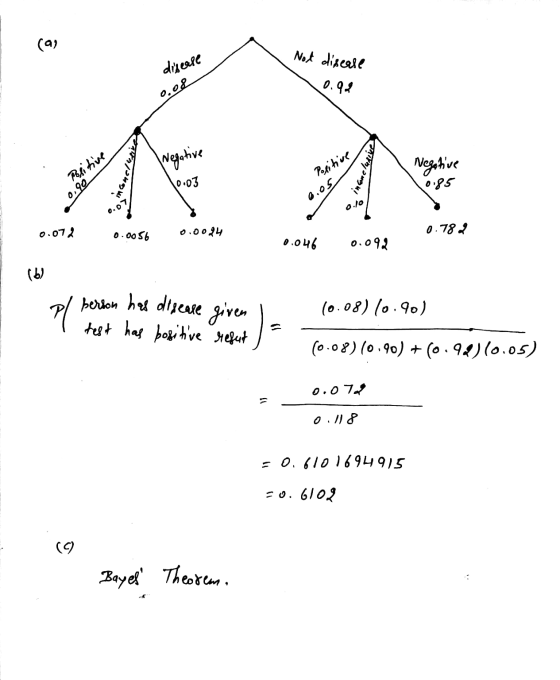
Problem Nine A test for a certain disease was given to 1,000 subjects, 8% of whom were known to have the disease. For the subjects who had the disease, the test had a positive result for the disease in 90% of the subjects, was inconclusive for 7% and a negative result in 3% of the subjects. For subjects who did not have the disease, the test had a positive result in 5% of subjects, was inconclusive in 10% and a negative result in the remaining 85%.
A. Draw a tree diagram to model the probabilities in this
problem.
B. What is the probability of a randomly selected person having the
disease GIVEN that the test has a positive result?
C. Which theorem/rule did you apply to solve this problem?
Homework Answers
Add Answer to:
Problem Nine A test for a certain disease was given to 1,000
subjects, 8% of whom...
Problem Nine A test for a certain disease was given to 1,000 subjects, 8% of whom...
Problem Nine A test for a certain disease was given to 1,000 subjects, 8% of whom were known to have the disease. For the subjects who had the disease, the test had a positive result for the disease in 90% of the subjects, was inconclusive for 7% and a negative result in 3% of the subjects. For subjects who did not have the disease, the test had a positive result in 5% of subjects, was inconclusive in 10% and a...
Only 1 in 1,000 is afflicted with a rare disease for which a diagnostic test has...
Only 1 in 1,000 is afflicted with a rare disease for which a diagnostic test has been developed. When a person has the disease , the test returns a positive result 99% of the time. However, when a person does not have the disease, the test shows a positive result only 2% of the time. When a person's test results are positive, in order to validate the results, a second test is given. The second test has the same accuracy...
A test for a certain disease has the approximately probabilities of getting a positive or negative...
A test for a certain disease has the approximately probabilities of getting a positive or negative test result based on whether the person has or does not have the disease. Test Results Positive Negative Has the Disease 0.95 0.05 Does not have the disease 0.01 0.99 Based on previous records, the probability of a person having the disease is 0.04. If a person is chosen at random, what is the probability of getting a positive result?
In a laboratory, blood test is 95% effective in detecting a certain disease, when it is,...
In a laboratory, blood test is 95% effective in detecting a certain disease, when it is, in fact, present. However, the test also yields a false positive (test is positive but patient does not have the disease) result for 1% of the healthy people tested. 0.5% of the population actually has the disease. Given this information, calculate the following probabilities: The probability that the test is positive. Given a negative result, the probability that the person does not have the...
A blood test to diagnose a disease was performed on a number of patients. Given the...
A blood test to diagnose a disease was performed on a number of patients. Given the following data: Number of patients who had a positive test result and had the disease = 1,193 Number of patients = 1,561 Number of patients who had a negative test, and did not have the disease = 253 Number of patients who had a positive test result, but did not have the disease = 58 Number of patients who had a negative test result,...
3) A certain blood test for a disease gives a positive result 90% of the time...
 3) A certain blood test for a disease gives a positive result 90% of the time among patients having the disease. It also gives a positive result 25% of the time among people who do not have the disease. It is believed that 30% of the population has this disease a) What is the probability that a person with a positive test result indeed has the disease? b) What is the probability that the blood test gives a negative result?...
Problem 4. Screening Tests Suppose that a certain disease is prese test designed to detect this...
 Problem 4. Screening Tests Suppose that a certain disease is prese test designed to detect this disease if present. The test does not always work perfectly. Sometimes the test is negative when the disease times that the test produces various results. nt in 10% of the population, and that there is a screening is present, and sometimes it is positive when the disease is absent. The table below shows the proportions of Test is Positive (P) Test is Negative (N)...
A laboratory test for a disease afflicting 5% of the population is either positive, indicating the...
A laboratory test for a disease afflicting 5% of the population is either positive, indicating the disease is present, or negative, indicating the disease is not present. When people having the disease are tested, 80% of the tests come back positive, and when people who don’t have the disease are tested, 15% of the tests come back from the lab marked positive (a “false positive” result). What are the chance a randomly selected person’s test results would come back positive?...
probabilities I know from given problem: .99 have disease AND Test + therefore... .01 have disease...
 probabilities I know from given problem:
.99 have disease AND Test + therefore...
.01 have disease AND Test -
.02 do not have disease AND Test + therefore...
.98 do not have disease AND Test -
.10 of TOTAL population HAVE Disease
therefore...
.90 of TOTAL population DO NOT HAVE Disease.
what I thought I would have to do to get what is being
asked is P(have disease | tests +) = P(Have disease AND Test +) /
P(test +)...
probabilities I know from given problem:
.99 have disease AND Test + therefore...
.01 have disease AND Test -
.02 do not have disease AND Test + therefore...
.98 do not have disease AND Test -
.10 of TOTAL population HAVE Disease
therefore...
.90 of TOTAL population DO NOT HAVE Disease.
what I thought I would have to do to get what is being
asked is P(have disease | tests +) = P(Have disease AND Test +) /
P(test +)...
It is known that 2.6% of the population has a certain disease. A new test is...
 It is known that 2.6% of the population has a certain disease. A new test is developed to screen for the disease. A study has shown that the test returns a positive result for 18% of all individuals, and returns a positive result for 92% of individuals who do have the disease. If a person tests positively for the disease under this test, what is the probability that they actually have the disease? 0.1276 0.1329 0.1435 0.1223 O 0.1382
 3) A certain blood test for a disease gives a positive result 90% of the time among patients having the disease. It also gives a positive result 25% of the time among people who do not have the disease. It is believed that 30% of the population has this disease a) What is the probability that a person with a positive test result indeed has the disease? b) What is the probability that the blood test gives a negative result?...
 Problem 4. Screening Tests Suppose that a certain disease is prese test designed to detect this disease if present. The test does not always work perfectly. Sometimes the test is negative when the disease times that the test produces various results. nt in 10% of the population, and that there is a screening is present, and sometimes it is positive when the disease is absent. The table below shows the proportions of Test is Positive (P) Test is Negative (N)...
 probabilities I know from given problem:
.99 have disease AND Test + therefore...
.01 have disease AND Test -
.02 do not have disease AND Test + therefore...
.98 do not have disease AND Test -
.10 of TOTAL population HAVE Disease
therefore...
.90 of TOTAL population DO NOT HAVE Disease.
what I thought I would have to do to get what is being
asked is P(have disease | tests +) = P(Have disease AND Test +) /
P(test +)...
probabilities I know from given problem:
.99 have disease AND Test + therefore...
.01 have disease AND Test -
.02 do not have disease AND Test + therefore...
.98 do not have disease AND Test -
.10 of TOTAL population HAVE Disease
therefore...
.90 of TOTAL population DO NOT HAVE Disease.
what I thought I would have to do to get what is being
asked is P(have disease | tests +) = P(Have disease AND Test +) /
P(test +)...
 It is known that 2.6% of the population has a certain disease. A new test is developed to screen for the disease. A study has shown that the test returns a positive result for 18% of all individuals, and returns a positive result for 92% of individuals who do have the disease. If a person tests positively for the disease under this test, what is the probability that they actually have the disease? 0.1276 0.1329 0.1435 0.1223 O 0.1382
Most questions answered within 3 hours.
-
Where is the error in this code sequence?
String s1 = "Hello";
String s2 = "ello";...
asked 10 months ago -
Financial data for Joel de Paris, Inc., for last year
follow:
Joel de Paris, Inc.
Balance...
asked 10 months ago -
Consider this reaction:
Al2(SO4)3 (aq)+ BaCl3
(aq) Al2Cl6 (aq)- +
3BaSO4(s) . What is the...
asked 10 months ago -
Suppose that Savneet is considering increasing her
recent random sample from 20 car rentals to 40...
asked 10 months ago -
Trucks arrive at an unloading terminal at an average rate of 120
per hour.
Trucks arrive...
asked 10 months ago -
Why are methanol and ethanol completely soluble in water while
octanol is not very little soluble....
asked 10 months ago -
A facilities manager at a university reads in a research report
that the mean amount of...
asked 10 months ago -
When the CuSO4 is rehydrated by adding water to the anhydrous
compound, is this an endothermic...
asked 10 months ago -
A ray of sunlight is passing from diamond into crown glass; the
angle of incidence is...
asked 10 months ago -
A block of mass 0.249 kg is placed on top of a light, vertical
spring of...
asked 10 months ago -
how do the kidneys compensate in the presences of acidosis
a) trigger hyperventilate
b) reserve acid...
asked 10 months ago -
Question 501 pts
The rental rate of capital to the firm increases. Which of the
following...
asked 10 months ago