
Homework Answers
Kinetic energy is defined as the work done in moving a particle under a force so

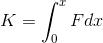
So,
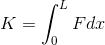
ques 1 K.E at x = l
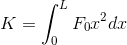

Ques 2 K.E = 3L
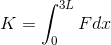


ques 3
m= 2kg
L = 3 m
So
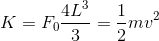
here F0 = 1


Add Answer to:
A particle is moving along the x-axis. It starts from rest at x = 0 and...
1. [6 Points] A particle is moving along the x-axis. It starts from rest at x...
 1. [6 Points] A particle is moving along the x-axis. It starts from rest at x = 0 and moves to x = L under the action of a variable force with an x-component given by F(x): x2 if 0 SXSL F(x) = 3 L2 Lx if LSX <3L 1 Everything is in SI units: x in meters and F in Newtons. Part 1: What is the particle's kinetic energy at x = L? Express your answer in terms of...
А PARTICLE IS MoviNG ALONG THE X-AXIS IT STARTS. FROM REST AT X - AND MOVES...
 А PARTICLE IS MoviNG ALONG THE X-AXIS IT STARTS. FROM REST AT X - AND MOVES TO X = L UNDER THE ACTION OF A VARIABLG FORCE X-COMPONENT GIVEN Br Fx (x) : WITH An 2 X if FB) 312 IL if Lex 63L EVERY THING IN 57 UNITS : X W METERS AND FW NEWTON A) WHAT IS THE PARTICIE'S KINETIC ENERG EXPRESS YOUR ANSWER IN TERMS OF L AND FO. K (x x=L? = =) = ? IS...
Small typo: In part 1 you are asked to calculate the kinetic energy at x =...
 Small typo:
In part 1 you are asked to calculate the kinetic energy at x =
L, so it should say K(x= L) NOT K(x=L/2).
In part 2 you are asked to calculate the kinetic energy at x = 3L,
so it should say K(x= 3L) NOT K(x=L).
А PARTICLE IS MoviNG ALONG THE X-AXIS IT STARTS. FROM REST AT X - AND MOVES TO X = L UNDER THE ACTION OF A VARIABLG FORCE X-COMPONENT GIVEN Br Fx (x)...
Small typo:
In part 1 you are asked to calculate the kinetic energy at x =
L, so it should say K(x= L) NOT K(x=L/2).
In part 2 you are asked to calculate the kinetic energy at x = 3L,
so it should say K(x= 3L) NOT K(x=L).
А PARTICLE IS MoviNG ALONG THE X-AXIS IT STARTS. FROM REST AT X - AND MOVES TO X = L UNDER THE ACTION OF A VARIABLG FORCE X-COMPONENT GIVEN Br Fx (x)...
A particle of mass m = 2.70 kg moving along the x axis from x =...
A particle of mass m = 2.70 kg moving along the x axis from x = 0 to x = 10.6 m experiences a net conservative force in an isolated system given by F = 5x − 4, where F is in newtons and x is in meters. (a) What is the work done on the particle by the force F? J (b) What is the change in the potential energy of the system during this motion? J (c) If...
A particle moving along the x axis is acted upon by a single force F =...
A particle moving along the x axis is acted upon by a single force F = F0e–kx, where F0 and k are constants. The particle is released from rest at x = 0. It will attain a maximum kinetic energy of:
A force F = cx – 3.00x2 ) i acts on a particle as the particle...
 A force F = cx – 3.00x2 ) i acts on a particle as the particle moves along an x axis, with Ē in newtons, x in meters, and c a constant. At x = 0 m, the particle's kinetic energy is 21.0 ; at x = 4.00 m, it is 12.0 J. Find c. Number Units the tolerance is +/-3% Click if you would like to Show Work for this question: Open Show Work
At t= 0, a particle starts from rest at x= 0, y = 0, and moves...
At t= 0, a particle starts from rest at x= 0, y = 0, and moves in the xy plane with an acceleration a⃗ = (4.0i^ + 3.0j^)m/s2. Assume t is in seconds. Part A Determine the x component of velocity as a function of time t. Express your answer using two significant figures. Part B Determine the y component of velocity as a function of time t. Express your answer using two significant figures. Part C Determine the speed...
A particle moving along the x axis in simple harmonic motion starts from its equilibrium position,...
A particle moving along the x axis in simple harmonic motion starts from its equilibrium position, the origin, at t = 0 and moves to the right. The amplitude of its motion is2.50 cm, and the frequency is 1.30 Hz. (a) Find an expression for the position of the particle as a function of time. (Use the following as necessary: t, and ?.) x = (b) Determine the maximum speed of the particle. cm/s (c) Determine the earliest time (t...
A particle with mass 4.0 kg is initially at rest at the origin (x=0). It then...
A particle with mass 4.0 kg is initially at rest at the origin (x=0). It then moves along the x-axis acted on by a force F(x)=18.0-2.0x2, where F is in Newtons if x is expressed in meters. Find the kinetic energy of the particle when it reaches x=3 m. A Honda Civic (mass=1090 kg) is initially traveling due East at 18.3 m/s when it suddenly collides head on with a Toyota Camry (mass=1612 kg) initially traveling due West at 31.8...
For problems #4 and #5, suppose that a particle is moving along the x-axis and that...
 For problems #4 and #5, suppose that a particle is moving along the x-axis and that its position at time=1 is given by the function (). Furthermore, suppose that f(2)=-3 and that f(2)=6. No justification required. 4. At time=2, which one of the following statements is true. Write the letter of the correct answer on the answer sheet. No justification required. a) The particle is to the left of x = 0 and the particle is moving to the left....
 1. [6 Points] A particle is moving along the x-axis. It starts from rest at x = 0 and moves to x = L under the action of a variable force with an x-component given by F(x): x2 if 0 SXSL F(x) = 3 L2 Lx if LSX <3L 1 Everything is in SI units: x in meters and F in Newtons. Part 1: What is the particle's kinetic energy at x = L? Express your answer in terms of...
 А PARTICLE IS MoviNG ALONG THE X-AXIS IT STARTS. FROM REST AT X - AND MOVES TO X = L UNDER THE ACTION OF A VARIABLG FORCE X-COMPONENT GIVEN Br Fx (x) : WITH An 2 X if FB) 312 IL if Lex 63L EVERY THING IN 57 UNITS : X W METERS AND FW NEWTON A) WHAT IS THE PARTICIE'S KINETIC ENERG EXPRESS YOUR ANSWER IN TERMS OF L AND FO. K (x x=L? = =) = ? IS...
 Small typo:
In part 1 you are asked to calculate the kinetic energy at x =
L, so it should say K(x= L) NOT K(x=L/2).
In part 2 you are asked to calculate the kinetic energy at x = 3L,
so it should say K(x= 3L) NOT K(x=L).
А PARTICLE IS MoviNG ALONG THE X-AXIS IT STARTS. FROM REST AT X - AND MOVES TO X = L UNDER THE ACTION OF A VARIABLG FORCE X-COMPONENT GIVEN Br Fx (x)...
Small typo:
In part 1 you are asked to calculate the kinetic energy at x =
L, so it should say K(x= L) NOT K(x=L/2).
In part 2 you are asked to calculate the kinetic energy at x = 3L,
so it should say K(x= 3L) NOT K(x=L).
А PARTICLE IS MoviNG ALONG THE X-AXIS IT STARTS. FROM REST AT X - AND MOVES TO X = L UNDER THE ACTION OF A VARIABLG FORCE X-COMPONENT GIVEN Br Fx (x)...
 A force F = cx – 3.00x2 ) i acts on a particle as the particle moves along an x axis, with Ē in newtons, x in meters, and c a constant. At x = 0 m, the particle's kinetic energy is 21.0 ; at x = 4.00 m, it is 12.0 J. Find c. Number Units the tolerance is +/-3% Click if you would like to Show Work for this question: Open Show Work
 For problems #4 and #5, suppose that a particle is moving along the x-axis and that its position at time=1 is given by the function (). Furthermore, suppose that f(2)=-3 and that f(2)=6. No justification required. 4. At time=2, which one of the following statements is true. Write the letter of the correct answer on the answer sheet. No justification required. a) The particle is to the left of x = 0 and the particle is moving to the left....
Most questions answered within 3 hours.
-
Where is the error in this code sequence?
String s1 = "Hello";
String s2 = "ello";...
asked 10 months ago -
Financial data for Joel de Paris, Inc., for last year
follow:
Joel de Paris, Inc.
Balance...
asked 10 months ago -
Consider this reaction:
Al2(SO4)3 (aq)+ BaCl3
(aq) Al2Cl6 (aq)- +
3BaSO4(s) . What is the...
asked 10 months ago -
Suppose that Savneet is considering increasing her
recent random sample from 20 car rentals to 40...
asked 10 months ago -
Trucks arrive at an unloading terminal at an average rate of 120
per hour.
Trucks arrive...
asked 10 months ago -
Why are methanol and ethanol completely soluble in water while
octanol is not very little soluble....
asked 10 months ago -
A facilities manager at a university reads in a research report
that the mean amount of...
asked 10 months ago -
When the CuSO4 is rehydrated by adding water to the anhydrous
compound, is this an endothermic...
asked 10 months ago -
A ray of sunlight is passing from diamond into crown glass; the
angle of incidence is...
asked 10 months ago -
A block of mass 0.249 kg is placed on top of a light, vertical
spring of...
asked 10 months ago -
how do the kidneys compensate in the presences of acidosis
a) trigger hyperventilate
b) reserve acid...
asked 10 months ago -
Question 501 pts
The rental rate of capital to the firm increases. Which of the
following...
asked 10 months ago