![If the function h() is [(4 sin(21) + 8 cos (21)) (], identify the Laplace transform H(s) of the given function. 2s + 8 S + 8](http://img.homeworklib.com/questions/33d6d580-069b-11eb-b886-e52ded47ed98.png?x-oss-process=image/resize,w_560)
Homework Answers
We can write the given function as

where u is the Heaviside step function.
Now, the Laplace transform of this is given by

So we have


 ..........(1)
Now, from standard Laplace transform formulas, we have


So, using these in (1) we have


Thus, the answer is given by

Add Answer to:
If the function h() is [(4 sin(21) + 8 cos (21)) (], identify the Laplace transform...
Identify the Laplace transform of the function h(t) = 7 cos (2t - 1) (1). 3.782s...
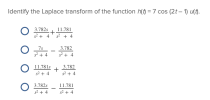 Identify the Laplace transform of the function h(t) = 7 cos (2t - 1) (1). 3.782s 8² + 4 + 11.781 S2 + 4 7s S2 + 4 3.782 8 + 4 O 11.781s + 3.782 S2 + 4 S2 + 4 O 3.782 11.781 S2 + 4 S2 + 4
Determine the inverse Laplace transform of the function below. se -35 s2 +85 + 25 e...
 Determine the inverse Laplace transform of the function below. se -35 s2 +85 + 25 e Click here to view the table of Laplace transforms. -35 -(41-12) Se s2 +8s + 25 3 (3 cos (3-9) - 4 sin (3-9))h(t-3) (Use parentheses to clearly denote the argument of each function.) L-1
(1 point) Consider the initial value problem d2y dy 8 +41y8 cos(2t), dt dy (0) y(0) = -2 -6 dt dt2 Write down the Lapla...
 (1 point) Consider the initial value problem d2y dy 8 +41y8 cos(2t), dt dy (0) y(0) = -2 -6 dt dt2 Write down the Laplace transform of the left-hand side of the equation given the initial conditions (sA2-8s+41)Y+2s-18 Your answer should be a function of s and Y with Y denoting the Laplace transform of the solution y. Write down the Laplace transform of the right-hand side of the equation (-8s+32)/(sA2-8s+20) Your answer should be a function of s only...
Check the existence of the Laplace transform for the given function and hence show that -...
 Check the existence of the Laplace transform for the given function and hence show that - cos 20 1s² + 4 L = In t s2 where L{f(t)} is represent the Laplace transform of f(t). [Hint: 2 cos A cos B = COSIA+B) + cos(A - B) sin(A + B) + sin(A - B) = sinA cosB, sin(A + B) – sin(A - ?) = os AsmB] [2+ Find the Fourier Sine series of [8 f(x) = e-*,0<x<. Using the...
Determine the inverse Laplace transform of the function below. Se - 2s S2 + 8s +32...
 Determine the inverse Laplace transform of the function below. Se - 2s S2 + 8s +32 Click here to view the table of Laplace transforms. Click here to view the table of properties of Laplace transforms. - 2s Se - 1 >(t) = $2 +85 +32 (Use parentheses to clearly denote the argument of each function.)
3 B 1. Find the third roots of 21+ Find the inverse of the Laplace transform...
 3 B 1. Find the third roots of 21+ Find the inverse of the Laplace transform 2. tan" G) 3. Check the existence of the Laplace transform for the given function and hence she that -02:49 in 133+ 4 S- where LF(t)) is represent the place transform of (1) [Hint: 2 cos Acos B = (A-2).sin(A+B) + sin(A - m = sin cos sin(A + B) - Sin(A) = 0 4. Find the Fourier Sine series of f(x) <rci 5....
please answer all!!' i really need these! Determine the inverse Laplace transform of the function below....
 please answer all!!' i really need these!
Determine the inverse Laplace transform of the function below. 1 + 1 Click here to view the table of Laplace transforms. Click here to view the table of properties of Laplace transforms. + Determine the inverse Laplace transform of the function below. 8 +9 Click here to view the table of Laplace transforms. Click here to view the table of properties of Laplace transforms. 8 L S + 9 Determine the inverse Laplace...
please answer all!!' i really need these!
Determine the inverse Laplace transform of the function below. 1 + 1 Click here to view the table of Laplace transforms. Click here to view the table of properties of Laplace transforms. + Determine the inverse Laplace transform of the function below. 8 +9 Click here to view the table of Laplace transforms. Click here to view the table of properties of Laplace transforms. 8 L S + 9 Determine the inverse Laplace...
Find the Laplace transform F(s) L(f(t)) given f(t) = 5e-4 sin(5t) + 2e cos(6t). F(8) =
 Find the Laplace transform F(s) L(f(t)) given f(t) = 5e-4 sin(5t) + 2e cos(6t). F(8) =
1.The following function does not have a Laplace transformation 2.The Laplace transformation for () is 3.If...
 1.The following function does not have
a Laplace transformation
2.The Laplace transformation for ()
is
3.If f(s). g(s) represent the Laplace
transformations for f(t). g(t) respectively, then the transform of
h(t)= () is h(s)=
PS:
D is for none of the above
Please justify answer
Thanks in advance
1. La siguiente funcion NO tiene transformada de Laplace a. f(t) = eta b. g(t) = sin 4t c. h(t) = 21 d. ninguna de las anteriores 2. La transformada de Laplace...
1.The following function does not have
a Laplace transformation
2.The Laplace transformation for ()
is
3.If f(s). g(s) represent the Laplace
transformations for f(t). g(t) respectively, then the transform of
h(t)= () is h(s)=
PS:
D is for none of the above
Please justify answer
Thanks in advance
1. La siguiente funcion NO tiene transformada de Laplace a. f(t) = eta b. g(t) = sin 4t c. h(t) = 21 d. ninguna de las anteriores 2. La transformada de Laplace...
USE DEFINITION 1 TO DETERMINE THE LAPLACE TRANSFORM OF THE FOLLOWING FUNCTION. f(t)= e sin(t) Laplace...
 USE DEFINITION 1 TO DETERMINE THE LAPLACE TRANSFORM OF THE FOLLOWING FUNCTION. f(t)= e sin(t) Laplace Transform Definition 1. Let f(t)be a function on [0,00). The Laplace transform of f is the function defined by the integral The domain of F(s) is all the values of " for which the integral in (1) exists.' The Laplace transform of fis denoted by both and ${/}. QUESTION 2. (3PTS) USE TABLE 7.1 AND 7.2 TO DETERMINE THE LAPLACE TRANSFORM OF THE GIVEN...
 Identify the Laplace transform of the function h(t) = 7 cos (2t - 1) (1). 3.782s 8² + 4 + 11.781 S2 + 4 7s S2 + 4 3.782 8 + 4 O 11.781s + 3.782 S2 + 4 S2 + 4 O 3.782 11.781 S2 + 4 S2 + 4
 Determine the inverse Laplace transform of the function below. se -35 s2 +85 + 25 e Click here to view the table of Laplace transforms. -35 -(41-12) Se s2 +8s + 25 3 (3 cos (3-9) - 4 sin (3-9))h(t-3) (Use parentheses to clearly denote the argument of each function.) L-1
 (1 point) Consider the initial value problem d2y dy 8 +41y8 cos(2t), dt dy (0) y(0) = -2 -6 dt dt2 Write down the Laplace transform of the left-hand side of the equation given the initial conditions (sA2-8s+41)Y+2s-18 Your answer should be a function of s and Y with Y denoting the Laplace transform of the solution y. Write down the Laplace transform of the right-hand side of the equation (-8s+32)/(sA2-8s+20) Your answer should be a function of s only...
 Check the existence of the Laplace transform for the given function and hence show that - cos 20 1s² + 4 L = In t s2 where L{f(t)} is represent the Laplace transform of f(t). [Hint: 2 cos A cos B = COSIA+B) + cos(A - B) sin(A + B) + sin(A - B) = sinA cosB, sin(A + B) – sin(A - ?) = os AsmB] [2+ Find the Fourier Sine series of [8 f(x) = e-*,0<x<. Using the...
 Determine the inverse Laplace transform of the function below. Se - 2s S2 + 8s +32 Click here to view the table of Laplace transforms. Click here to view the table of properties of Laplace transforms. - 2s Se - 1 >(t) = $2 +85 +32 (Use parentheses to clearly denote the argument of each function.)
 3 B 1. Find the third roots of 21+ Find the inverse of the Laplace transform 2. tan" G) 3. Check the existence of the Laplace transform for the given function and hence she that -02:49 in 133+ 4 S- where LF(t)) is represent the place transform of (1) [Hint: 2 cos Acos B = (A-2).sin(A+B) + sin(A - m = sin cos sin(A + B) - Sin(A) = 0 4. Find the Fourier Sine series of f(x) <rci 5....
 please answer all!!' i really need these!
Determine the inverse Laplace transform of the function below. 1 + 1 Click here to view the table of Laplace transforms. Click here to view the table of properties of Laplace transforms. + Determine the inverse Laplace transform of the function below. 8 +9 Click here to view the table of Laplace transforms. Click here to view the table of properties of Laplace transforms. 8 L S + 9 Determine the inverse Laplace...
please answer all!!' i really need these!
Determine the inverse Laplace transform of the function below. 1 + 1 Click here to view the table of Laplace transforms. Click here to view the table of properties of Laplace transforms. + Determine the inverse Laplace transform of the function below. 8 +9 Click here to view the table of Laplace transforms. Click here to view the table of properties of Laplace transforms. 8 L S + 9 Determine the inverse Laplace...
 Find the Laplace transform F(s) L(f(t)) given f(t) = 5e-4 sin(5t) + 2e cos(6t). F(8) =
 1.The following function does not have
a Laplace transformation
2.The Laplace transformation for ()
is
3.If f(s). g(s) represent the Laplace
transformations for f(t). g(t) respectively, then the transform of
h(t)= () is h(s)=
PS:
D is for none of the above
Please justify answer
Thanks in advance
1. La siguiente funcion NO tiene transformada de Laplace a. f(t) = eta b. g(t) = sin 4t c. h(t) = 21 d. ninguna de las anteriores 2. La transformada de Laplace...
1.The following function does not have
a Laplace transformation
2.The Laplace transformation for ()
is
3.If f(s). g(s) represent the Laplace
transformations for f(t). g(t) respectively, then the transform of
h(t)= () is h(s)=
PS:
D is for none of the above
Please justify answer
Thanks in advance
1. La siguiente funcion NO tiene transformada de Laplace a. f(t) = eta b. g(t) = sin 4t c. h(t) = 21 d. ninguna de las anteriores 2. La transformada de Laplace...
 USE DEFINITION 1 TO DETERMINE THE LAPLACE TRANSFORM OF THE FOLLOWING FUNCTION. f(t)= e sin(t) Laplace Transform Definition 1. Let f(t)be a function on [0,00). The Laplace transform of f is the function defined by the integral The domain of F(s) is all the values of " for which the integral in (1) exists.' The Laplace transform of fis denoted by both and ${/}. QUESTION 2. (3PTS) USE TABLE 7.1 AND 7.2 TO DETERMINE THE LAPLACE TRANSFORM OF THE GIVEN...
Most questions answered within 3 hours.
-
Where is the error in this code sequence?
String s1 = "Hello";
String s2 = "ello";...
asked 10 months ago -
Financial data for Joel de Paris, Inc., for last year
follow:
Joel de Paris, Inc.
Balance...
asked 10 months ago -
Consider this reaction:
Al2(SO4)3 (aq)+ BaCl3
(aq) Al2Cl6 (aq)- +
3BaSO4(s) . What is the...
asked 10 months ago -
Suppose that Savneet is considering increasing her
recent random sample from 20 car rentals to 40...
asked 10 months ago -
Trucks arrive at an unloading terminal at an average rate of 120
per hour.
Trucks arrive...
asked 10 months ago -
Why are methanol and ethanol completely soluble in water while
octanol is not very little soluble....
asked 10 months ago -
A facilities manager at a university reads in a research report
that the mean amount of...
asked 10 months ago -
When the CuSO4 is rehydrated by adding water to the anhydrous
compound, is this an endothermic...
asked 10 months ago -
A ray of sunlight is passing from diamond into crown glass; the
angle of incidence is...
asked 10 months ago -
A block of mass 0.249 kg is placed on top of a light, vertical
spring of...
asked 10 months ago -
how do the kidneys compensate in the presences of acidosis
a) trigger hyperventilate
b) reserve acid...
asked 10 months ago -
Question 501 pts
The rental rate of capital to the firm increases. Which of the
following...
asked 10 months ago