
Homework Answers
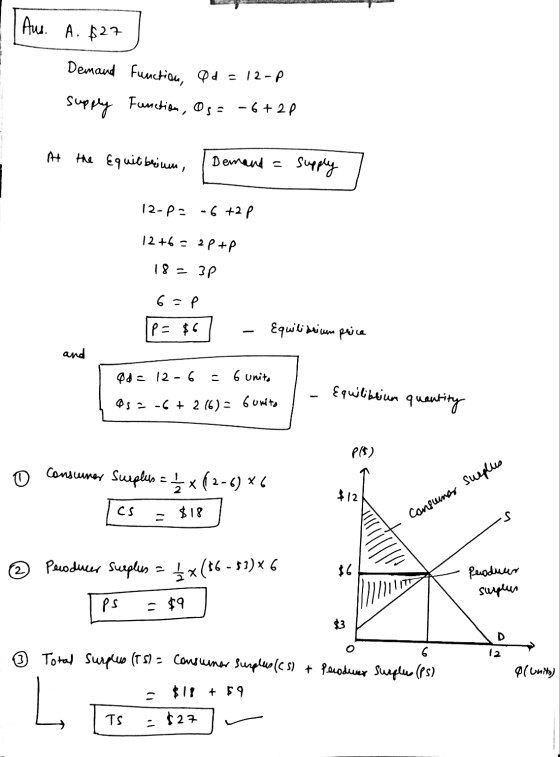
Ans. A. $27
Add Answer to:
Suppose that a market is perfectly competitive. The supply and demand functions are given below: Qd...
Suppose that the market demand and supply equations in a perfectly competitive market are QD =...
Suppose that the market demand and supply equations in a perfectly competitive market are QD = 16 − 4P and QS = −2 + 2P, respectively. What is the full economic price if the government imposes a price ceiling of $2?
Consider a perfectly competitive market where Demand is described as Qd 100-2P. a. If the market...
 Consider a perfectly competitive market where Demand is described as Qd 100-2P. a. If the market price is 10, how many units are consumed in the market? What is the consumer surplus in the market? b. Suppose the market Supply is described as Qs 10 P. What is the equilibrium price in the market? Quantity? C. Suppose the market Supply is described as Qs 10+ P. What is the excess quantity supplied in the market at P demanded in the...
1 Suppose the demand for shoes is given by: QD= 210 -2P. The supply of shoes...
1 Suppose the demand for shoes is given by: QD= 210 -2P. The supply of shoes is given by: QS= 9P -120. Calculate the Gains from Trade (also known as Economic Surplus) that would exist in this market in a competitive equilibrium. 2 Suppose the demand for jackets was given by: QD= 140 -0.4P. The supply of jackets is given by: QS= 4P -80. Suppose the price was $49 per jacket. Calculate whether there is a surplus or shortage of...
The wheat market is perfectly competitive, and the market supply and demand curves are given by the following equations:
The wheat market is perfectly competitive, and the market supply and demand curves are given by the following equations: QD = 20,000,000 - 4,000,000P QS = 7,000,000 + 2,500,000P, where QD and QS are quantity demanded and quantity supplied measured in bushels, and P = price per bushel. a. Determine consumer surplus at the equilibrium price and quantity. b. Assume that the government has imposed a price floor at $2.25 per bushel and agrees to buy any resulting excess supply. How many bushels of wheat...
Suppose that the market for a children’s book is given by the following demand and supply...
Suppose that the market for a children’s book is given by the following demand and supply functions: Demand: QD= 98 - 4P Supply: QS= -4 + 2P Where: QD and QS are quantity demand and quantity supplied respectively, and P is the price. The equilibrium price is $______
Suppose that the market for a children’s book is given by the following demand and supply...
Suppose that the market for a children’s book is given by the following demand and supply functions: Demand: QD= 98 - 4P Supply: QS= -4 + 2P Where: QD and QS are quantity demand and quantity supplied respectively, and P is the price. The equilibrium quantity is ______ units
Suppose that in a perfectly competitive market, demand is given by Q=63.0-P and supply is given...
Suppose that in a perfectly competitive market, demand is given by Q=63.0-P and supply is given by Q=P-9.0. What is aggregate surplus in the competitive market equilibrium? No units, no rounding.
A perfectly competitive market is described by the demand curve QD= 60 – 2P, and the supply curve QS = 5P – 10. A typic...
A perfectly competitive market is described by the demand curve QD= 60 – 2P, and the supply curve QS = 5P – 10. A typical firm has the total cost equation: C = 16 + 2QF + QF2. What is the equilibrium price and quantity in the market? Compute the firm’s total revenue, total cost, and total profit. MC = dC/dQF = 2QF + 2
The market demand function for corn is Qd = 15 − 2p and the market supply...
The market demand function for corn is Qd = 15 − 2p and the market supply function is Qs = 5p − 6, both quantities are measured in billions of bushels per year. What are the aggregate surplus, consumer surplus, and producer surplus at the competitive equilibrium?
DEMAND & SUPPLY: Consider the market for bananas which is known to be perfectly competitive. The...
DEMAND & SUPPLY: Consider the market for bananas which is known to be perfectly competitive. The market is characterized by the following relationships: QD = 10,000 – 140P QS = 7500 + 125P Plot the demand curve and the supply curve on a graph. Clearly label the axes and the intercepts. Why is the demand-curve downward-sloping? What is the slope of the demand curve? Why is the supply-curve upward-sloping? What is the slope of the supply curve? What is the...
 Consider a perfectly competitive market where Demand is described as Qd 100-2P. a. If the market price is 10, how many units are consumed in the market? What is the consumer surplus in the market? b. Suppose the market Supply is described as Qs 10 P. What is the equilibrium price in the market? Quantity? C. Suppose the market Supply is described as Qs 10+ P. What is the excess quantity supplied in the market at P demanded in the...
Most questions answered within 3 hours.
-
Where is the error in this code sequence?
String s1 = "Hello";
String s2 = "ello";...
asked 10 months ago -
Financial data for Joel de Paris, Inc., for last year
follow:
Joel de Paris, Inc.
Balance...
asked 10 months ago -
Consider this reaction:
Al2(SO4)3 (aq)+ BaCl3
(aq) Al2Cl6 (aq)- +
3BaSO4(s) . What is the...
asked 10 months ago -
Suppose that Savneet is considering increasing her
recent random sample from 20 car rentals to 40...
asked 10 months ago -
Trucks arrive at an unloading terminal at an average rate of 120
per hour.
Trucks arrive...
asked 10 months ago -
Why are methanol and ethanol completely soluble in water while
octanol is not very little soluble....
asked 10 months ago -
A facilities manager at a university reads in a research report
that the mean amount of...
asked 10 months ago -
When the CuSO4 is rehydrated by adding water to the anhydrous
compound, is this an endothermic...
asked 10 months ago -
A ray of sunlight is passing from diamond into crown glass; the
angle of incidence is...
asked 10 months ago -
A block of mass 0.249 kg is placed on top of a light, vertical
spring of...
asked 10 months ago -
how do the kidneys compensate in the presences of acidosis
a) trigger hyperventilate
b) reserve acid...
asked 10 months ago -
Question 501 pts
The rental rate of capital to the firm increases. Which of the
following...
asked 10 months ago