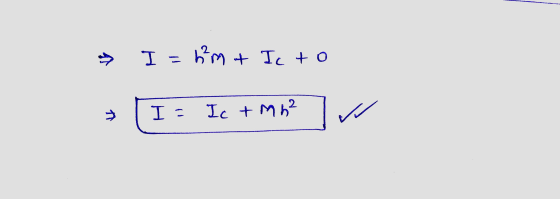
Prove the equation of the parallel axis theorem (derive the equation).
Prove the equation of the parallel axis theorem (derive the equation).
Homework Answers

Add Answer to:
Prove the equation of the parallel axis theorem (derive the
equation).
The Parallel-Axis Theorem allows one to find the moment of inertia of an object if the...
The Parallel-Axis Theorem allows one to find the moment of inertia of an object if the moment of inertia through the center of mass (c.o.m.) is known and the second axis is parallel to the axis through the c.o.m.. The equation is given by I= Icom +md2, where Icom is the moment of inertia about an axis through the c.o.m., m is the mass of the object, d is the perpendicular distance from the axis through the c.o.m. to the...
Parallel-Axis Theorem for an Area 2 of 8 Learning Goal: I, Iy = ft To be...
 Parallel-Axis Theorem for an Area 2 of 8 Learning Goal: I, Iy = ft To be able to use the parallel-axis theorem to calculate the moment of inertia for an area. The parallel-axis theorem can be used to find an area's Submit axis that passes through the centroid and whose moment of inertia is known. If ar and y' are the axes that pass through an area's centroid, the parallel-axis theorem for the moment about the x axis, moment about...
Use the parallel axis theorem and Table 10.2 to find the moment of inertia of a...
Use the parallel axis theorem and Table 10.2 to find the moment of inertia of a thin spherical shell about an axis tangent to its surface.
The parallel axis theorem provides a useful way to calculate the moment of inertia I about...
The parallel axis theorem provides a useful way to calculate the moment of inertia I about an arbitrary axis. The theorem states that I = Icm + Mh2, where Icm is the moment of inertia of the object relative to an axis that passes through the center of mass and is parallel to the axis of interest, M is the total mass of the object, and h is the perpendicular distance between the two axes. Use this theorem and information...
Also for part b, use parallel axis theorem to calculate x prime and y prime axis....
 Also for part b, use parallel axis theorem to calculate x prime
and y prime axis.
(a) Determine the moment of inertia of the cross-sectional area of the beam about the x- axis and y-axis. (6) Using the parallel axis theorem, determine the moment of inertia of the cross- sectional area about the x'-axis and y'-axis YOU MUST USE THE TABLE PROVIDED FOR (a) ABOVE. 150 mm -- 150 mm 20 mm 200 mm 20 mm 200 mm 20 mm...
Also for part b, use parallel axis theorem to calculate x prime
and y prime axis.
(a) Determine the moment of inertia of the cross-sectional area of the beam about the x- axis and y-axis. (6) Using the parallel axis theorem, determine the moment of inertia of the cross- sectional area about the x'-axis and y'-axis YOU MUST USE THE TABLE PROVIDED FOR (a) ABOVE. 150 mm -- 150 mm 20 mm 200 mm 20 mm 200 mm 20 mm...
Review Part B Learning Goal: To be able to use the parallel-axis theorem to calculate the...
 Review Part B Learning Goal: To be able to use the parallel-axis theorem to calculate the moment of inertia for an area. The parallel-axis theorem can be used to find an area's moment of inertia about any axis that is parallel to an axis Figure 2 of 3 > As shown, a rectangle has a base of b = 5.10 ft and a height of h = 2.90 ft (Figure 2) The rectangle's bottom is located at a distance yı...
Use parallel-axis theorem to find the product of inertia of the area shown with respect to...
 Use parallel-axis theorem to find the product of inertia of the
area shown with respect to the centroidal x and y axes.
3 in 16 in. 8.92 in. 2 in 0.61 in. 4 in C 16.5 in. |4 in.
Use parallel-axis theorem to find the product of inertia of the
area shown with respect to the centroidal x and y axes.
3 in 16 in. 8.92 in. 2 in 0.61 in. 4 in C 16.5 in. |4 in.
Try using the parallel axis theorem in to solve this problem Determine the moment of inertia...
 Try using the parallel axis theorem in to solve this
problem
Determine the moment of inertia for the shaded area shown below about the x axis. yz = 400.x (100-x) --- 200 mm - 100 mm y2 = 400x 200 mm 22 x-- - dx 100 mm
Try using the parallel axis theorem in to solve this
problem
Determine the moment of inertia for the shaded area shown below about the x axis. yz = 400.x (100-x) --- 200 mm - 100 mm y2 = 400x 200 mm 22 x-- - dx 100 mm
Using the parallel-axis theorem, determine the moment of inertia of the area shown with respect to...
 Using the parallel-axis theorem, determine the moment of inertia
of the area shown with respect to the x-x and y–y axes.
60 mm 20 mm 20 mm 10 mm חוות 10 mm- 100 mm 10 mm
Using the parallel-axis theorem, determine the moment of inertia
of the area shown with respect to the x-x and y–y axes.
60 mm 20 mm 20 mm 10 mm חוות 10 mm- 100 mm 10 mm
PROBLEM 3 3 in 16 in. 8.92 in. Using the parallel-axis theorem, determine the product of...
 PROBLEM 3 3 in 16 in. 8.92 in. Using the parallel-axis theorem, determine the product of inertia of the area shown with respect to the centroidal x and y axes. 2 in 0.61 in. 4 in с 2 16,5 in
 Parallel-Axis Theorem for an Area 2 of 8 Learning Goal: I, Iy = ft To be able to use the parallel-axis theorem to calculate the moment of inertia for an area. The parallel-axis theorem can be used to find an area's Submit axis that passes through the centroid and whose moment of inertia is known. If ar and y' are the axes that pass through an area's centroid, the parallel-axis theorem for the moment about the x axis, moment about...
 Also for part b, use parallel axis theorem to calculate x prime
and y prime axis.
(a) Determine the moment of inertia of the cross-sectional area of the beam about the x- axis and y-axis. (6) Using the parallel axis theorem, determine the moment of inertia of the cross- sectional area about the x'-axis and y'-axis YOU MUST USE THE TABLE PROVIDED FOR (a) ABOVE. 150 mm -- 150 mm 20 mm 200 mm 20 mm 200 mm 20 mm...
Also for part b, use parallel axis theorem to calculate x prime
and y prime axis.
(a) Determine the moment of inertia of the cross-sectional area of the beam about the x- axis and y-axis. (6) Using the parallel axis theorem, determine the moment of inertia of the cross- sectional area about the x'-axis and y'-axis YOU MUST USE THE TABLE PROVIDED FOR (a) ABOVE. 150 mm -- 150 mm 20 mm 200 mm 20 mm 200 mm 20 mm...
 Review Part B Learning Goal: To be able to use the parallel-axis theorem to calculate the moment of inertia for an area. The parallel-axis theorem can be used to find an area's moment of inertia about any axis that is parallel to an axis Figure 2 of 3 > As shown, a rectangle has a base of b = 5.10 ft and a height of h = 2.90 ft (Figure 2) The rectangle's bottom is located at a distance yı...
 Use parallel-axis theorem to find the product of inertia of the
area shown with respect to the centroidal x and y axes.
3 in 16 in. 8.92 in. 2 in 0.61 in. 4 in C 16.5 in. |4 in.
Use parallel-axis theorem to find the product of inertia of the
area shown with respect to the centroidal x and y axes.
3 in 16 in. 8.92 in. 2 in 0.61 in. 4 in C 16.5 in. |4 in.
 Try using the parallel axis theorem in to solve this
problem
Determine the moment of inertia for the shaded area shown below about the x axis. yz = 400.x (100-x) --- 200 mm - 100 mm y2 = 400x 200 mm 22 x-- - dx 100 mm
Try using the parallel axis theorem in to solve this
problem
Determine the moment of inertia for the shaded area shown below about the x axis. yz = 400.x (100-x) --- 200 mm - 100 mm y2 = 400x 200 mm 22 x-- - dx 100 mm
 Using the parallel-axis theorem, determine the moment of inertia
of the area shown with respect to the x-x and y–y axes.
60 mm 20 mm 20 mm 10 mm חוות 10 mm- 100 mm 10 mm
Using the parallel-axis theorem, determine the moment of inertia
of the area shown with respect to the x-x and y–y axes.
60 mm 20 mm 20 mm 10 mm חוות 10 mm- 100 mm 10 mm
 PROBLEM 3 3 in 16 in. 8.92 in. Using the parallel-axis theorem, determine the product of inertia of the area shown with respect to the centroidal x and y axes. 2 in 0.61 in. 4 in с 2 16,5 in
Most questions answered within 3 hours.
-
Where is the error in this code sequence?
String s1 = "Hello";
String s2 = "ello";...
asked 11 months ago -
Financial data for Joel de Paris, Inc., for last year
follow:
Joel de Paris, Inc.
Balance...
asked 11 months ago -
Consider this reaction:
Al2(SO4)3 (aq)+ BaCl3
(aq) Al2Cl6 (aq)- +
3BaSO4(s) . What is the...
asked 11 months ago -
Suppose that Savneet is considering increasing her
recent random sample from 20 car rentals to 40...
asked 11 months ago -
Trucks arrive at an unloading terminal at an average rate of 120
per hour.
Trucks arrive...
asked 11 months ago -
Why are methanol and ethanol completely soluble in water while
octanol is not very little soluble....
asked 11 months ago -
A facilities manager at a university reads in a research report
that the mean amount of...
asked 11 months ago -
When the CuSO4 is rehydrated by adding water to the anhydrous
compound, is this an endothermic...
asked 11 months ago -
A ray of sunlight is passing from diamond into crown glass; the
angle of incidence is...
asked 11 months ago -
A block of mass 0.249 kg is placed on top of a light, vertical
spring of...
asked 11 months ago -
how do the kidneys compensate in the presences of acidosis
a) trigger hyperventilate
b) reserve acid...
asked 11 months ago -
Question 501 pts
The rental rate of capital to the firm increases. Which of the
following...
asked 11 months ago