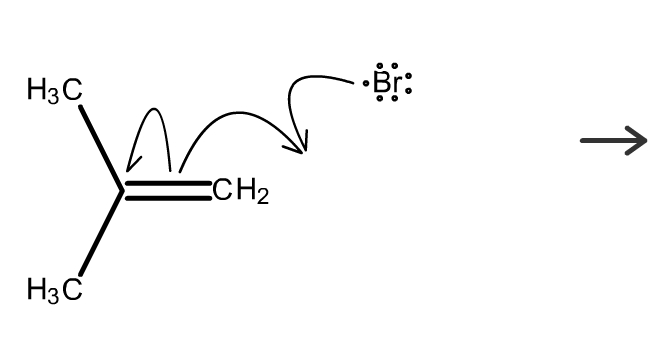
Draw the product of the transformation shown by the fishhook notation. Include all hydrogen atoms and nonbonding electrons.
Homework Answers
Request Professional Answer
Request Answer!
We need at least 9 more requests to produce the answer.
1 / 10 have requested this problem solution
The more requests, the faster the answer.
All students who have requested the answer will be notified once they are available.
Similar Homework Help Questions
Draw the products of the transformation shown by the fishhook notation. Include all hydrogen atoms and...
 Draw the products of the transformation shown by the fishhook
notation. Include all hydrogen atoms and nonbonding electrons.
Draw the products of the transformation shown by the fishhook
notation. Include all hydrogen atoms and nonbonding electrons.
Draw the products of the transformation shown by the fishhook notation. Include any electrons. Draw the...
 Draw the products of the transformation shown by the fishhook
notation. Include any electrons.
Draw the products of the transformation shown by the fishhook notation. Include any electrons.
Draw the products of the transformation shown by the fishhook
notation. Include any electrons.
Draw the products of the transformation shown by the fishhook notation. Include any electrons.
Part A Make a sketch of the following molecule: N2. Draw the molecule by placing atoms...
Part A Make a sketch of the following molecule: N2. Draw the molecule by placing atoms on the grid and connecting them with bonds. Include all hydrogen atoms and nonbonding electrons. Part B Make a sketch of the following molecule: N2H2 (skeletal structure HNNH). Draw the molecule by placing atoms on the grid and connecting them with bonds. Include all hydrogen atoms and nonbonding electrons. Part C Determine the molecular geometry about each interior nitrogen atom of this molecule. Part...
Sketch the following molecule: CH3NH2 (skeletal structure H3CNH2). Draw the molecule by placing atoms on the...
Sketch the following molecule: CH3NH2 (skeletal structure H3CNH2). Draw the molecule by placing atoms on the grid and connecting them with bonds. Include all hydrogen atoms and nonbonding electrons.
a previous | 22 of 32 | next Think and Explain: 6.57 Part A Draw the...
 a previous | 22 of 32 | next Think and Explain: 6.57 Part A Draw the electron-dot structure for the covalent compound hydrogen cyanide, HCN Draw the molecule by placing atoms on the grid and connecting them with bonds. Include all hydrogen atoms and nonbonding electrons. one th er fro
Draw the Lewis structure (including resonance structures) for the acetate ion (CH3COO−). For each resonance structure,...
Draw the Lewis structure (including resonance structures) for the acetate ion (CH3COO−). For each resonance structure, assign formal charges to all atoms that have formal charge. Draw the Lewis dot structures for the acetate ion. Show the formal charges of all atoms. Include all hydrogen atoms and nonbonding electrons.
An oxygen atom can bond to a hydrogen iodide molecule to give HIO. Draw the structural...
An oxygen atom can bond to a hydrogen iodide molecule to give HIO. Draw the structural formula for HIO and label a coordinate covalent bond. Draw the molecule by placing atoms on the grid and connecting them with bonds. Include all nonbonding electrons. Select all coordinate covalent bonds.
Draw the bridged bromonium ion that is formed as an intermediate during the bromination of this...
 Draw the bridged bromonium ion that is formed as an intermediate
during the bromination of this alkene. Include hydrogen atoms,
nonbonding electrons, and formal charge(s) in your structure.
Draw the bridged bromonium ion that is formed as an intermediate
during the bromination of this alkene. Include hydrogen atoms,
nonbonding electrons, and formal charge(s) in your structure.
16. [10 pts) Use curved-arrow notation to write out a detailed, step-wise mechanism for the following...
 16. [10 pts) Use curved-arrow notation to write out a detailed, step-wise mechanism for the following transformation. Be sure to (a) include all of your lone pairs, (b) include all formal charges, (c) draw your arrows neatly and precisely, and (d) enclose intermediates within square brackets. (If you get stuck, number the atoms of your reactant and the corresponding atoms in your product to help recognize what bonds are made and broken!)
Draw the neutral products formed in the following hydrolysis reaction.
 Draw the neutral products formed in the following hydrolysis reaction. Modify the predrawn structure. Draw all hydrogen atoms. You do not need to draw nonbonding electrons.
 Draw the products of the transformation shown by the fishhook
notation. Include all hydrogen atoms and nonbonding electrons.
Draw the products of the transformation shown by the fishhook
notation. Include all hydrogen atoms and nonbonding electrons.
 Draw the products of the transformation shown by the fishhook
notation. Include any electrons.
Draw the products of the transformation shown by the fishhook notation. Include any electrons.
Draw the products of the transformation shown by the fishhook
notation. Include any electrons.
Draw the products of the transformation shown by the fishhook notation. Include any electrons.
 a previous | 22 of 32 | next Think and Explain: 6.57 Part A Draw the electron-dot structure for the covalent compound hydrogen cyanide, HCN Draw the molecule by placing atoms on the grid and connecting them with bonds. Include all hydrogen atoms and nonbonding electrons. one th er fro
 Draw the bridged bromonium ion that is formed as an intermediate
during the bromination of this alkene. Include hydrogen atoms,
nonbonding electrons, and formal charge(s) in your structure.
Draw the bridged bromonium ion that is formed as an intermediate
during the bromination of this alkene. Include hydrogen atoms,
nonbonding electrons, and formal charge(s) in your structure.
 16. [10 pts) Use curved-arrow notation to write out a detailed, step-wise mechanism for the following transformation. Be sure to (a) include all of your lone pairs, (b) include all formal charges, (c) draw your arrows neatly and precisely, and (d) enclose intermediates within square brackets. (If you get stuck, number the atoms of your reactant and the corresponding atoms in your product to help recognize what bonds are made and broken!)
ADVERTISEMENT
Need Online Homework Help?
Ask
a QuestionGet Answers For Free
Most questions answered within 3 hours.
Most questions answered within 3 hours.
ADVERTISEMENT
Active Questions
-
Where is the error in this code sequence?
String s1 = "Hello";
String s2 = "ello";...
asked 10 months ago -
Financial data for Joel de Paris, Inc., for last year
follow:
Joel de Paris, Inc.
Balance...
asked 10 months ago -
Consider this reaction:
Al2(SO4)3 (aq)+ BaCl3
(aq) Al2Cl6 (aq)- +
3BaSO4(s) . What is the...
asked 10 months ago -
Suppose that Savneet is considering increasing her
recent random sample from 20 car rentals to 40...
asked 10 months ago -
Trucks arrive at an unloading terminal at an average rate of 120
per hour.
Trucks arrive...
asked 10 months ago -
Why are methanol and ethanol completely soluble in water while
octanol is not very little soluble....
asked 10 months ago -
A facilities manager at a university reads in a research report
that the mean amount of...
asked 10 months ago -
When the CuSO4 is rehydrated by adding water to the anhydrous
compound, is this an endothermic...
asked 10 months ago -
A ray of sunlight is passing from diamond into crown glass; the
angle of incidence is...
asked 10 months ago -
A block of mass 0.249 kg is placed on top of a light, vertical
spring of...
asked 10 months ago -
how do the kidneys compensate in the presences of acidosis
a) trigger hyperventilate
b) reserve acid...
asked 10 months ago -
Question 501 pts
The rental rate of capital to the firm increases. Which of the
following...
asked 10 months ago
ADVERTISEMENT