
Homework Answers
Add Answer to:
؟
A car (1000 kg) climbs up a hill sloped at 28° while traveling at constant...
A car (1000 kg) climbs up a hill sloped at 28° while traveling at constant speed...
 A car (1000 kg) climbs up a hill sloped at 28° while traveling at constant speed of 75 km/hr, what is the power (kW) required for the uphill motion? Select one: O a. power 95.9 kW. O b. power 119.7 kW. c. power 89.6 kW. d. power 108.7 kW. e power 102.3 kW.
thermal and heat question A car (1000 kg) climbs up a hill sloped at 28° while...
 thermal and heat question
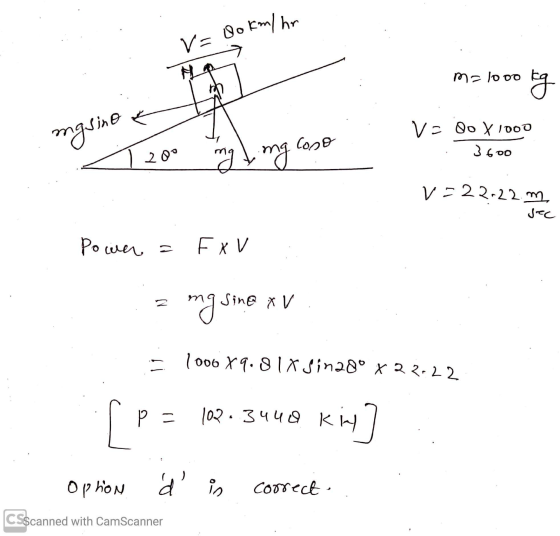
A car (1000 kg) climbs up a hill sloped at 28° while traveling at constant speed of 80 km/hr, what is the power (kW) required for the uphill motion? Select one: O a. power 102.3 kW. O b. power 95.9 kW. O c. power 108.7 kW. O d. power 89.6 kW. O e. power 119.7 kW.
thermal and heat question
A car (1000 kg) climbs up a hill sloped at 28° while traveling at constant speed of 80 km/hr, what is the power (kW) required for the uphill motion? Select one: O a. power 102.3 kW. O b. power 95.9 kW. O c. power 108.7 kW. O d. power 89.6 kW. O e. power 119.7 kW.
What is the enthalpy (kJ/kg) of refrigerant 134a which is at 4 C and quality 30%?...
 What is the enthalpy (kJ/kg) of refrigerant 134a which
is at 4 C and quality 30%?
.
LE 20 zain JO Zain JO Question 9 Not yet answered Marked out of 1.00 P Flag question A car (1000 kg) climbs up a hill sloped at 28° while traveling at constant speed of 80 km/hr, what is the power (kW) required for the uphill motion? Select one: a. power 108.7 kW. b. power 89.6 kW. c. power 119.7 kW. d. power...
What is the enthalpy (kJ/kg) of refrigerant 134a which
is at 4 C and quality 30%?
.
LE 20 zain JO Zain JO Question 9 Not yet answered Marked out of 1.00 P Flag question A car (1000 kg) climbs up a hill sloped at 28° while traveling at constant speed of 80 km/hr, what is the power (kW) required for the uphill motion? Select one: a. power 108.7 kW. b. power 89.6 kW. c. power 119.7 kW. d. power...
What is the enthalpy (kJ/kg) of refrigerant 134a which is at 4C and quality 40%? Select...
 What is the enthalpy (kJ/kg) of refrigerant 134a which is at 4C and quality 40%? Select one: a. h = 204.57 kJ/kg. O b. h=96.35 kJ/kg. O c. h = 135.46 kJ/kg. O d. h = 115.90 kJ/kg. O e. h = 155.02 kJ/kg. A car (1000 kg) climbs up a hill sloped at 28° while traveling at constant speed of 80 km/hr, what is the power (kW) required for the uphill motion? Select one: O a. power 102.3 kW....
A vehicle of mass 2000 kg has a constant resistance to motion of 3000 N. The...
 A vehicle of mass 2000 kg has a constant resistance to motion of
3000 N. The maximum speed of the vehicle, when travelling on a
horizontal road, is 120 km/hour. Find the acceleration of the car
when it is travelling at a speed of 50 km/hour up a hill inclined
at an angle of 3o to the horizontal, with the engine
operating at maximum power (assume the resistance to motion
remains unchanged whether the car is travelling uphill or
horizonally...
A vehicle of mass 2000 kg has a constant resistance to motion of
3000 N. The maximum speed of the vehicle, when travelling on a
horizontal road, is 120 km/hour. Find the acceleration of the car
when it is travelling at a speed of 50 km/hour up a hill inclined
at an angle of 3o to the horizontal, with the engine
operating at maximum power (assume the resistance to motion
remains unchanged whether the car is travelling uphill or
horizonally...
A car of mass 1000 Kg descends a hill inclined with horizontal by 30°, the car...
 A car of mass 1000 Kg descends a hill inclined with horizontal by 30°, the car is traveling at 80 km/h is uniformly brought to rest over a distance of 40 m. Calculate using work-energy method the average braking force required. The resistance to the motion is 200 N. 40 0 = 30°
A car of mass 1100 kg starts from rest at sea level and climbs a hill...
A car of mass 1100 kg starts from rest at sea level and climbs a hill of height 50.0 m. At the top of the hill, the car has a speed of 25.0 m/s, and at this instant, the driver shuts off the engine of the car. The car then coasts down the other side of the hill to height of 15.0 m above sea level. Assume that friction and air resistance are negligibly small. a) (6 pts) How much...
A car travels up a hill at a constant speed of 40 km/h and returns down...
A car travels up a hill at a constant speed of 40 km/h and returns down the hill at a constant speed of 60 km/h. Calculate the average speed for the round trip.
A car travels up a hill at a constant speed of 31 km/h and returns down...
A car travels up a hill at a constant speed of 31 km/h and returns down the hill at a constant speed of 79 km/h. Calculate the average speed for the round trip.
A car has an initial speed of 118 km/h and climbs up an incline with its...
A car has an initial speed of 118 km/h and climbs up an incline with its engine DISENGAGED (no engine force). DON"T use scientific notation. Angle is 33 degrees. (a) If work done by friction is negligible, How high (the h in the figure) a hill can the car coast up (engine disengaged) before coming to a stop? (b) If, in actuality, a 700-kg car with an initial speed of 118 km/h is observed to coast up a hill to...
 A car (1000 kg) climbs up a hill sloped at 28° while traveling at constant speed of 75 km/hr, what is the power (kW) required for the uphill motion? Select one: O a. power 95.9 kW. O b. power 119.7 kW. c. power 89.6 kW. d. power 108.7 kW. e power 102.3 kW.
 thermal and heat question
A car (1000 kg) climbs up a hill sloped at 28° while traveling at constant speed of 80 km/hr, what is the power (kW) required for the uphill motion? Select one: O a. power 102.3 kW. O b. power 95.9 kW. O c. power 108.7 kW. O d. power 89.6 kW. O e. power 119.7 kW.
thermal and heat question
A car (1000 kg) climbs up a hill sloped at 28° while traveling at constant speed of 80 km/hr, what is the power (kW) required for the uphill motion? Select one: O a. power 102.3 kW. O b. power 95.9 kW. O c. power 108.7 kW. O d. power 89.6 kW. O e. power 119.7 kW.
 What is the enthalpy (kJ/kg) of refrigerant 134a which
is at 4 C and quality 30%?
.
LE 20 zain JO Zain JO Question 9 Not yet answered Marked out of 1.00 P Flag question A car (1000 kg) climbs up a hill sloped at 28° while traveling at constant speed of 80 km/hr, what is the power (kW) required for the uphill motion? Select one: a. power 108.7 kW. b. power 89.6 kW. c. power 119.7 kW. d. power...
What is the enthalpy (kJ/kg) of refrigerant 134a which
is at 4 C and quality 30%?
.
LE 20 zain JO Zain JO Question 9 Not yet answered Marked out of 1.00 P Flag question A car (1000 kg) climbs up a hill sloped at 28° while traveling at constant speed of 80 km/hr, what is the power (kW) required for the uphill motion? Select one: a. power 108.7 kW. b. power 89.6 kW. c. power 119.7 kW. d. power...
 What is the enthalpy (kJ/kg) of refrigerant 134a which is at 4C and quality 40%? Select one: a. h = 204.57 kJ/kg. O b. h=96.35 kJ/kg. O c. h = 135.46 kJ/kg. O d. h = 115.90 kJ/kg. O e. h = 155.02 kJ/kg. A car (1000 kg) climbs up a hill sloped at 28° while traveling at constant speed of 80 km/hr, what is the power (kW) required for the uphill motion? Select one: O a. power 102.3 kW....
 A vehicle of mass 2000 kg has a constant resistance to motion of
3000 N. The maximum speed of the vehicle, when travelling on a
horizontal road, is 120 km/hour. Find the acceleration of the car
when it is travelling at a speed of 50 km/hour up a hill inclined
at an angle of 3o to the horizontal, with the engine
operating at maximum power (assume the resistance to motion
remains unchanged whether the car is travelling uphill or
horizonally...
A vehicle of mass 2000 kg has a constant resistance to motion of
3000 N. The maximum speed of the vehicle, when travelling on a
horizontal road, is 120 km/hour. Find the acceleration of the car
when it is travelling at a speed of 50 km/hour up a hill inclined
at an angle of 3o to the horizontal, with the engine
operating at maximum power (assume the resistance to motion
remains unchanged whether the car is travelling uphill or
horizonally...
 A car of mass 1000 Kg descends a hill inclined with horizontal by 30°, the car is traveling at 80 km/h is uniformly brought to rest over a distance of 40 m. Calculate using work-energy method the average braking force required. The resistance to the motion is 200 N. 40 0 = 30°
Most questions answered within 3 hours.
-
Where is the error in this code sequence?
String s1 = "Hello";
String s2 = "ello";...
asked 11 months ago -
Financial data for Joel de Paris, Inc., for last year
follow:
Joel de Paris, Inc.
Balance...
asked 11 months ago -
Consider this reaction:
Al2(SO4)3 (aq)+ BaCl3
(aq) Al2Cl6 (aq)- +
3BaSO4(s) . What is the...
asked 11 months ago -
Suppose that Savneet is considering increasing her
recent random sample from 20 car rentals to 40...
asked 11 months ago -
Trucks arrive at an unloading terminal at an average rate of 120
per hour.
Trucks arrive...
asked 11 months ago -
Why are methanol and ethanol completely soluble in water while
octanol is not very little soluble....
asked 11 months ago -
A facilities manager at a university reads in a research report
that the mean amount of...
asked 11 months ago -
When the CuSO4 is rehydrated by adding water to the anhydrous
compound, is this an endothermic...
asked 11 months ago -
A ray of sunlight is passing from diamond into crown glass; the
angle of incidence is...
asked 11 months ago -
A block of mass 0.249 kg is placed on top of a light, vertical
spring of...
asked 11 months ago -
how do the kidneys compensate in the presences of acidosis
a) trigger hyperventilate
b) reserve acid...
asked 11 months ago -
Question 501 pts
The rental rate of capital to the firm increases. Which of the
following...
asked 11 months ago