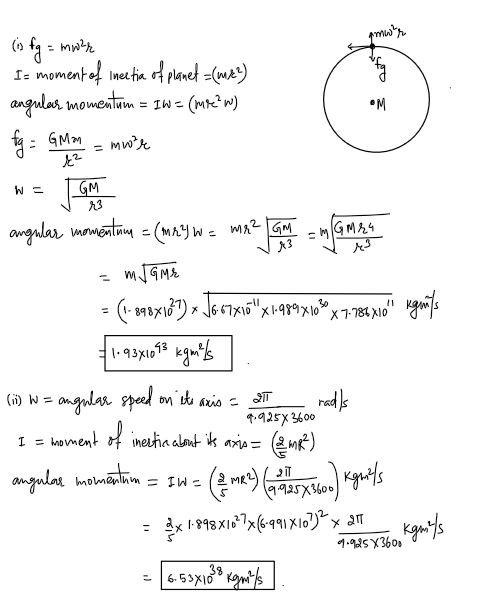
if the sun has mass of 1.989*10^30kg another planet rotating around it has mass 1.898*10^27kg use...
Homework Answers
Add Answer to:
if
the sun has mass of 1.989*10^30kg
another planet rotating around it has mass 1.898*10^27kg
use...
4. The planet Earth orbits around the Sun and also spins around its own axis. (a)...
 4. The planet Earth orbits around the Sun and also spins around its own axis. (a) Calculate the angular momentum of Earth in its orbit around the sun. (b) Calculate the angular momentum of Earth spinning on its axis. (c) What is the ratio of the angular momentum of Earth in its orbit to the angular momentum of Earth about its axis?
What is the angular kinetic energy of the Earth due to its orbit around the sun?...
 What is the angular kinetic energy of the Earth due to its orbit around the sun? In Homework 10, you found the two main angular velocities of the Earth: one due to the Earth's motion around the sun, and one due to its rotation about its own axis. Now let's figure out the energy and momentum associated with that motion. IVO ALV O a ? For the purposes of this problem, treat the Earth as a solid, uniform sphere with...
(a) Calculate the angular momentum (in kgm/s) of Neptune in its orbit around the Sun (The...
 (a) Calculate the angular momentum (in kgm/s) of Neptune in its orbit around the Sun (The mass of Neptune is 1.020 x 10% ko, the orbital radius is 4.497 x 10 km and the orbital period is 165 y.) kg. m/s (6) Compare this angular momentum with the angular momentum of Neptune on its axis. (The radius of Neptune is 2.476 x 10 km and the rotation period is 16.11 h.) Lorbital - rotation
planet moves in an elliptical orbit around the sun. The mass of the sun is Ms....
planet moves in an elliptical orbit around the sun. The mass of the sun is Ms. The minimum and maximum distances of the planet from the sun are R1 and R2, respectively. Part A Using Kepler's 3rd law and Newton's law of universal gravitation, find the period of revolution P of the planet as it moves around the sun. Assume that the mass of the planet is much smaller than the mass of the sun. Use G for the gravitational...
A moon of mass m orbits around a non-rotating planet of mass M with orbital angular velocity . The moon also rotates about its own axis with angular velocity .
 1. A moon of mass \(m\) orbits around a non-rotating planet of mass \(M\) with orbital angular velocity \(\Omega\). The moon also rotates about its own axis with angular velocity \(\omega\). The axis of rotation of the moon is perpendicular to the plane of the orbit. Let \(I\) be the moment of inertia of the moon about its own axis. You can assume \(m<<M\)so that the center ofmass of the system is at the center of the planet.(a) What is...
planet X travels in a circular motion orbit around the Sun. The radius of Planet X...
planet X travels in a circular motion orbit around the Sun. The radius of Planet X is twice that of Earth. The year on Planet X is 540 Earth years. The mass of Planet X is half that of Earth. The mass of the sun is 1.99*10^30 kg. The Earth's orbital distance from the Sun is 1.50*10^11 m.
What is the angular momentum of Neptune in a circular orbit around the Sun? Mass of...
What is the angular momentum of Neptune in a circular orbit around the Sun? Mass of sun is 1.989x10^30 kg, mass of Neptune is 1.898x10^27 kg. Gravitational Constant: G=6.67x10^-11Nm^2/kg^2. Radius of orbit around the sun is 7.786x10^8 km.
Astronomers discover an exoplanet (a planet of a star other than the Sun) that has an...
 Astronomers discover an exoplanet (a planet of a star other than the Sun) that has an orbital period of 3.97 Earth years in its circular orbit around its sun, which is a star with a measured mass of 3.41 times 10^30 kg. Find the radius of the exoplanet's orbit. _____ m
(a)Calculate the angular momentum (in kg · m2/s) of Mars in its orbit around the Sun....
(a)Calculate the angular momentum (in kg · m2/s) of Mars in its orbit around the Sun. (The mass of Mars is 6.420 ✕ 1023 kg, the orbital radius is 2.279 ✕ 108 km and the orbital period is 1.88 y.) kg · m2/s (b)Compare this angular momentum with the angular momentum of Mars on its axis. (The radius of Mars is 3.396 ✕ 103 km and the rotation period is 24.62 h.) Lorbital Lrotation
Astronomers discover an exoplanet (a planet of a star other than the Sun) that has an...
 Astronomers discover an exoplanet (a planet of a star other than the Sun) that has an orbital period of 3.77 Earth years in its circular orbit around its sun, which is a star with a measured mass of 3.79 x 1030 kg. Find the radius of the exoplanet's orbit. radius:
 4. The planet Earth orbits around the Sun and also spins around its own axis. (a) Calculate the angular momentum of Earth in its orbit around the sun. (b) Calculate the angular momentum of Earth spinning on its axis. (c) What is the ratio of the angular momentum of Earth in its orbit to the angular momentum of Earth about its axis?
 What is the angular kinetic energy of the Earth due to its orbit around the sun? In Homework 10, you found the two main angular velocities of the Earth: one due to the Earth's motion around the sun, and one due to its rotation about its own axis. Now let's figure out the energy and momentum associated with that motion. IVO ALV O a ? For the purposes of this problem, treat the Earth as a solid, uniform sphere with...
 (a) Calculate the angular momentum (in kgm/s) of Neptune in its orbit around the Sun (The mass of Neptune is 1.020 x 10% ko, the orbital radius is 4.497 x 10 km and the orbital period is 165 y.) kg. m/s (6) Compare this angular momentum with the angular momentum of Neptune on its axis. (The radius of Neptune is 2.476 x 10 km and the rotation period is 16.11 h.) Lorbital - rotation
 Astronomers discover an exoplanet (a planet of a star other than the Sun) that has an orbital period of 3.97 Earth years in its circular orbit around its sun, which is a star with a measured mass of 3.41 times 10^30 kg. Find the radius of the exoplanet's orbit. _____ m
 Astronomers discover an exoplanet (a planet of a star other than the Sun) that has an orbital period of 3.77 Earth years in its circular orbit around its sun, which is a star with a measured mass of 3.79 x 1030 kg. Find the radius of the exoplanet's orbit. radius:
Most questions answered within 3 hours.
-
Where is the error in this code sequence?
String s1 = "Hello";
String s2 = "ello";...
asked 11 months ago -
Financial data for Joel de Paris, Inc., for last year
follow:
Joel de Paris, Inc.
Balance...
asked 11 months ago -
Consider this reaction:
Al2(SO4)3 (aq)+ BaCl3
(aq) Al2Cl6 (aq)- +
3BaSO4(s) . What is the...
asked 11 months ago -
Suppose that Savneet is considering increasing her
recent random sample from 20 car rentals to 40...
asked 11 months ago -
Trucks arrive at an unloading terminal at an average rate of 120
per hour.
Trucks arrive...
asked 11 months ago -
Why are methanol and ethanol completely soluble in water while
octanol is not very little soluble....
asked 11 months ago -
A facilities manager at a university reads in a research report
that the mean amount of...
asked 11 months ago -
When the CuSO4 is rehydrated by adding water to the anhydrous
compound, is this an endothermic...
asked 11 months ago -
A ray of sunlight is passing from diamond into crown glass; the
angle of incidence is...
asked 11 months ago -
A block of mass 0.249 kg is placed on top of a light, vertical
spring of...
asked 11 months ago -
how do the kidneys compensate in the presences of acidosis
a) trigger hyperventilate
b) reserve acid...
asked 11 months ago -
Question 501 pts
The rental rate of capital to the firm increases. Which of the
following...
asked 11 months ago