You invest $20 at the beginning of each year for the next 7 years at the...
You invest $20 at the beginning of each year for the next 7 years at the annual rate of 8%. How much interest results from compounding (in dollars)?
A. Below 5
B. Between 5 and 10
C. Between 10 and 15
D. Between 15 and 28
E. Between 28 and 42
F. Between 42 and 52
G. Between 52 and 62
H. Between 62 and 85
I. Above 85
Homework Answers
Sol:
Annual payment (P) = $20
Period (n) = 7 years
Annual rate (r) = 8%
To determine interest amount results from compounding:
Future value (FVA Due) = P x [(1+r)^n-1] x (1 + r) / r
FV = 20 x [(1 + 8%)^7 -1] x (1 + 8%) / 8%
FV = 20 x [(1.08)^7 -1 x 1.08] / 0.08
FV = 20 x 9.636628 = $192.73
Total investment = 20 x 7 = $140
Interest amount = FV - Total investment
Interest amount = )$192.73 - $140) = $52.73
Therefore interest amount results from compounding = $52.73
Answer will be G. Between 52 and 62
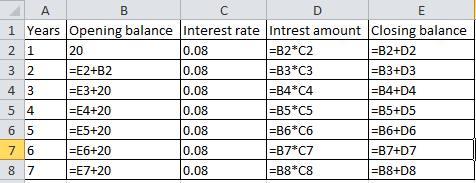
Future value can also be determined in excel as:
| Years | Opening balance | Interest rate | Interest amount | Closing balance |
| 1 | 20.00 | 8% | 1.60 | 21.60 |
| 2 | 41.60 | 8% | 3.33 | 44.93 |
| 3 | 64.93 | 8% | 5.19 | 70.12 |
| 4 | 90.12 | 8% | 7.21 | 97.33 |
| 5 | 117.33 | 8% | 9.39 | 126.72 |
| 6 | 146.72 | 8% | 11.74 | 158.46 |
| 7 | 178.46 | 8% | 14.28 | 192.73 |
Working
Add Answer to:
You invest $20 at the beginning of each year for the next 7
years at the...
You invest $20 at the end of each year for the next 6 years at the...
You invest $20 at the end of each year for the next 6 years at the annual rate of 9%. What percentage of total interest is due to simple interest?
Pedro Gonzalez will invest $13,000 at the beginning of each year for the next 15 years....
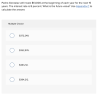 Pedro Gonzalez will invest $13,000 at the beginning of each year for the next 15 years. The interest rate is 8 percent. What is the future value? Use Appendix C to calculate the answer. Multiple Choice $372,248. $352,976. O $381,212. $381,212. o $394,212. $394,212.
How much would you need to invest today, assuming a fixed 7% annual interest rate, to...
How much would you need to invest today, assuming a fixed 7% annual interest rate, to have $500,000 in 30 years with annual compounding of interest? If you deposit $10,000 today into an interest bearing account earning 6% per year, how much will you have 25 years from now with monthly compounding of interest? If you save $600 at the end of each month, how much will you have in 20 years, assuming a 6% interest rate and monthly compounding?
1. Irene plans to save and invest annually, for the next 20 years, as follows: Years...
1. Irene plans to save and invest annually, for the next 20 years, as follows: Years 1-5: $3,500 per year Years 6-7: $0 because she will take leave from work to get an MBA Years 8-20: $5,000 per year If she can earn 6% per year, and her contributions are made at the beginning of the years, how much money will she have at the end of 20 years?
a. You are saving for retirement 10 years from now. How much should you invest today...
 a. You are saving for retirement 10 years from now. How much should you invest today so you will have an annuity of $20,000 per year for 20 years starting from the 11" year? b. If you were to invest $10,000 today @6%, how much would you have at the end of 15 years? C. You are planning to save $100,000 for a yacht purchase 5 years from now. If you believe you can earn an 8% rate of return,...
7. You expect to be able to save $10,000 per year for the next 20 years...
 7. You expect to be able to save $10,000 per year for the next 20 years for retirement. Assuming you will earn 8%, how much will you have in 20 years? 8. You have $15,000. Assuming you earn 6%, how long will it take for your money to double? 9. You invest $7,000, and after 8 years it grows to $12,000. What interest rate did your investment grow?
If you invest $4,000 per year at the end of each year for the next 30...
If you invest $4,000 per year at the end of each year for the next 30 years at an interest rate of 7.5%, how much will you have accumulated at the end of the 30 years? If instead, the payments occur at the beginning of the year what will be the amount?
If you invest $17,500 per year for 17 years (all payments made at the beginning of each year)
Calculate all of the problems in the document below in an Excel spreadsheet or on a financial calculator. Please show your work in order to get credit. For each problem, state the inputs given, what you are being asked to find (the missing input), and then use the Finance function to get the correct answer (if using Excel).17. If you invest $17,500 per year for 17 years (all payments made at the beginning of each year), you will have accumulated...
Suppose that you invest $100 in an account for 20 years. This account will credit you...
Suppose that you invest $100 in an account for 20 years. This account will credit you 5% annual effective rate of interest for the first 5 years, 5% annual effective rate of discount for the second 5 years, 5% simple rate of interest for the third 5 years and 5% simple rate of discount for the last 5 years. How much money will you have at the end of 20 years?
You receive $4,000 from your aunt when you turn 21 and you immediately invest the money...
 You receive $4,000 from your
aunt when you turn 21 and you immediately invest the money in a
saving account. The account earns 12% annual rate, with continuous
compounding. You get your first job after 5 years. a. Determine the
accumulated saving in this account at the end of 5 years. b. You
want to retire from work in 20 years. If you deposit $100 into your
account every month for the first 10 years, and $200 every month
for...
You receive $4,000 from your
aunt when you turn 21 and you immediately invest the money in a
saving account. The account earns 12% annual rate, with continuous
compounding. You get your first job after 5 years. a. Determine the
accumulated saving in this account at the end of 5 years. b. You
want to retire from work in 20 years. If you deposit $100 into your
account every month for the first 10 years, and $200 every month
for...
 Pedro Gonzalez will invest $13,000 at the beginning of each year for the next 15 years. The interest rate is 8 percent. What is the future value? Use Appendix C to calculate the answer. Multiple Choice $372,248. $352,976. O $381,212. $381,212. o $394,212. $394,212.
 a. You are saving for retirement 10 years from now. How much should you invest today so you will have an annuity of $20,000 per year for 20 years starting from the 11" year? b. If you were to invest $10,000 today @6%, how much would you have at the end of 15 years? C. You are planning to save $100,000 for a yacht purchase 5 years from now. If you believe you can earn an 8% rate of return,...
 7. You expect to be able to save $10,000 per year for the next 20 years for retirement. Assuming you will earn 8%, how much will you have in 20 years? 8. You have $15,000. Assuming you earn 6%, how long will it take for your money to double? 9. You invest $7,000, and after 8 years it grows to $12,000. What interest rate did your investment grow?
 You receive $4,000 from your
aunt when you turn 21 and you immediately invest the money in a
saving account. The account earns 12% annual rate, with continuous
compounding. You get your first job after 5 years. a. Determine the
accumulated saving in this account at the end of 5 years. b. You
want to retire from work in 20 years. If you deposit $100 into your
account every month for the first 10 years, and $200 every month
for...
You receive $4,000 from your
aunt when you turn 21 and you immediately invest the money in a
saving account. The account earns 12% annual rate, with continuous
compounding. You get your first job after 5 years. a. Determine the
accumulated saving in this account at the end of 5 years. b. You
want to retire from work in 20 years. If you deposit $100 into your
account every month for the first 10 years, and $200 every month
for...
Most questions answered within 3 hours.
-
Where is the error in this code sequence?
String s1 = "Hello";
String s2 = "ello";...
asked 11 months ago -
Financial data for Joel de Paris, Inc., for last year
follow:
Joel de Paris, Inc.
Balance...
asked 11 months ago -
Consider this reaction:
Al2(SO4)3 (aq)+ BaCl3
(aq) Al2Cl6 (aq)- +
3BaSO4(s) . What is the...
asked 11 months ago -
Suppose that Savneet is considering increasing her
recent random sample from 20 car rentals to 40...
asked 11 months ago -
Trucks arrive at an unloading terminal at an average rate of 120
per hour.
Trucks arrive...
asked 11 months ago -
Why are methanol and ethanol completely soluble in water while
octanol is not very little soluble....
asked 11 months ago -
A facilities manager at a university reads in a research report
that the mean amount of...
asked 11 months ago -
When the CuSO4 is rehydrated by adding water to the anhydrous
compound, is this an endothermic...
asked 11 months ago -
A ray of sunlight is passing from diamond into crown glass; the
angle of incidence is...
asked 11 months ago -
A block of mass 0.249 kg is placed on top of a light, vertical
spring of...
asked 11 months ago -
how do the kidneys compensate in the presences of acidosis
a) trigger hyperventilate
b) reserve acid...
asked 11 months ago -
Question 501 pts
The rental rate of capital to the firm increases. Which of the
following...
asked 11 months ago