
Homework Answers
Request Answer!
We need at least 10 more requests to produce the answer.
0 / 10 have requested this problem solution
The more requests, the faster the answer.
Add Answer to:
28. You have a problem when product is lost to premature crystallization on the fluted filter...
3. (A) Describe a procedure to solve the following problems in recrystallization technique: a) no crystals are formed when solution reaches room temperature b) oiling out c) presence of colored i...
 3. (A) Describe a procedure to solve the following problems in recrystallization technique: a) no crystals are formed when solution reaches room temperature b) oiling out c) presence of colored impurities d) presence of insoluble impurities e) loss of product due to premature crystallization on the fluted filter paper when (10 pts.) doing a gravity filtration.
3. (A) Describe a procedure to solve the following problems in recrystallization technique: a) no crystals are formed when solution reaches room temperature b)...
3. (A) Describe a procedure to solve the following problems in recrystallization technique: a) no crystals are formed when solution reaches room temperature b) oiling out c) presence of colored impurities d) presence of insoluble impurities e) loss of product due to premature crystallization on the fluted filter paper when (10 pts.) doing a gravity filtration.
3. (A) Describe a procedure to solve the following problems in recrystallization technique: a) no crystals are formed when solution reaches room temperature b)...
3. Describe a procedure to solve the following problems: a) no crystals are formed when solution...
3. Describe a procedure to solve the following problems: a) no crystals are formed when solution reaches room temperature b) oiling out c) presence of colored impurities d) presence of insoluble impurities e) loss of product due to premature crystallization on the fluted filter paper when doing a gravity filtration
Can someone tell me if a theoretical yield needs to be calculated for this experiment? And...
 Can someone tell me if a theoretical yield needs to be
calculated for this experiment? And if so, how do you calculate it?
please show all work. thank you. btw the aniline weighs
6.69g.
Synthesis of Acetanilide Acetanilide is synthesized from aniline by a reaction known as acylation. Acylation is the addition of an acyl group to a compound. In this experiment, aniline (1 amine) is reacted with acetic anhydride (acylating agent) to form acetanilide (an amide). H-C-CH3 + CH...
Can someone tell me if a theoretical yield needs to be
calculated for this experiment? And if so, how do you calculate it?
please show all work. thank you. btw the aniline weighs
6.69g.
Synthesis of Acetanilide Acetanilide is synthesized from aniline by a reaction known as acylation. Acylation is the addition of an acyl group to a compound. In this experiment, aniline (1 amine) is reacted with acetic anhydride (acylating agent) to form acetanilide (an amide). H-C-CH3 + CH...
3. Crystallization begins with a process called nucleation, where particles of the substance dissolved in solution...
 3. Crystallization begins with a process called nucleation, where particles of the substance dissolved in solution begin to aggregate. Crystals then begin to form on these aggregates. Based on this, explain why Steps 3 and 4 in Part III may induce crystallization. Part II: Observations Upuy Describe qualitative changes to solution - Solution went from bright yellow, orange to a mare dacu Orange /ced - hydrogen peroxide is originally clear but tuck's oldcu in the solution. The addition of hydrogen...
Part A of experiment: Working in the fume hood, combine 4.0 mL of 10% NaOH solution and 4 mL EtOH in a 50 mL round bot...
 Part A of experiment:
Working in the fume hood, combine 4.0 mL of 10% NaOH solution
and 4 mL EtOH in a 50 mL round bottom flask.
Dissolve 1.0 mL (8.6 mmol) of acetophenone into your
solution.
Add 1.0 mL (9.8 mmol) of benzaldehyde and a magnetic stir bar to
your flask. Clamp the flask
above a stir plate.
Monitor the reaction for 45 minutes by TLC. Acetophenone needs
to be diluted prior to TLC, and
cannot be spotted neat....
Part A of experiment:
Working in the fume hood, combine 4.0 mL of 10% NaOH solution
and 4 mL EtOH in a 50 mL round bottom flask.
Dissolve 1.0 mL (8.6 mmol) of acetophenone into your
solution.
Add 1.0 mL (9.8 mmol) of benzaldehyde and a magnetic stir bar to
your flask. Clamp the flask
above a stir plate.
Monitor the reaction for 45 minutes by TLC. Acetophenone needs
to be diluted prior to TLC, and
cannot be spotted neat....
Please help! (These are the instructions I had) 1) Preparation of K2[Cu(C2O4)2] 2H2O CuSO4•5H2O + 2K2C2O4•H2O...
Please help! (These are the instructions I had) 1) Preparation of K2[Cu(C2O4)2] 2H2O CuSO4•5H2O + 2K2C2O4•H2O → K2[Cu(C2O4)2]•2H2O + K2SO4 + 5H2O Heat a solution of 2.5g of potassium oxalate monohydrate in 12.5mL of water contained in a 50mL beaker (approx. 90°C). Heat 1.55g of copper sulfate pentahydrate in 3mL of water to about 90°C and add it rapidly, with vigorous stirring to the hot potassium oxalate solution. Set on the bench and allow to cool to room temperature then...
Name Lab Partner LAB 9 REFLECTIVE EXERCISES Lab Section 1 What data did you collect to...
 Name Lab Partner LAB 9 REFLECTIVE EXERCISES Lab Section 1 What data did you collect to indicate that you successfully produced aspirin? What did your results indicate about the purity of the aspirin you obtained? Explain your answers. 2 Given that the melting point of salicylic acid is 159 C, can you be certain that the product you isolated was not pure solicylic acid that was unchanged during the reaction? Can you be certain that the product you isolated was...
Please help me with these fill in the blanks. Thank you. Write the balanced net ionic...
 Please help me with these fill in the blanks. Thank you.
Write the balanced net ionic equation for the reaction of aqueous iron(l) ion reacting with H2G in acidic medium 9 Fe (a4) Without added acid, the H202 will form either OHT or O2, depending upon whether the H202 is reacting as an oxidizer or a reducer. If hydroxide ion is formed, the OH may react with some of the Fe to produce an insoluble hydroxide. Will the percent yield...
Please help me with these fill in the blanks. Thank you.
Write the balanced net ionic equation for the reaction of aqueous iron(l) ion reacting with H2G in acidic medium 9 Fe (a4) Without added acid, the H202 will form either OHT or O2, depending upon whether the H202 is reacting as an oxidizer or a reducer. If hydroxide ion is formed, the OH may react with some of the Fe to produce an insoluble hydroxide. Will the percent yield...
convert from moles to g or ml no structure was given the starting product is ketal...
 convert from moles to g or ml
no structure was given
the starting product is ketal alcohol
yes convert 0.01 moles of the starting material into
grams or ml
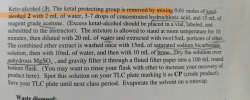
Keto-alcohol (3). The ketal protecting group is removed by mixing 0.01 moles of ketal- alcohol 2 with 2 mL of water, 5-7 drops of concentrated hydrochloric acid, and 15 mL of reagent grade acetone. (Excess ketal-alcohol should be placed in a vial, labeled, and submitted to the instructor). The mixture is...
convert from moles to g or ml
no structure was given
the starting product is ketal alcohol
yes convert 0.01 moles of the starting material into
grams or ml
Keto-alcohol (3). The ketal protecting group is removed by mixing 0.01 moles of ketal- alcohol 2 with 2 mL of water, 5-7 drops of concentrated hydrochloric acid, and 15 mL of reagent grade acetone. (Excess ketal-alcohol should be placed in a vial, labeled, and submitted to the instructor). The mixture is...
Objective Find the ratio of moles of reactant to moles of a product for the reaction...
Objective Find the ratio of moles of reactant to moles of a product for the reaction below. Compare mass and mole amounts of reactants to determine the amount of products that can be/are made. Background Chemical reactions are represented by balanced chemical equations. Proper interpretation of an equation provides a great deal of information about the reaction it represents and about the substances involved in the reaction. For example, the coefficients in a balanced equation indicate the number of moles...
 3. (A) Describe a procedure to solve the following problems in recrystallization technique: a) no crystals are formed when solution reaches room temperature b) oiling out c) presence of colored impurities d) presence of insoluble impurities e) loss of product due to premature crystallization on the fluted filter paper when (10 pts.) doing a gravity filtration.
3. (A) Describe a procedure to solve the following problems in recrystallization technique: a) no crystals are formed when solution reaches room temperature b)...
3. (A) Describe a procedure to solve the following problems in recrystallization technique: a) no crystals are formed when solution reaches room temperature b) oiling out c) presence of colored impurities d) presence of insoluble impurities e) loss of product due to premature crystallization on the fluted filter paper when (10 pts.) doing a gravity filtration.
3. (A) Describe a procedure to solve the following problems in recrystallization technique: a) no crystals are formed when solution reaches room temperature b)...
 Can someone tell me if a theoretical yield needs to be
calculated for this experiment? And if so, how do you calculate it?
please show all work. thank you. btw the aniline weighs
6.69g.
Synthesis of Acetanilide Acetanilide is synthesized from aniline by a reaction known as acylation. Acylation is the addition of an acyl group to a compound. In this experiment, aniline (1 amine) is reacted with acetic anhydride (acylating agent) to form acetanilide (an amide). H-C-CH3 + CH...
Can someone tell me if a theoretical yield needs to be
calculated for this experiment? And if so, how do you calculate it?
please show all work. thank you. btw the aniline weighs
6.69g.
Synthesis of Acetanilide Acetanilide is synthesized from aniline by a reaction known as acylation. Acylation is the addition of an acyl group to a compound. In this experiment, aniline (1 amine) is reacted with acetic anhydride (acylating agent) to form acetanilide (an amide). H-C-CH3 + CH...
 3. Crystallization begins with a process called nucleation, where particles of the substance dissolved in solution begin to aggregate. Crystals then begin to form on these aggregates. Based on this, explain why Steps 3 and 4 in Part III may induce crystallization. Part II: Observations Upuy Describe qualitative changes to solution - Solution went from bright yellow, orange to a mare dacu Orange /ced - hydrogen peroxide is originally clear but tuck's oldcu in the solution. The addition of hydrogen...
 Part A of experiment:
Working in the fume hood, combine 4.0 mL of 10% NaOH solution
and 4 mL EtOH in a 50 mL round bottom flask.
Dissolve 1.0 mL (8.6 mmol) of acetophenone into your
solution.
Add 1.0 mL (9.8 mmol) of benzaldehyde and a magnetic stir bar to
your flask. Clamp the flask
above a stir plate.
Monitor the reaction for 45 minutes by TLC. Acetophenone needs
to be diluted prior to TLC, and
cannot be spotted neat....
Part A of experiment:
Working in the fume hood, combine 4.0 mL of 10% NaOH solution
and 4 mL EtOH in a 50 mL round bottom flask.
Dissolve 1.0 mL (8.6 mmol) of acetophenone into your
solution.
Add 1.0 mL (9.8 mmol) of benzaldehyde and a magnetic stir bar to
your flask. Clamp the flask
above a stir plate.
Monitor the reaction for 45 minutes by TLC. Acetophenone needs
to be diluted prior to TLC, and
cannot be spotted neat....
 Name Lab Partner LAB 9 REFLECTIVE EXERCISES Lab Section 1 What data did you collect to indicate that you successfully produced aspirin? What did your results indicate about the purity of the aspirin you obtained? Explain your answers. 2 Given that the melting point of salicylic acid is 159 C, can you be certain that the product you isolated was not pure solicylic acid that was unchanged during the reaction? Can you be certain that the product you isolated was...
 Please help me with these fill in the blanks. Thank you.
Write the balanced net ionic equation for the reaction of aqueous iron(l) ion reacting with H2G in acidic medium 9 Fe (a4) Without added acid, the H202 will form either OHT or O2, depending upon whether the H202 is reacting as an oxidizer or a reducer. If hydroxide ion is formed, the OH may react with some of the Fe to produce an insoluble hydroxide. Will the percent yield...
Please help me with these fill in the blanks. Thank you.
Write the balanced net ionic equation for the reaction of aqueous iron(l) ion reacting with H2G in acidic medium 9 Fe (a4) Without added acid, the H202 will form either OHT or O2, depending upon whether the H202 is reacting as an oxidizer or a reducer. If hydroxide ion is formed, the OH may react with some of the Fe to produce an insoluble hydroxide. Will the percent yield...
 convert from moles to g or ml
no structure was given
the starting product is ketal alcohol
yes convert 0.01 moles of the starting material into
grams or ml
Keto-alcohol (3). The ketal protecting group is removed by mixing 0.01 moles of ketal- alcohol 2 with 2 mL of water, 5-7 drops of concentrated hydrochloric acid, and 15 mL of reagent grade acetone. (Excess ketal-alcohol should be placed in a vial, labeled, and submitted to the instructor). The mixture is...
convert from moles to g or ml
no structure was given
the starting product is ketal alcohol
yes convert 0.01 moles of the starting material into
grams or ml
Keto-alcohol (3). The ketal protecting group is removed by mixing 0.01 moles of ketal- alcohol 2 with 2 mL of water, 5-7 drops of concentrated hydrochloric acid, and 15 mL of reagent grade acetone. (Excess ketal-alcohol should be placed in a vial, labeled, and submitted to the instructor). The mixture is...
Most questions answered within 3 hours.
-
Where is the error in this code sequence?
String s1 = "Hello";
String s2 = "ello";...
asked 10 months ago -
Financial data for Joel de Paris, Inc., for last year
follow:
Joel de Paris, Inc.
Balance...
asked 10 months ago -
Consider this reaction:
Al2(SO4)3 (aq)+ BaCl3
(aq) Al2Cl6 (aq)- +
3BaSO4(s) . What is the...
asked 10 months ago -
Suppose that Savneet is considering increasing her
recent random sample from 20 car rentals to 40...
asked 10 months ago -
Trucks arrive at an unloading terminal at an average rate of 120
per hour.
Trucks arrive...
asked 10 months ago -
Why are methanol and ethanol completely soluble in water while
octanol is not very little soluble....
asked 10 months ago -
A facilities manager at a university reads in a research report
that the mean amount of...
asked 10 months ago -
When the CuSO4 is rehydrated by adding water to the anhydrous
compound, is this an endothermic...
asked 10 months ago -
A ray of sunlight is passing from diamond into crown glass; the
angle of incidence is...
asked 10 months ago -
A block of mass 0.249 kg is placed on top of a light, vertical
spring of...
asked 10 months ago -
how do the kidneys compensate in the presences of acidosis
a) trigger hyperventilate
b) reserve acid...
asked 10 months ago -
Question 501 pts
The rental rate of capital to the firm increases. Which of the
following...
asked 10 months ago