

Homework Answers
8) As we know that the capacitive reactance is inversely proptional to the frequency so , at the frequency of operation of Common Collector amplifier must be very low so that is it can be short circuited as it allow the flow of signal. So the answer will be (c) i.e very low.
9) In general the gain of the emitter follower circuit is about 0.8 to 0.99 as Re(emitter resistance is large) so the gain comes for the emitter folower circuit is approximately equals to one. So answer will be (b).
10) The capacitor, from emiiter to ground in a common emitter amplifier circuit is known as bypass capacitor. So answer will be (c)
11) As we know that the capacitive reactance is inversely proptional to the frequency so , at the frequency of operation of Common Emitter amplifier must be very low so that is it can be short circuited as it allow th flow of signal. So the answer will be (c) i.e very low.
Add Answer to:
QUESTION 8 In a common-collector amplifier, the coupling capacitors reactance at the frequency of operation must...
Given the multistage amplifier below, select all correct statements Multistage-Amp Group of answer choices The collector...
Given the multistage amplifier below, select all correct statements Multistage-Amp Group of answer choices The collector current in Q2 is approximately 16mA The input impedance of the amplifier is approximately 2.5Megohms The output impedance of the amplifier (assuming Q2) has a Beta=100 is close to 500Kohms The overall gain for the circuit (including loading effects) is approximately 13 If an overall gain for the multistage amplifier of 20 is desired, RG can be selected around 450 to account for any...
Problem Ten Design a common collector amplifier that has a low break frequency at 20Hz and...
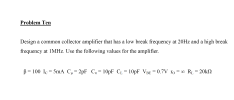 Problem Ten Design a common collector amplifier that has a low break frequency at 20Hz and a high break frequency at 1MHZ. Use the following values for the amplifier. 100 Ic 5mA Cu = 2pF C- 10PF CL 10PF VBe = 0.7V ro oo R 20k2
4. Consider the common-emitter amplifier of Figure 5. Draw the dc circuit and find ICQ. Draw the dc circuit and find IC...
 4. Consider the common-emitter amplifier of Figure 5. Draw the dc circuit and find ICQ. Draw the dc circuit and find ICQ. Find the value of Then, calculate values for Voltage gain Av, Open circuit voltage gain Avoc, input impedance Zin, current gain Ai, power gain G, and out- put impedance Zo. Assume operation in the frequency range for which influence of coupling and bypass capacitors can be ignored +15 V +15 V B 100 100 Ω 47ka Figure 5...
QUESTION 1 For normal operation of an npn transistor, the base must be O a. disconnected...
 QUESTION 1 For normal operation of an npn transistor, the base must be O a. disconnected O b. negative with respect to the emitter O C positive with respect to the emitter O d. positive with respect to the collector QUESTION 2 The bias condition for a transistor to be used as a linear amplifier is called O a. forward-reverse b. forward-forward C. reverse-reverse d. collector bias
4. Consider the common-emitter amplifier of Figure 5. Draw the dc circuit and find「CQ. Draw the...
 4. Consider the common-emitter amplifier of Figure 5. Draw the dc circuit and find「CQ. Draw the dc circuit and find ICQ. Find the value of r. Then, calculate values for Voltage gain Av, Open circuit voltage gain Avoc, input impedance Zin, current gain Ai, power gain G, and out- put impedance Zo. Assume operation in the frequency range for which influence of coupling and bypass capacitors can be ignored. +15 V +15 V s in 100Ω CE Figure 5
9. A circuit that combines a zener regulator and an emitter follower is referred to as...
 9. A circuit that combines a zener regulator and an emitter follower is referred to as A. An emitter regulator B. A follower regulator C. A zener follower D. A zener diode 10. Small load resistances that would overload a CE amplifier can be used with an emitter follower because an emitter follower A. steps up impedance B. amplifies high frequencies better C. has a higher voltage gain D. cannot amplify current 11. The emitter-follower amplifier has a A. low...
Coupling capacitors are used in electronics to link different circuit stages together while isolating the intended DC o...
 Coupling capacitors are used in electronics to link different circuit stages together while isolating the intended DC operating point of each stage so that they are not disturbed by the adjacent connections These capacitors thus separate the quiescent values of each stage from the others while allowing AC signals of interest to 'pass' through, and be processed by, the different stages unperturbed. This question explores the steady-state operations of the coupling capacitors. The circuit below shows the small-signal equivalent model...
QUESTION 3 In saturation, collector-emitter voltage is O a.5 V b.equal to collector-bias voltage O c....
 QUESTION 3 In saturation, collector-emitter voltage is O a.5 V b.equal to collector-bias voltage O c. minimum O d. maximum QUESTION 4 When operated in cutoff and saturation, the transistor acts like a a linear amplifier b. switch O c. variable capacitor Od variable resistor If a sinusoidal voltage is applied to the base of a biased on transistor and the resulting sinusoidal collector-to-emitter voltage is clipped near zero volts, the transistor is to Clipped ICO VE Clipped OVO a....
USE EXACT ANALYSIS Use 4 decimal places, no commas. Given: Single-stage, voltage-divider biased, common collector amplifier...
 USE EXACT ANALYSIS Use 4 decimal places, no commas. Given: Single-stage, voltage-divider biased, common collector amplifier with a. VCC = 15V b. R1 55 kohms c. R2 15 kohms d. RE 1.5 kohms e. Rs = 14 ohms f. RL = 500 ohms g. DC Beta = 50 h, AC Beta = 100 *C1 and C2 are coupling capacitors. C3 is bypass capacitor Required: A. VTH =[a] V B. RTH =[b] kohms C. IE [c] mA D. VC =[d] V...
Avec Úvo SRE L V II. (5pt) Consider the above-right common-collector or emitter-follower BJT amplifier circuit....
 Avec Úvo SRE L V II. (5pt) Consider the above-right common-collector or emitter-follower BJT amplifier circuit. Given: ß= 100, RE = 10 k1, Vcc = 20 V, RB = 5 k1, R1 = 10 kl, and Ry = 2 k1. (a) (1pt) Find the Q-point, i.e. Ibo, Ico, and VCEO; (b) (1pt) draw the small-signal equivalent circuit assuming that the capacitors (C, and Cy) are short circuits for the small signal; (c) (1pt) solve for the voltage gain, Av; (d)...
 Problem Ten Design a common collector amplifier that has a low break frequency at 20Hz and a high break frequency at 1MHZ. Use the following values for the amplifier. 100 Ic 5mA Cu = 2pF C- 10PF CL 10PF VBe = 0.7V ro oo R 20k2
 4. Consider the common-emitter amplifier of Figure 5. Draw the dc circuit and find ICQ. Draw the dc circuit and find ICQ. Find the value of Then, calculate values for Voltage gain Av, Open circuit voltage gain Avoc, input impedance Zin, current gain Ai, power gain G, and out- put impedance Zo. Assume operation in the frequency range for which influence of coupling and bypass capacitors can be ignored +15 V +15 V B 100 100 Ω 47ka Figure 5...
 QUESTION 1 For normal operation of an npn transistor, the base must be O a. disconnected O b. negative with respect to the emitter O C positive with respect to the emitter O d. positive with respect to the collector QUESTION 2 The bias condition for a transistor to be used as a linear amplifier is called O a. forward-reverse b. forward-forward C. reverse-reverse d. collector bias
 4. Consider the common-emitter amplifier of Figure 5. Draw the dc circuit and find「CQ. Draw the dc circuit and find ICQ. Find the value of r. Then, calculate values for Voltage gain Av, Open circuit voltage gain Avoc, input impedance Zin, current gain Ai, power gain G, and out- put impedance Zo. Assume operation in the frequency range for which influence of coupling and bypass capacitors can be ignored. +15 V +15 V s in 100Ω CE Figure 5
 9. A circuit that combines a zener regulator and an emitter follower is referred to as A. An emitter regulator B. A follower regulator C. A zener follower D. A zener diode 10. Small load resistances that would overload a CE amplifier can be used with an emitter follower because an emitter follower A. steps up impedance B. amplifies high frequencies better C. has a higher voltage gain D. cannot amplify current 11. The emitter-follower amplifier has a A. low...
 Coupling capacitors are used in electronics to link different circuit stages together while isolating the intended DC operating point of each stage so that they are not disturbed by the adjacent connections These capacitors thus separate the quiescent values of each stage from the others while allowing AC signals of interest to 'pass' through, and be processed by, the different stages unperturbed. This question explores the steady-state operations of the coupling capacitors. The circuit below shows the small-signal equivalent model...
 QUESTION 3 In saturation, collector-emitter voltage is O a.5 V b.equal to collector-bias voltage O c. minimum O d. maximum QUESTION 4 When operated in cutoff and saturation, the transistor acts like a a linear amplifier b. switch O c. variable capacitor Od variable resistor If a sinusoidal voltage is applied to the base of a biased on transistor and the resulting sinusoidal collector-to-emitter voltage is clipped near zero volts, the transistor is to Clipped ICO VE Clipped OVO a....
 USE EXACT ANALYSIS Use 4 decimal places, no commas. Given: Single-stage, voltage-divider biased, common collector amplifier with a. VCC = 15V b. R1 55 kohms c. R2 15 kohms d. RE 1.5 kohms e. Rs = 14 ohms f. RL = 500 ohms g. DC Beta = 50 h, AC Beta = 100 *C1 and C2 are coupling capacitors. C3 is bypass capacitor Required: A. VTH =[a] V B. RTH =[b] kohms C. IE [c] mA D. VC =[d] V...
 Avec Úvo SRE L V II. (5pt) Consider the above-right common-collector or emitter-follower BJT amplifier circuit. Given: ß= 100, RE = 10 k1, Vcc = 20 V, RB = 5 k1, R1 = 10 kl, and Ry = 2 k1. (a) (1pt) Find the Q-point, i.e. Ibo, Ico, and VCEO; (b) (1pt) draw the small-signal equivalent circuit assuming that the capacitors (C, and Cy) are short circuits for the small signal; (c) (1pt) solve for the voltage gain, Av; (d)...
Most questions answered within 3 hours.
-
Where is the error in this code sequence?
String s1 = "Hello";
String s2 = "ello";...
asked 10 months ago -
Financial data for Joel de Paris, Inc., for last year
follow:
Joel de Paris, Inc.
Balance...
asked 10 months ago -
Consider this reaction:
Al2(SO4)3 (aq)+ BaCl3
(aq) Al2Cl6 (aq)- +
3BaSO4(s) . What is the...
asked 10 months ago -
Suppose that Savneet is considering increasing her
recent random sample from 20 car rentals to 40...
asked 10 months ago -
Trucks arrive at an unloading terminal at an average rate of 120
per hour.
Trucks arrive...
asked 10 months ago -
Why are methanol and ethanol completely soluble in water while
octanol is not very little soluble....
asked 10 months ago -
A facilities manager at a university reads in a research report
that the mean amount of...
asked 10 months ago -
When the CuSO4 is rehydrated by adding water to the anhydrous
compound, is this an endothermic...
asked 10 months ago -
A ray of sunlight is passing from diamond into crown glass; the
angle of incidence is...
asked 10 months ago -
A block of mass 0.249 kg is placed on top of a light, vertical
spring of...
asked 10 months ago -
how do the kidneys compensate in the presences of acidosis
a) trigger hyperventilate
b) reserve acid...
asked 10 months ago -
Question 501 pts
The rental rate of capital to the firm increases. Which of the
following...
asked 10 months ago