Could someone help with the following problem??? Helium enters a constant flow heat exchanger at 100...
Could someone help with the following problem???
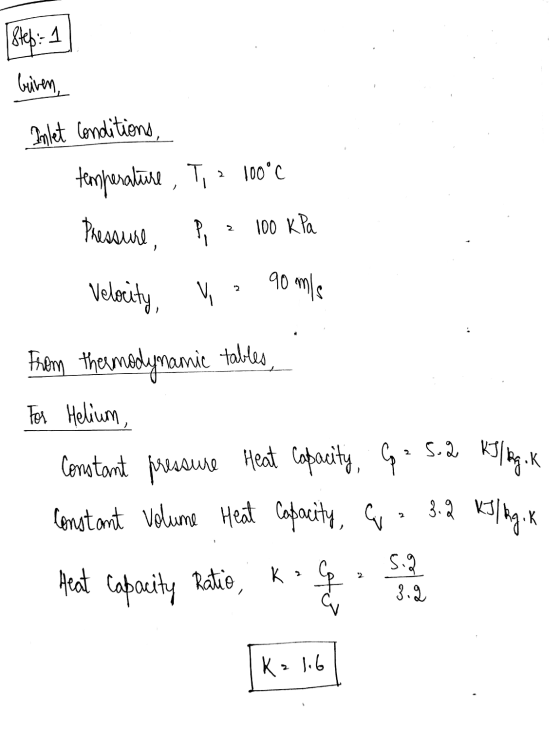
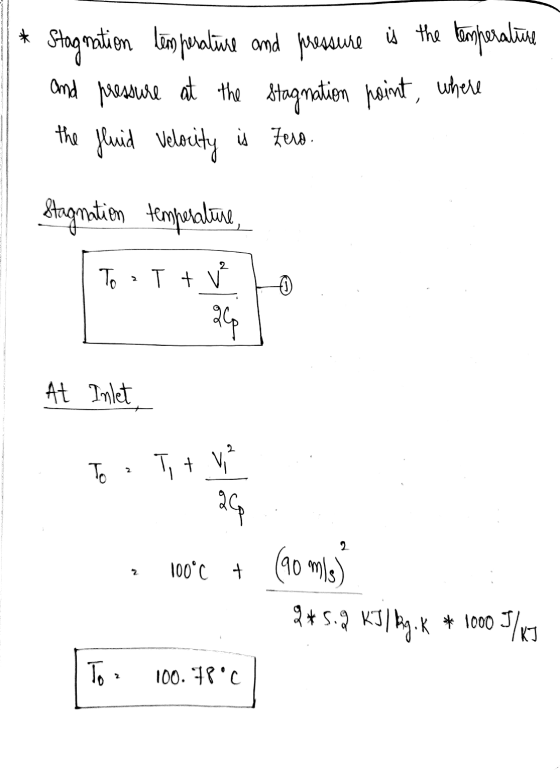
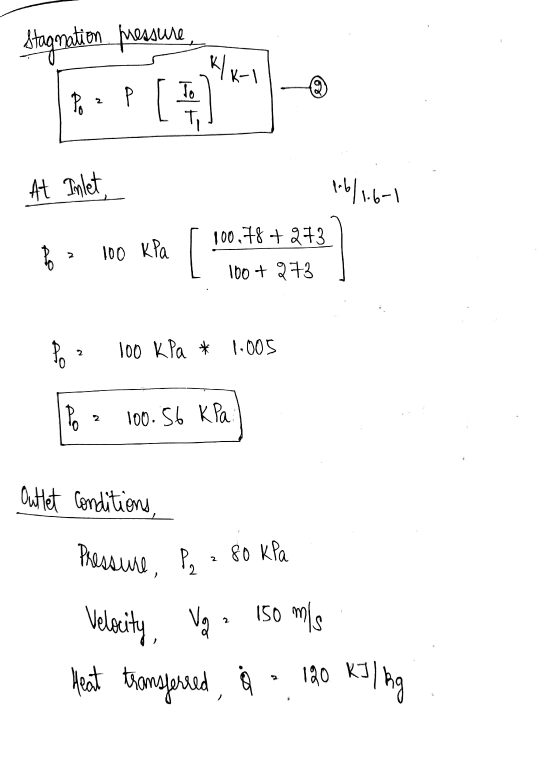
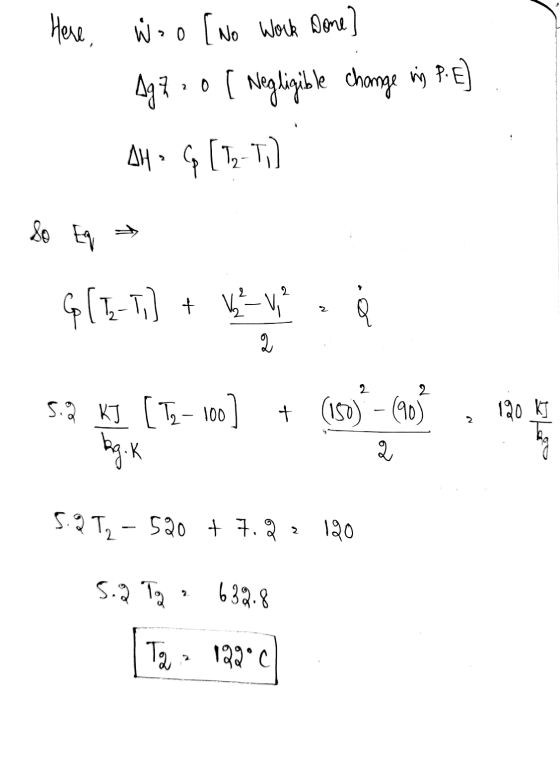
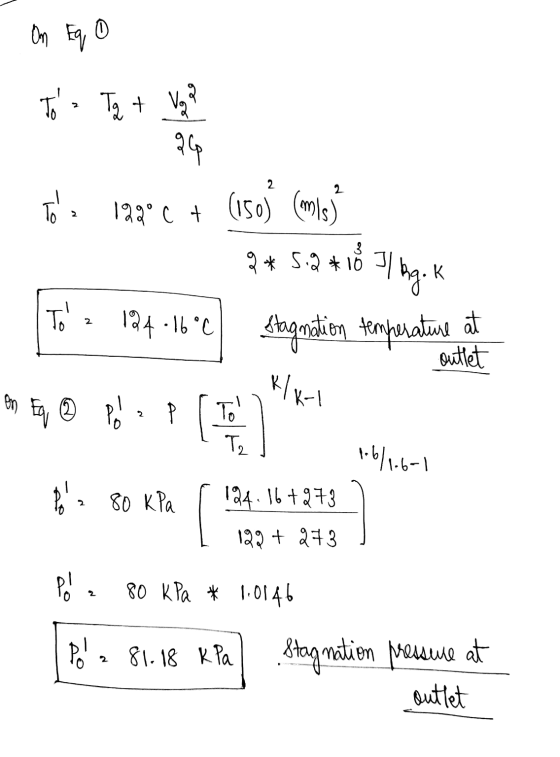
Helium enters a constant flow heat exchanger at 100 kPa, 100 C, and 90 m / s, and receives heat in the amount of 120 kJ / kg as it flows through it. Helium leaves the heat exchanger at 80 kPa with a speed of 150 0 m / s. Determine the pressure and temperature of nitrogen stagnation in the input and output states.
Helium enters a constant flow heat exchanger at 100 kPa, 100 C, and 90 m / s, and receives heat in the amount of 120 kJ / kg as it flows through it. Helium leaves the heat exchanger at 80 kPa with a speed of 150 0 m / s. Determine the pressure and temperature of helium stagnation in the input and output states.
Homework Answers
![Energy Balance for an open System m[ AH + AV? + Ag+] - $ + W 8. m = Mass flow rate AH = change in Enthalpy AV? change in kine](http://img.homeworklib.com/questions/81504f70-0c54-11eb-ac06-83fe422a2667.png?x-oss-process=image/resize,w_560)
Add Answer to:
Could someone help with the following problem???
Helium enters a constant flow heat exchanger at 100...
Steam Generator air (inlet) - 320°C P. = 100 kPa th =0.5 kg/s heat exchanger -...
 Steam Generator air (inlet) - 320°C P. = 100 kPa th =0.5 kg/s heat exchanger - water (inlet) T = 20°C Pw = 100 kPa m = 0.025 kg/s Problem sketch Solve with EES. Document all necessary balances The problem sketch illustrates a heat exchanger in which hot air is used to generate steam. Air enters the heat exchanger at 1a, in = 320C, Pa = 100 kPa, and ma -0.5 kg/s. Model air as an ideal gas with constant...
5-30 Air enters an adiabatic nozzle steadily at 300 kPa, 200°C, and 30 m/s and leaves...
 5-30 Air enters an adiabatic nozzle steadily at 300 kPa, 200°C, and 30 m/s and leaves at 100 kPa and 180 m/s. The inlet area of the nozzle is 80 cm². Determine (a) the mass flow rate through the nozzle, (b) the exit temperature of the air, and (c) the exit area of the nozzle. Answers: (a) 0.5304 kg/s, (b) 184.6°C, (c) 38.7 cm P = 300 kPa T, = 200°C Vi = 30 m/s A = 80 cm AIR...
this problem in heat exchanger, please solve. . In a parallel flow heat exchanger, hot liquid...
 this problem in heat exchanger, please solve.
. In a parallel flow heat exchanger, hot liquid enters at 400°C and leaves at 250°C. Cold fluid enters at 50°C and leaves at 110°C. The inside and outside heat transfer coefficients are 120W/m2 K and 190 W/m2 K respectively. The inside and outside diameters of tube are 0.06 m and 0.08 m respectively. If the heat transferred per hour is 1.6x 10⁵ kJ. Determine the length of tube required. Ans:12.5 m
this problem in heat exchanger, please solve.
. In a parallel flow heat exchanger, hot liquid enters at 400°C and leaves at 250°C. Cold fluid enters at 50°C and leaves at 110°C. The inside and outside heat transfer coefficients are 120W/m2 K and 190 W/m2 K respectively. The inside and outside diameters of tube are 0.06 m and 0.08 m respectively. If the heat transferred per hour is 1.6x 10⁵ kJ. Determine the length of tube required. Ans:12.5 m
Oil enters a counterflow heat exchanger at 600 K with a mass flow rate of 10...
Oil enters a counterflow heat exchanger at 600 K with a mass flow rate of 10 kg/s and exits at 275 K. A separate stream of liquid water enters at 20°C, 5 bar. Each stream experiences no significant change in pressure. Stray heat transfer with the surroundings of the heat exchanger and kinetic and potential energy effects can be ignored. The specific heat of the oil is constant, c = 2 kJ/kg · K. If the designer wants to ensure...
A flow rate of 0.4 m / s of air enters a compressor at 100 kPa....
A flow rate of 0.4 m / s of air enters a compressor at 100 kPa. 20ºC and 20m / s and leaves at 500C and 120 m / S. Determine the power of the compressor if the heat losses are 3000 kJ / min.
Figure P2.32 shows a cross-flow heat exchanger used to condense Freon-12. Freon-12 vapor enters the unit...
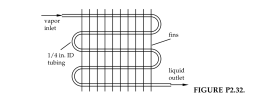 Figure P2.32 shows a cross-flow heat exchanger used to condense
Freon-12. Freon-12 vapor enters the unit at a flow rate of 0.065
kg/s. Freon-12 leaves the exchanger as a liquid (Sp. Gr. = 1.915)
at room temperature and pressure. Determine the exit velocity of
the liquid.
vapor inlet fins 1/4 in. ID tubing liquid outlet FIGURE P2.32.
Figure P2.32 shows a cross-flow heat exchanger used to condense
Freon-12. Freon-12 vapor enters the unit at a flow rate of 0.065
kg/s. Freon-12 leaves the exchanger as a liquid (Sp. Gr. = 1.915)
at room temperature and pressure. Determine the exit velocity of
the liquid.
vapor inlet fins 1/4 in. ID tubing liquid outlet FIGURE P2.32.
Tubular heat exchanger design A liquid food (with specific heat 3.9 kJ/[kg °C]) flows in the...
Tubular heat exchanger design A liquid food (with specific heat 3.9 kJ/[kg °C]) flows in the inner pipe of a double pipe heat exchanger. The liquid food enters the heat exchanger at 72°C and exits at 6°C at a flow rate of 0.5 kg/s. In the annular section, cold water at 2°C enters the heat exchanger and flows concurrently at a flow rate of 12 kg/s. The average specific heat of water is 4.10 kJ/(kg °C). Assuming steady-state conditions. a)...
Steam enters a counterflow heat exchanger operating at steady state at 0.07 MPa with a quality...
Steam enters a counterflow heat exchanger operating at steady state at 0.07 MPa with a quality of 0.9 and exits at the same pressure as saturated liquid. The steam mass flow rate is 1.3 kg/min. A separate stream of air with a mass flow rate of 100 kg/min enters at 30oC and exits at 60oC. The ideal gas model with cp = 1.005 kJ/kg·K can be assumed for air. Kinetic and potential energy effects are negligible. Determine the temperature of...
A heat exchanger is being investigated as a waste heat recovery device. A heat exchanger is commo...
A heat exchanger is being investigated as a waste heat recovery device. A heat exchanger is common device for using a hot fluid to heat a cold fluid without the fluids mixing. The cold fluid stream of liquid A enters at 294.2 K and leaves the device at a temperature of 330.91 K. Liquid A flows at a rate of 0.006 Kg/s and has a specific heat of 4180 J/(Kg K) and a specific volume of 0.00102 m3/Kg. Liquid B...
Water at 600ºC, 10 MPa enters the “hot” side of a well-insulated heat exchanger with a...
Water at 600ºC, 10 MPa enters the “hot” side of a well-insulated heat exchanger with a flowrate of 0.1 kg/s and exits as saturated liquid. Water enters the “cold” side of the heat exchanger at 10ºC, 100 kPa with a flowrate of 0.5 kg/s. Find (a) the rate of heat transfer (in kW) between the two fluids and (b) the exit temperature of the cold water (in ºC).
 Steam Generator air (inlet) - 320°C P. = 100 kPa th =0.5 kg/s heat exchanger - water (inlet) T = 20°C Pw = 100 kPa m = 0.025 kg/s Problem sketch Solve with EES. Document all necessary balances The problem sketch illustrates a heat exchanger in which hot air is used to generate steam. Air enters the heat exchanger at 1a, in = 320C, Pa = 100 kPa, and ma -0.5 kg/s. Model air as an ideal gas with constant...
 5-30 Air enters an adiabatic nozzle steadily at 300 kPa, 200°C, and 30 m/s and leaves at 100 kPa and 180 m/s. The inlet area of the nozzle is 80 cm². Determine (a) the mass flow rate through the nozzle, (b) the exit temperature of the air, and (c) the exit area of the nozzle. Answers: (a) 0.5304 kg/s, (b) 184.6°C, (c) 38.7 cm P = 300 kPa T, = 200°C Vi = 30 m/s A = 80 cm AIR...
 this problem in heat exchanger, please solve.
. In a parallel flow heat exchanger, hot liquid enters at 400°C and leaves at 250°C. Cold fluid enters at 50°C and leaves at 110°C. The inside and outside heat transfer coefficients are 120W/m2 K and 190 W/m2 K respectively. The inside and outside diameters of tube are 0.06 m and 0.08 m respectively. If the heat transferred per hour is 1.6x 10⁵ kJ. Determine the length of tube required. Ans:12.5 m
this problem in heat exchanger, please solve.
. In a parallel flow heat exchanger, hot liquid enters at 400°C and leaves at 250°C. Cold fluid enters at 50°C and leaves at 110°C. The inside and outside heat transfer coefficients are 120W/m2 K and 190 W/m2 K respectively. The inside and outside diameters of tube are 0.06 m and 0.08 m respectively. If the heat transferred per hour is 1.6x 10⁵ kJ. Determine the length of tube required. Ans:12.5 m
 Figure P2.32 shows a cross-flow heat exchanger used to condense
Freon-12. Freon-12 vapor enters the unit at a flow rate of 0.065
kg/s. Freon-12 leaves the exchanger as a liquid (Sp. Gr. = 1.915)
at room temperature and pressure. Determine the exit velocity of
the liquid.
vapor inlet fins 1/4 in. ID tubing liquid outlet FIGURE P2.32.
Figure P2.32 shows a cross-flow heat exchanger used to condense
Freon-12. Freon-12 vapor enters the unit at a flow rate of 0.065
kg/s. Freon-12 leaves the exchanger as a liquid (Sp. Gr. = 1.915)
at room temperature and pressure. Determine the exit velocity of
the liquid.
vapor inlet fins 1/4 in. ID tubing liquid outlet FIGURE P2.32.
Most questions answered within 3 hours.
-
Where is the error in this code sequence?
String s1 = "Hello";
String s2 = "ello";...
asked 10 months ago -
Financial data for Joel de Paris, Inc., for last year
follow:
Joel de Paris, Inc.
Balance...
asked 10 months ago -
Consider this reaction:
Al2(SO4)3 (aq)+ BaCl3
(aq) Al2Cl6 (aq)- +
3BaSO4(s) . What is the...
asked 10 months ago -
Suppose that Savneet is considering increasing her
recent random sample from 20 car rentals to 40...
asked 10 months ago -
Trucks arrive at an unloading terminal at an average rate of 120
per hour.
Trucks arrive...
asked 10 months ago -
Why are methanol and ethanol completely soluble in water while
octanol is not very little soluble....
asked 10 months ago -
A facilities manager at a university reads in a research report
that the mean amount of...
asked 10 months ago -
When the CuSO4 is rehydrated by adding water to the anhydrous
compound, is this an endothermic...
asked 10 months ago -
A ray of sunlight is passing from diamond into crown glass; the
angle of incidence is...
asked 10 months ago -
A block of mass 0.249 kg is placed on top of a light, vertical
spring of...
asked 10 months ago -
how do the kidneys compensate in the presences of acidosis
a) trigger hyperventilate
b) reserve acid...
asked 10 months ago -
Question 501 pts
The rental rate of capital to the firm increases. Which of the
following...
asked 10 months ago