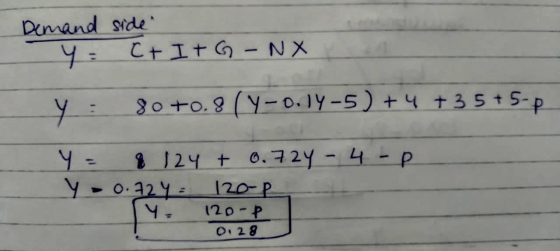
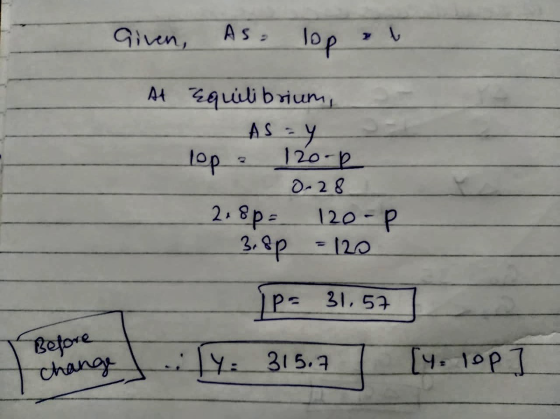
An economy is described by: AS = 10p, C = 80 + .8(Y – .1Y –...
Homework Answers
 Balanced budget is achieved by keeping the
same amount of change in G and T.
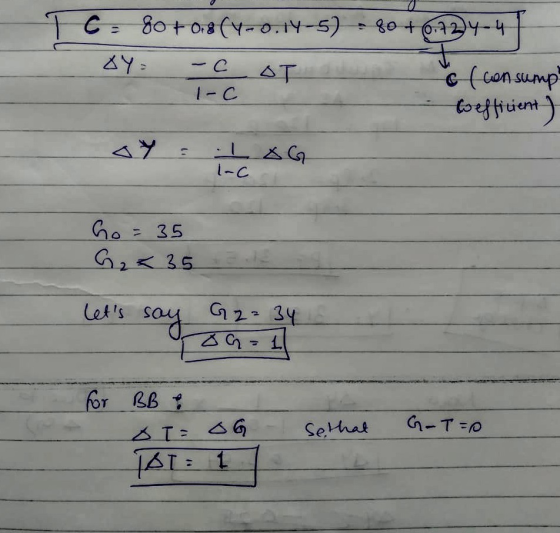
Balanced budget is achieved by keeping the
same amount of change in G and T.
As Balanced Budget= G - T
Therefore, ∆G = ∆T
I have assumed that ∆G = 1 = ∆T
Now, Balanced Budget multiplier is given by adding the individual multipliers of G and T.
Which is nothing but 1
Because, [1/(1 - c)] + [ -c / (1 - c)] = 1
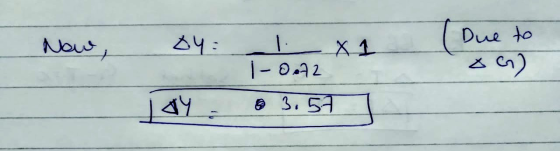
So, change is national income will be always be equal to change in G or T.
∆Y = ∆G = ∆T
New national product = Y + ∆G
Here, with an example of ∆G=1, new national product is 316.7.
An economy is described by: AS - 10p, C 90+81Y - 1Y - 5),1-4, Go -...
 An economy is described by: AS - 10p, C 90+81Y - 1Y - 5),1-4, Go - 35 and NX-5-p-0.12. Parliament enacts a rule requiring a balanced budget by Oanh mandates a reduction in G2 < 35. With this reduction in spending. National Output will be equal to
For an economy described by the following equations: C = 1,800 + 0.6 (Y – T)...
For an economy described by the following equations: C = 1,800 + 0.6 (Y – T) I p = 900 G = 1,500 NX = 100 T = 1,500 Y* = 9,000 Assume that the multiplier for this economy is 2.5. Find the effect on short-run equilibrium output of: a. An increase in government purchases from 1,500 to 1,600. Instructions: Enter your responses as whole numbers. Short-run equilibrium output will (Click to select) increase decrease to . b. A decrease in tax collections from 1,500...
A small open economy is described by the following set of equations: C = 300 +...
A small open economy is described by the following set of equations: C = 300 + 0.6(Y − T) I = 700 − 80r NX = 200 − 50ε G = T = 500 (Balanced Budget) (M/P)^d = Y − 200r M = 3, 000 P = 3 r ∗ = 5 (a) Derive and graph the IS∗ and LM∗ curves. (b) Calculate the equilibrium exchange rate, income and net exports. (c) Assume a floating exchange rate. Calculate what happens...
An economy is described by the following equations: C= 1800 +0.6(Y-T) consumption function Ip = 900...
 An economy is described by the following equations: C= 1800 +0.6(Y-T) consumption function Ip = 900 planned investment G=1500 government spending NX = 100 net exports T= 1500 taxes Y* = 9000 potential output What is the output gap for this economy? If the natural rate of unemployment is 4 percent, what is the actual unemployment rate for this economy (use Okun's law)?
An economy is described by the following equations: C = 80 + 0.6 (Y – T)...
An economy is described by the following equations: C = 80 + 0.6 (Y – T) I p = 70 G = 120 NX = 10 T = 150 Y* = 400 The multiplier in this economy is 2.5. a. Find a numerical equation relating planned aggregate expenditure to output. Instruction: Enter your response for mpc rounded to one decimal place. PAE = + Y. b. Construct a table to find the value of short-run equilibrium output. Instruction: If you are...
Consider an open economy described by the following equations (all figures in millions of dollars): Y...
Consider an open economy described by the following equations (all figures in millions of dollars): Y = C + I + G + NX Y = 8,000 (current value of output) G = 2,000 T = 1,000 + .1(Y) C = 450 + 0.75 (Y – T) I = 2,000 – 40 r NX = 700- 600ɛ (ɛ is the exchange rate) r = r* = 5 a) What is the current state of this economy in term of national...
3. Goods market equilibrium An economy is described by: C = 160 + 0.6YD I =...
3. Goods market equilibrium An economy is described by: C = 160 + 0.6YD I = 150 G = 150 T = 100 NX = 0 a. Find equilibrium Y (real GDP). b. Find disposable income, YD c. Consumer spending. Now let G = 200. d. Find the new value of Y. e. Find the new value of disposable income. f. Compute private saving, public saving and national saving. g. Does national saving = I in this case. Show why...
II. Consumption, Saving and Government Budget again Now the economy is doing very strong, and we ...
II. Consumption, Saving and Government Budget again Now the economy is doing very strong, and we can assume it is under full employment (long run) equilibrium. However, suppose households are uncertain about what events and policies may lie ahead, and decide to cut back consumption spending. (1) What short run and long run impacts would you expect this increased saving (decreased consumption) have on the economy, specifically on output (Y), price level (P), inflation (∏), real interest rate (r), nominal...
U ponunt 0 Consume 3. An economy is described by the following equations: (LO2) C =...
 U ponunt 0 Consume 3. An economy is described by the following equations: (LO2) C = 1,800 + 0.6(Y - T) P = 900 G = 1,500 NX = 100 T = 1,500 Y* = 9,000 crical equation linking planned aggregate expenditure to output. onomous expenditure and induced expenditure in this economy. a. Find a numerical equation linking plan b. Find autonomous expenditure a or the economy described in Problem 3: (L03) a. Construct a table like Table 11.1 to...
An economy is described as follows: C = 400 + 0.6(Y – T) I p =...
An economy is described as follows: C = 400 + 0.6(Y – T) I p = 200 G = 200 NX = 60 T = 100 Y* = 2,100 a. For the economy described above, find autonomous expenditure, the multiplier, short-run equilibrium output, and the output gap. Instructions: Enter your responses as absolute values. Autonomous expenditure: Multiplier: Short-run equilibrium output: There is (Click to select) a recessionary an expansionary no output gap in the amount of . b. Illustrate this economy’s short-run equilibrium on a...
 An economy is described by: AS - 10p, C 90+81Y - 1Y - 5),1-4, Go - 35 and NX-5-p-0.12. Parliament enacts a rule requiring a balanced budget by Oanh mandates a reduction in G2 < 35. With this reduction in spending. National Output will be equal to
 An economy is described by the following equations: C= 1800 +0.6(Y-T) consumption function Ip = 900 planned investment G=1500 government spending NX = 100 net exports T= 1500 taxes Y* = 9000 potential output What is the output gap for this economy? If the natural rate of unemployment is 4 percent, what is the actual unemployment rate for this economy (use Okun's law)?
 U ponunt 0 Consume 3. An economy is described by the following equations: (LO2) C = 1,800 + 0.6(Y - T) P = 900 G = 1,500 NX = 100 T = 1,500 Y* = 9,000 crical equation linking planned aggregate expenditure to output. onomous expenditure and induced expenditure in this economy. a. Find a numerical equation linking plan b. Find autonomous expenditure a or the economy described in Problem 3: (L03) a. Construct a table like Table 11.1 to...
Most questions answered within 3 hours.
-
Where is the error in this code sequence?
String s1 = "Hello";
String s2 = "ello";...
asked 11 months ago -
Financial data for Joel de Paris, Inc., for last year
follow:
Joel de Paris, Inc.
Balance...
asked 11 months ago -
Consider this reaction:
Al2(SO4)3 (aq)+ BaCl3
(aq) Al2Cl6 (aq)- +
3BaSO4(s) . What is the...
asked 11 months ago -
Suppose that Savneet is considering increasing her
recent random sample from 20 car rentals to 40...
asked 11 months ago -
Trucks arrive at an unloading terminal at an average rate of 120
per hour.
Trucks arrive...
asked 11 months ago -
Why are methanol and ethanol completely soluble in water while
octanol is not very little soluble....
asked 11 months ago -
A facilities manager at a university reads in a research report
that the mean amount of...
asked 11 months ago -
When the CuSO4 is rehydrated by adding water to the anhydrous
compound, is this an endothermic...
asked 11 months ago -
A ray of sunlight is passing from diamond into crown glass; the
angle of incidence is...
asked 11 months ago -
A block of mass 0.249 kg is placed on top of a light, vertical
spring of...
asked 11 months ago -
how do the kidneys compensate in the presences of acidosis
a) trigger hyperventilate
b) reserve acid...
asked 11 months ago -
Question 501 pts
The rental rate of capital to the firm increases. Which of the
following...
asked 11 months ago