
Homework Answers
Add Answer to:
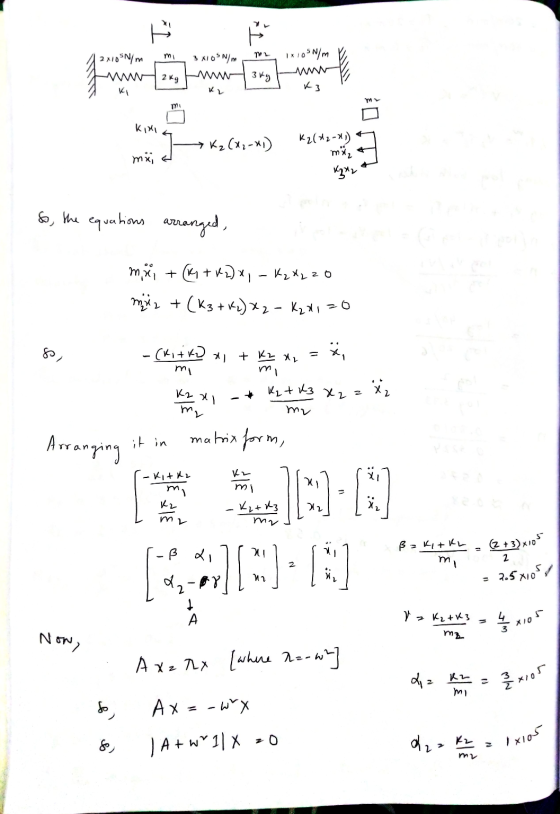
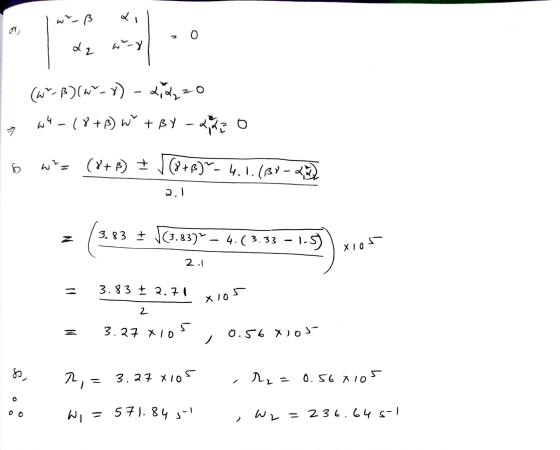
6.37 Determine the natural frequencies of the two-degree- of-freedom mechanical system of Figure P6.37. 2 x...
Determine the natural frequencies of the two-degree-of-freedom mechanical system of Figure P6.37 6.37 Determine the natural...
 Determine the natural frequencies of the two-degree-of-freedom
mechanical system of Figure P6.37
6.37 Determine the natural frequencies of the two-degree- of-freedom mechanical system of Figure P6.37. N N 2 x 10 3 x 10 10 2 kg 3 kg FIG. P6.37
Determine the natural frequencies of the two-degree-of-freedom
mechanical system of Figure P6.37
6.37 Determine the natural frequencies of the two-degree- of-freedom mechanical system of Figure P6.37. N N 2 x 10 3 x 10 10 2 kg 3 kg FIG. P6.37
Determine the natural frequencies and vibration modes of the two degree of freedom rectilinear system shown...
 Determine the natural frequencies and vibration modes of the two
degree of freedom rectilinear system shown in the following
figure.
please detail all the steps
ans:
k m, ww m2 DCL LEE LFF Оn1 — 0 k(m1+m2) Wn2 7ш.Тш X1 X2 -т, — Х, ( X2 X1 т2
Determine the natural frequencies and vibration modes of the two
degree of freedom rectilinear system shown in the following
figure.
please detail all the steps
ans:
k m, ww m2 DCL LEE LFF Оn1 — 0 k(m1+m2) Wn2 7ш.Тш X1 X2 -т, — Х, ( X2 X1 т2
Problem: Find the natural frequencies of the system shown in Figure. Take m 2 kg ma 2.5 kg ms 3.0...
 Problem: Find the natural frequencies of the system shown in Figure. Take m 2 kg ma 2.5 kg ms 3.0 kg me = 1.5 kg 914 Given: Four degree of freedom spring-mass system with given masses an stiffnesses. Find: Natural frequencies and mode shapes. Approach: Find the eigenvalues and eigenvectors of the dynamical matrix. 1. Determine [m] and [k] matrices of the vibrating system with all details 2. Determine [DI matrix. 3. Determine Natural frequencies and mode shapes analytically 3....
14. There is a two-degree-of-freedom system with no external force as shown in Figure 4. Here,...
 14. There is a two-degree-of-freedom system with no external force as shown in Figure 4. Here, kı=kz=k=10kN/m, ka=ks=2kN/m and m:=m2=2kg, answer the following. (25 points) 14-1. Find the equation of motion in matrix-vector form. 14-2. Find the natural frequencies W1, W2 (rad/sec) through the eigenvalue problem. 14-3. Find the eigenvectors corresponding to the eigenfrequencies through the eigenvalue problem, except that the first element is 1. X + ke ki 111; W ke Figure 4. Two degree of freedom model
1. Consider the two degree of freedom system shown. (a) Find the natural frequencies for the system (b) Determine the modal fraction for each mode. (c) Draw the mode shapes for each mode and iden...
 1. Consider the two degree of freedom system shown. (a) Find the natural frequencies for the system (b) Determine the modal fraction for each mode. (c) Draw the mode shapes for each mode and identify any nodes for each mode. (d) Demonstrate mode shape orthogonality. (e) If F- and the motion is initiated by giving the mass whose displacement is a velocity of 0.2 m/s when in equilibrium, determine 0) and ,0 (f) Determine the steady-state solution for both *)...
Problem 9. Find natural frequencies and principal coordinates of the two-degrees-of-freedom vibrating system: a) b) Problem 9. Find natural frequencies and principal coordinates of the two-degre...
 Problem 9. Find natural frequencies and principal coordinates of the two-degrees-of-freedom vibrating system: a) b)
Problem 9. Find natural frequencies and principal coordinates of the two-degrees-of-freedom vibrating system: a) b)
Problem 9. Find natural frequencies and principal coordinates of the two-degrees-of-freedom vibrating system: a) b)
8. Determine the natural frequencies of the system shown in Fig 1, where fi (t) =...
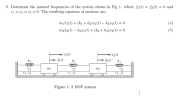 8. Determine the natural frequencies of the system shown in Fig 1, where fi (t) = falt) = 0 and 1c 0. The resulting equation of motions are: xi(t) 2(t) k1 m1 m2 C3 Figure 1: 2 DOF system
For the system shown in Figure 5, a. How many degrees of freedom is this system and why? (5) b. If x3-0 (the upper end...
 For the system shown in Figure 5, a. How many degrees of freedom is this system and why? (5) b. If x3-0 (the upper end is fixed and K1 and K2=K (5) Write the equations of motion. Set the necessary matrix to find the natural frequencies and mode shapes Determine and explain how to get the natural frequencies 1. (5) (5) 2. 3. Figure 5 ww ww-
For the system shown in Figure 5, a. How many degrees of freedom...
For the system shown in Figure 5, a. How many degrees of freedom is this system and why? (5) b. If x3-0 (the upper end is fixed and K1 and K2=K (5) Write the equations of motion. Set the necessary matrix to find the natural frequencies and mode shapes Determine and explain how to get the natural frequencies 1. (5) (5) 2. 3. Figure 5 ww ww-
For the system shown in Figure 5, a. How many degrees of freedom...
Problem 5 (20%) For the system shown in Figure 5, a. How many degrees of freedom is this system and why? (5) b. If x3 0...
 Problem 5 (20%) For the system shown in Figure 5, a. How many degrees of freedom is this system and why? (5) b. If x3 0 (the upper end is fixed and K1 and K2=K Write the equations of motion. Set the necessary matrix to find the natural frequencies and mode shapes (5) (5) (5) 1. 2. 3. Determine and explain how to get the natural frequencies. m2 Figure 5 www
Problem 5 (20%) For the system shown in Figure...
Problem 5 (20%) For the system shown in Figure 5, a. How many degrees of freedom is this system and why? (5) b. If x3 0 (the upper end is fixed and K1 and K2=K Write the equations of motion. Set the necessary matrix to find the natural frequencies and mode shapes (5) (5) (5) 1. 2. 3. Determine and explain how to get the natural frequencies. m2 Figure 5 www
Problem 5 (20%) For the system shown in Figure...
2) A single degree of freedom system is excited by sinusoidal force. Determine the damping ratio...
 2) A single degree of freedom system is excited by sinusoidal force. Determine the damping ratio of the system if the amplitude of displacement at resonance is 2 in, the exciting frequency is one- tenth of the natural frequency and the amplitude of displacement at resonance is 0.2 in a) 0.25 Hz b) 0.5 Hz c) 0.0025 Hz d) 005 Hz
2) A single degree of freedom system is excited by sinusoidal force. Determine the damping ratio of the system...
2) A single degree of freedom system is excited by sinusoidal force. Determine the damping ratio of the system if the amplitude of displacement at resonance is 2 in, the exciting frequency is one- tenth of the natural frequency and the amplitude of displacement at resonance is 0.2 in a) 0.25 Hz b) 0.5 Hz c) 0.0025 Hz d) 005 Hz
2) A single degree of freedom system is excited by sinusoidal force. Determine the damping ratio of the system...
 Determine the natural frequencies of the two-degree-of-freedom
mechanical system of Figure P6.37
6.37 Determine the natural frequencies of the two-degree- of-freedom mechanical system of Figure P6.37. N N 2 x 10 3 x 10 10 2 kg 3 kg FIG. P6.37
Determine the natural frequencies of the two-degree-of-freedom
mechanical system of Figure P6.37
6.37 Determine the natural frequencies of the two-degree- of-freedom mechanical system of Figure P6.37. N N 2 x 10 3 x 10 10 2 kg 3 kg FIG. P6.37
 Determine the natural frequencies and vibration modes of the two
degree of freedom rectilinear system shown in the following
figure.
please detail all the steps
ans:
k m, ww m2 DCL LEE LFF Оn1 — 0 k(m1+m2) Wn2 7ш.Тш X1 X2 -т, — Х, ( X2 X1 т2
Determine the natural frequencies and vibration modes of the two
degree of freedom rectilinear system shown in the following
figure.
please detail all the steps
ans:
k m, ww m2 DCL LEE LFF Оn1 — 0 k(m1+m2) Wn2 7ш.Тш X1 X2 -т, — Х, ( X2 X1 т2
 Problem: Find the natural frequencies of the system shown in Figure. Take m 2 kg ma 2.5 kg ms 3.0 kg me = 1.5 kg 914 Given: Four degree of freedom spring-mass system with given masses an stiffnesses. Find: Natural frequencies and mode shapes. Approach: Find the eigenvalues and eigenvectors of the dynamical matrix. 1. Determine [m] and [k] matrices of the vibrating system with all details 2. Determine [DI matrix. 3. Determine Natural frequencies and mode shapes analytically 3....
 14. There is a two-degree-of-freedom system with no external force as shown in Figure 4. Here, kı=kz=k=10kN/m, ka=ks=2kN/m and m:=m2=2kg, answer the following. (25 points) 14-1. Find the equation of motion in matrix-vector form. 14-2. Find the natural frequencies W1, W2 (rad/sec) through the eigenvalue problem. 14-3. Find the eigenvectors corresponding to the eigenfrequencies through the eigenvalue problem, except that the first element is 1. X + ke ki 111; W ke Figure 4. Two degree of freedom model
 1. Consider the two degree of freedom system shown. (a) Find the natural frequencies for the system (b) Determine the modal fraction for each mode. (c) Draw the mode shapes for each mode and identify any nodes for each mode. (d) Demonstrate mode shape orthogonality. (e) If F- and the motion is initiated by giving the mass whose displacement is a velocity of 0.2 m/s when in equilibrium, determine 0) and ,0 (f) Determine the steady-state solution for both *)...
 Problem 9. Find natural frequencies and principal coordinates of the two-degrees-of-freedom vibrating system: a) b)
Problem 9. Find natural frequencies and principal coordinates of the two-degrees-of-freedom vibrating system: a) b)
Problem 9. Find natural frequencies and principal coordinates of the two-degrees-of-freedom vibrating system: a) b)
 8. Determine the natural frequencies of the system shown in Fig 1, where fi (t) = falt) = 0 and 1c 0. The resulting equation of motions are: xi(t) 2(t) k1 m1 m2 C3 Figure 1: 2 DOF system
 For the system shown in Figure 5, a. How many degrees of freedom is this system and why? (5) b. If x3-0 (the upper end is fixed and K1 and K2=K (5) Write the equations of motion. Set the necessary matrix to find the natural frequencies and mode shapes Determine and explain how to get the natural frequencies 1. (5) (5) 2. 3. Figure 5 ww ww-
For the system shown in Figure 5, a. How many degrees of freedom...
For the system shown in Figure 5, a. How many degrees of freedom is this system and why? (5) b. If x3-0 (the upper end is fixed and K1 and K2=K (5) Write the equations of motion. Set the necessary matrix to find the natural frequencies and mode shapes Determine and explain how to get the natural frequencies 1. (5) (5) 2. 3. Figure 5 ww ww-
For the system shown in Figure 5, a. How many degrees of freedom...
 Problem 5 (20%) For the system shown in Figure 5, a. How many degrees of freedom is this system and why? (5) b. If x3 0 (the upper end is fixed and K1 and K2=K Write the equations of motion. Set the necessary matrix to find the natural frequencies and mode shapes (5) (5) (5) 1. 2. 3. Determine and explain how to get the natural frequencies. m2 Figure 5 www
Problem 5 (20%) For the system shown in Figure...
Problem 5 (20%) For the system shown in Figure 5, a. How many degrees of freedom is this system and why? (5) b. If x3 0 (the upper end is fixed and K1 and K2=K Write the equations of motion. Set the necessary matrix to find the natural frequencies and mode shapes (5) (5) (5) 1. 2. 3. Determine and explain how to get the natural frequencies. m2 Figure 5 www
Problem 5 (20%) For the system shown in Figure...
 2) A single degree of freedom system is excited by sinusoidal force. Determine the damping ratio of the system if the amplitude of displacement at resonance is 2 in, the exciting frequency is one- tenth of the natural frequency and the amplitude of displacement at resonance is 0.2 in a) 0.25 Hz b) 0.5 Hz c) 0.0025 Hz d) 005 Hz
2) A single degree of freedom system is excited by sinusoidal force. Determine the damping ratio of the system...
2) A single degree of freedom system is excited by sinusoidal force. Determine the damping ratio of the system if the amplitude of displacement at resonance is 2 in, the exciting frequency is one- tenth of the natural frequency and the amplitude of displacement at resonance is 0.2 in a) 0.25 Hz b) 0.5 Hz c) 0.0025 Hz d) 005 Hz
2) A single degree of freedom system is excited by sinusoidal force. Determine the damping ratio of the system...
Most questions answered within 3 hours.
-
Where is the error in this code sequence?
String s1 = "Hello";
String s2 = "ello";...
asked 11 months ago -
Financial data for Joel de Paris, Inc., for last year
follow:
Joel de Paris, Inc.
Balance...
asked 11 months ago -
Consider this reaction:
Al2(SO4)3 (aq)+ BaCl3
(aq) Al2Cl6 (aq)- +
3BaSO4(s) . What is the...
asked 11 months ago -
Suppose that Savneet is considering increasing her
recent random sample from 20 car rentals to 40...
asked 11 months ago -
Trucks arrive at an unloading terminal at an average rate of 120
per hour.
Trucks arrive...
asked 11 months ago -
Why are methanol and ethanol completely soluble in water while
octanol is not very little soluble....
asked 11 months ago -
A facilities manager at a university reads in a research report
that the mean amount of...
asked 11 months ago -
When the CuSO4 is rehydrated by adding water to the anhydrous
compound, is this an endothermic...
asked 11 months ago -
A ray of sunlight is passing from diamond into crown glass; the
angle of incidence is...
asked 11 months ago -
A block of mass 0.249 kg is placed on top of a light, vertical
spring of...
asked 11 months ago -
how do the kidneys compensate in the presences of acidosis
a) trigger hyperventilate
b) reserve acid...
asked 11 months ago -
Question 501 pts
The rental rate of capital to the firm increases. Which of the
following...
asked 11 months ago