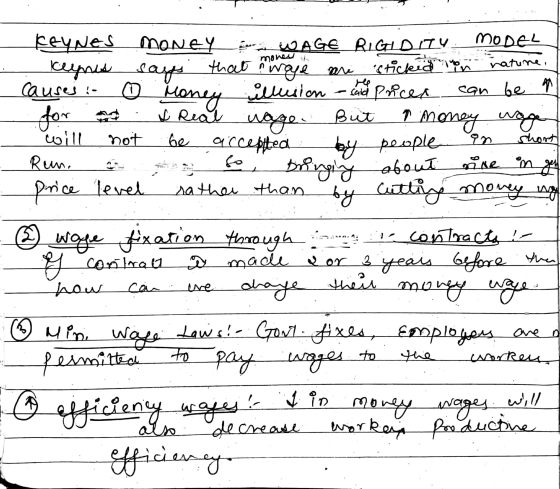
(3 Marks) Why are wages and prices sticky, according to Keynes?
(3 Marks) Why are wages and prices sticky, according to Keynes?
Homework Answers
Why do sticky wages and prices increase the impact of an economic downturn on unemployment and...
Why do sticky wages and prices increase the impact of an economic downturn on unemployment and recession?
How do sticky wages and prices make monetary policy effective in the short run?
How do sticky wages and prices make monetary policy effective in the short run?
Does it make sense that wages would be sticky downwards but not upwards? Why or why...
Does it make sense that wages would be sticky downwards but not upwards? Why or why not?
Keynesian theory of sticky wages primarily applies to in the price level during As a result...
 Keynesian theory of sticky wages primarily applies to in the price level during As a result of sticky wages, O both prices charged by firms, and input prices, change at the same rate. O prices charged by firms increase slower than input prices, including wages. salaries paid to workers do not rise to compensate for increases in the price level. salaries paid to workers do not fall at the same rate as decreases in the price level. Sticky wages lead...
Keynes believed that the only way to alter unemployment was through a. monetary policy. b. wages...
Keynes believed that the only way to alter unemployment was through a. monetary policy. b. wages and prices. c. aggregate supply. d. aggregate demand.
3. From a Keynesian point of view, which is more likely to cause a recession: aggregate demand or aggregate supply, and...
 3. From a Keynesian point of view, which is more likely to cause a recession: aggregate demand or aggregate supply, and why? In your answer explain the difference between Keynes law and Say's law. 4. Why do sticky wages and prices increase the impact of an economic downturn on unemployment and recession?
9. Why do wages tend to be sticky' downward? There are several reasons why wage tond...
 9. Why do wages tend to be sticky' downward? There are several reasons why wage tond Hole "stucky" dan word. Forexample, under an implicit Centract, it is difficult for an employer to cut an employees wage. Empyers tend to lay of scmeccckers-tron to cut wages for everyone. wages will decline only very slowly when The economy business is having & tugh time, due to economic laws and institutions. 10. Explain the concept of natural rate of unemployment. Using the graph...
In Laurence Meyer’s “Monetarism Without Money” model, there are “backward-looking” elements in his equations (1) and...
In Laurence Meyer’s “Monetarism Without Money” model, there are “backward-looking” elements in his equations (1) and (2) so that last period’s level of the output gap and last period’s rate of inflation affect this period’s output gap and inflation rate. This is to capture the role of sticky wages and prices in the short run. Here he must really be talking about sticky rates of change of wages and prices. How does this allow a role for monetary policy, and...
1. Do you think prices tend to be sticky? 2. What do economists mean when they...
1. Do you think prices tend to be sticky? 2. What do economists mean when they say tha participants in the economy choose between present and future consumption? 3. Why are uncertainty, expectations, and shocks important in economic system?
 Keynesian theory of sticky wages primarily applies to in the price level during As a result of sticky wages, O both prices charged by firms, and input prices, change at the same rate. O prices charged by firms increase slower than input prices, including wages. salaries paid to workers do not rise to compensate for increases in the price level. salaries paid to workers do not fall at the same rate as decreases in the price level. Sticky wages lead...
 3. From a Keynesian point of view, which is more likely to cause a recession: aggregate demand or aggregate supply, and why? In your answer explain the difference between Keynes law and Say's law. 4. Why do sticky wages and prices increase the impact of an economic downturn on unemployment and recession?
 9. Why do wages tend to be sticky' downward? There are several reasons why wage tond Hole "stucky" dan word. Forexample, under an implicit Centract, it is difficult for an employer to cut an employees wage. Empyers tend to lay of scmeccckers-tron to cut wages for everyone. wages will decline only very slowly when The economy business is having & tugh time, due to economic laws and institutions. 10. Explain the concept of natural rate of unemployment. Using the graph...
Most questions answered within 3 hours.
-
Where is the error in this code sequence?
String s1 = "Hello";
String s2 = "ello";...
asked 10 months ago -
Financial data for Joel de Paris, Inc., for last year
follow:
Joel de Paris, Inc.
Balance...
asked 10 months ago -
Consider this reaction:
Al2(SO4)3 (aq)+ BaCl3
(aq) Al2Cl6 (aq)- +
3BaSO4(s) . What is the...
asked 10 months ago -
Suppose that Savneet is considering increasing her
recent random sample from 20 car rentals to 40...
asked 10 months ago -
Trucks arrive at an unloading terminal at an average rate of 120
per hour.
Trucks arrive...
asked 10 months ago -
Why are methanol and ethanol completely soluble in water while
octanol is not very little soluble....
asked 10 months ago -
A facilities manager at a university reads in a research report
that the mean amount of...
asked 10 months ago -
When the CuSO4 is rehydrated by adding water to the anhydrous
compound, is this an endothermic...
asked 10 months ago -
A ray of sunlight is passing from diamond into crown glass; the
angle of incidence is...
asked 10 months ago -
A block of mass 0.249 kg is placed on top of a light, vertical
spring of...
asked 10 months ago -
how do the kidneys compensate in the presences of acidosis
a) trigger hyperventilate
b) reserve acid...
asked 10 months ago -
Question 501 pts
The rental rate of capital to the firm increases. Which of the
following...
asked 10 months ago