
Homework Answers
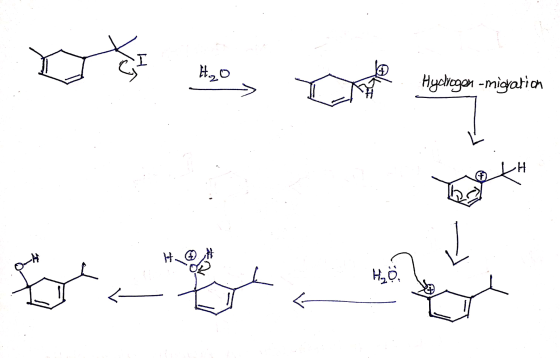
In the first reaction after leaving iodide the tertiary carbocation will form.
The formed tertiary carbocation changes into more stable allylic tertiary carbocation by hydrogen migration.
Finally the water molecule attack the finaly formed tertiary carbocation which gives our product.
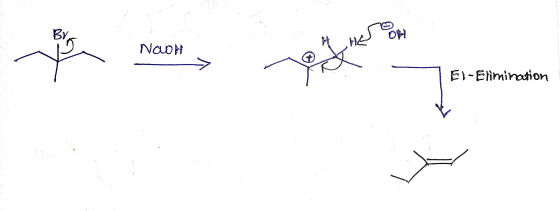
The second reaction is an example of E1-Elimination. The tertiary bromide react with NaOH give alkene as the product.
Add Answer to:
3. Provide a mechanism for the following reaction. (This a hint to question 2) 5 points...
1. Provide a mechanism for the following reaction. 5 points HCI + 11,0 2. Provide a...
 1. Provide a mechanism for the following reaction. 5 points HCI + 11,0 2. Provide a mechanism and the favored product(s) with the following reaction. Remember MeOH is CH3OH. 5 points MeOH Br 3. Provide a mechanism for the following reaction. (This a hint to question 2) 5 points OH HO 4. Draw a mechanism and provide the most favorable product from the reaction below. 5 points Br NaOH
Draw a mechanism and provide the most favorable product from the reaction below 4. Draw a...
 Draw a mechanism and provide the most favorable product from
the reaction below
4. Draw a mechanism and provide the most favorable product from the reaction below Br NaOH
Draw a mechanism and provide the most favorable product from
the reaction below
4. Draw a mechanism and provide the most favorable product from the reaction below Br NaOH
4. Provide a mechanism for the following reaction that accounts for the regio.... 5. Draw a...
 4. Provide a mechanism for the following reaction that
accounts for the regio....
5. Draw a reasonable reaction mechanism for the following
transformation
4. Provide a mechanism for the following reaction that accounts for the regio- and stereoselectivity that is observed. NaOH OH 5. Draw a reasonable reaction mechanism for the following transformation. Me Me H2PO
4. Provide a mechanism for the following reaction that
accounts for the regio....
5. Draw a reasonable reaction mechanism for the following
transformation
4. Provide a mechanism for the following reaction that accounts for the regio- and stereoselectivity that is observed. NaOH OH 5. Draw a reasonable reaction mechanism for the following transformation. Me Me H2PO
In the lab, Cassandra the Chemist™ studied the reaction between 2-bromo-3-methyl pentane with a base under...
 In the lab, Cassandra the Chemist™ studied the reaction between
2-bromo-3-methyl pentane with a base under the presence of heat.
During her studies, she found that the reaction rate doubled when
she doubled the amount of the base. Draw a full, arrow-pushing,
mechanism of the above reaction showing the most prevalent product
formed.
11. (22 pts) In the lab, Cassandra the Chemist"M pentane with a base under the presence of heat. During her studies, she found that the reaction studied...
In the lab, Cassandra the Chemist™ studied the reaction between
2-bromo-3-methyl pentane with a base under the presence of heat.
During her studies, she found that the reaction rate doubled when
she doubled the amount of the base. Draw a full, arrow-pushing,
mechanism of the above reaction showing the most prevalent product
formed.
11. (22 pts) In the lab, Cassandra the Chemist"M pentane with a base under the presence of heat. During her studies, she found that the reaction studied...
26) Predict the major product for the following reaction and draw the full mechanism for product...
 26) Predict the major product for the following reaction and draw the full mechanism for product formation (Hint: Aldol Condensation Reaction) pts NaOH/H2O Heat H Bonus: Provide a step wise synthesis for the following conversions? 6 Pts (Multi step) Br A) OH NH OH B ) OH
please provide a full mechanism for the following reaction: 3) Provide a full mechanism to account...
 please provide a full mechanism for the following
reaction:
3) Provide a full mechanism to account for the product of the reaction shown below: o r _Naoip, Br * B Br Product Mechanism
please provide a full mechanism for the following
reaction:
3) Provide a full mechanism to account for the product of the reaction shown below: o r _Naoip, Br * B Br Product Mechanism
26) Predict the major product for the following reaction and draw the full mechanism for product...
 26) Predict the major product for the following reaction and draw the full mechanism for product formation (Hint: Aldol Condensation Reaction) 6 pts NaOH/H2O Heat Н. Bonus: Provide a step wise synthesis for the following conversions? 6 Pts (Multi step) wie Br A) OH OH NH2 B) OH C)
Question 18 1 points Consider an El mechanism for the reaction of bromocyclopentane with hydroxide as...
 Question 18 1 points Consider an El mechanism for the reaction of bromocyclopentane with hydroxide as shown below. Which elementary step or sequence of steps from the list below would outlin step(s) for an E1 mechanism? H E1 - OH "Be H H H Н. H (1) WBE - Br Η. Η Η H -Н (2) - Br Br HH + H,0 + Br Η. Η H HO + H,0 - Br WB HO - B (5) HO:
Question 9 (2 points) Identify the final product for the following reaction. 1. BH THE 2....
 Question 9 (2 points) Identify the final product for the following reaction. 1. BH THE 2. O2, NaOH OH OH doy HII oa) IV ob) III OC) od) 11 Question 10 (2 points) Provide the structure of the expected major organic product generated upon completion of the following reaction scheme: (CH)CCH_CH=CH, HB HO H (CH)CCH.CH (снуусан,он- 1 Br (CH2jcChych do (touche con IV oa) IV ob) 11 oc) od) DI
1) What is the product and Mechanism for the following SN2 reaction? (5 Points) 2) What...
 1) What is the product and Mechanism for the following SN2 reaction? (5 Points) 2) What is/are the product(s) and Mechanism for the following E2 reaction? (5 Points) NaOCH 3) What is/are the product(s) and Mechanism for the following SN1/E1 Reaction? (5 Points) CH,CH,OH 4) What kind of reagent would be needed in order to get this SN2 product? (5 Points) SN2
 1. Provide a mechanism for the following reaction. 5 points HCI + 11,0 2. Provide a mechanism and the favored product(s) with the following reaction. Remember MeOH is CH3OH. 5 points MeOH Br 3. Provide a mechanism for the following reaction. (This a hint to question 2) 5 points OH HO 4. Draw a mechanism and provide the most favorable product from the reaction below. 5 points Br NaOH
 Draw a mechanism and provide the most favorable product from
the reaction below
4. Draw a mechanism and provide the most favorable product from the reaction below Br NaOH
Draw a mechanism and provide the most favorable product from
the reaction below
4. Draw a mechanism and provide the most favorable product from the reaction below Br NaOH
 4. Provide a mechanism for the following reaction that
accounts for the regio....
5. Draw a reasonable reaction mechanism for the following
transformation
4. Provide a mechanism for the following reaction that accounts for the regio- and stereoselectivity that is observed. NaOH OH 5. Draw a reasonable reaction mechanism for the following transformation. Me Me H2PO
4. Provide a mechanism for the following reaction that
accounts for the regio....
5. Draw a reasonable reaction mechanism for the following
transformation
4. Provide a mechanism for the following reaction that accounts for the regio- and stereoselectivity that is observed. NaOH OH 5. Draw a reasonable reaction mechanism for the following transformation. Me Me H2PO
 In the lab, Cassandra the Chemist™ studied the reaction between
2-bromo-3-methyl pentane with a base under the presence of heat.
During her studies, she found that the reaction rate doubled when
she doubled the amount of the base. Draw a full, arrow-pushing,
mechanism of the above reaction showing the most prevalent product
formed.
11. (22 pts) In the lab, Cassandra the Chemist"M pentane with a base under the presence of heat. During her studies, she found that the reaction studied...
In the lab, Cassandra the Chemist™ studied the reaction between
2-bromo-3-methyl pentane with a base under the presence of heat.
During her studies, she found that the reaction rate doubled when
she doubled the amount of the base. Draw a full, arrow-pushing,
mechanism of the above reaction showing the most prevalent product
formed.
11. (22 pts) In the lab, Cassandra the Chemist"M pentane with a base under the presence of heat. During her studies, she found that the reaction studied...
 26) Predict the major product for the following reaction and draw the full mechanism for product formation (Hint: Aldol Condensation Reaction) pts NaOH/H2O Heat H Bonus: Provide a step wise synthesis for the following conversions? 6 Pts (Multi step) Br A) OH NH OH B ) OH
 please provide a full mechanism for the following
reaction:
3) Provide a full mechanism to account for the product of the reaction shown below: o r _Naoip, Br * B Br Product Mechanism
please provide a full mechanism for the following
reaction:
3) Provide a full mechanism to account for the product of the reaction shown below: o r _Naoip, Br * B Br Product Mechanism
 26) Predict the major product for the following reaction and draw the full mechanism for product formation (Hint: Aldol Condensation Reaction) 6 pts NaOH/H2O Heat Н. Bonus: Provide a step wise synthesis for the following conversions? 6 Pts (Multi step) wie Br A) OH OH NH2 B) OH C)
 Question 18 1 points Consider an El mechanism for the reaction of bromocyclopentane with hydroxide as shown below. Which elementary step or sequence of steps from the list below would outlin step(s) for an E1 mechanism? H E1 - OH "Be H H H Н. H (1) WBE - Br Η. Η Η H -Н (2) - Br Br HH + H,0 + Br Η. Η H HO + H,0 - Br WB HO - B (5) HO:
 Question 9 (2 points) Identify the final product for the following reaction. 1. BH THE 2. O2, NaOH OH OH doy HII oa) IV ob) III OC) od) 11 Question 10 (2 points) Provide the structure of the expected major organic product generated upon completion of the following reaction scheme: (CH)CCH_CH=CH, HB HO H (CH)CCH.CH (снуусан,он- 1 Br (CH2jcChych do (touche con IV oa) IV ob) 11 oc) od) DI
 1) What is the product and Mechanism for the following SN2 reaction? (5 Points) 2) What is/are the product(s) and Mechanism for the following E2 reaction? (5 Points) NaOCH 3) What is/are the product(s) and Mechanism for the following SN1/E1 Reaction? (5 Points) CH,CH,OH 4) What kind of reagent would be needed in order to get this SN2 product? (5 Points) SN2
Most questions answered within 3 hours.
-
Where is the error in this code sequence?
String s1 = "Hello";
String s2 = "ello";...
asked 11 months ago -
Financial data for Joel de Paris, Inc., for last year
follow:
Joel de Paris, Inc.
Balance...
asked 11 months ago -
Consider this reaction:
Al2(SO4)3 (aq)+ BaCl3
(aq) Al2Cl6 (aq)- +
3BaSO4(s) . What is the...
asked 11 months ago -
Suppose that Savneet is considering increasing her
recent random sample from 20 car rentals to 40...
asked 11 months ago -
Trucks arrive at an unloading terminal at an average rate of 120
per hour.
Trucks arrive...
asked 11 months ago -
Why are methanol and ethanol completely soluble in water while
octanol is not very little soluble....
asked 11 months ago -
A facilities manager at a university reads in a research report
that the mean amount of...
asked 11 months ago -
When the CuSO4 is rehydrated by adding water to the anhydrous
compound, is this an endothermic...
asked 11 months ago -
A ray of sunlight is passing from diamond into crown glass; the
angle of incidence is...
asked 11 months ago -
A block of mass 0.249 kg is placed on top of a light, vertical
spring of...
asked 11 months ago -
how do the kidneys compensate in the presences of acidosis
a) trigger hyperventilate
b) reserve acid...
asked 11 months ago -
Question 501 pts
The rental rate of capital to the firm increases. Which of the
following...
asked 11 months ago