1.1 What is the equation for the rate of formation of tert-butyl alcohol from the reaction of tert-butyl bromide (t-BuBr) with water by an SN1 mechanism?
A. Rate= k[t-BuBr]
B Rate=k[ t-BuBr][H2O]
C. Rate=k[ H2O]
D. Rate=k[t-BuBr]^2
1.2 What is the equation for the rate of formation of 1-iodobutane from the reaction of 1-chlorobutane (BuCl) with NaI by an SN2 mechanism?
A. Rate=k[BuCl]
B. Rate=k[BuCl][NaI]
C. Rate=k[NaI]
D. Rate=k[BuCl]^2
1.3 What is the equation for the rate of formation of 2-methoxypropane,(CH3CH(OCH3)CH3,from the reaction of 2-bromopropane (i-PrBr) with sodium methoxide(NaOCH3)?
A. Rate=k[i-PrBr]
B. Rate=k[i-PrBr]^2
C. Rate=k[NaHO3]
D. Rate=k[i-PrBr][NaHO3]
1.4 What is the equation for the rate of formation of 2-methoxypropane,CH3CH(OCH3)CH3, from the reaction of 2-bromopropane (i-PrBr) with methanol?
A. Rate=k[i-PrBr]
B. Rate=k[i-PrBr]^2
C. Rate=k[NaOCH3]
D. Rate=k[iPrBr][NaOCH3]
1.5 Explain each trend in 1-2 sentences
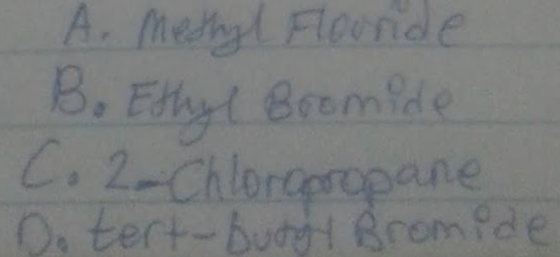
1.6 Which of the following alkyl halides undergoes the fastest SN2 reaction with sodium cyanide
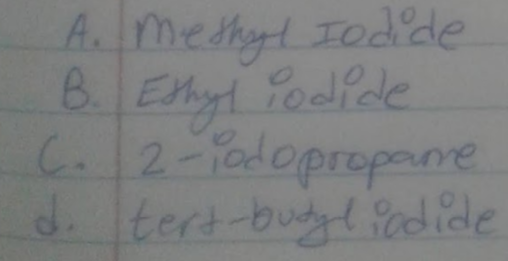
1.7 Which of the following alkyl halides undergoes the fastest SN2 reaction with sodium methylthiolate,NaSMe?
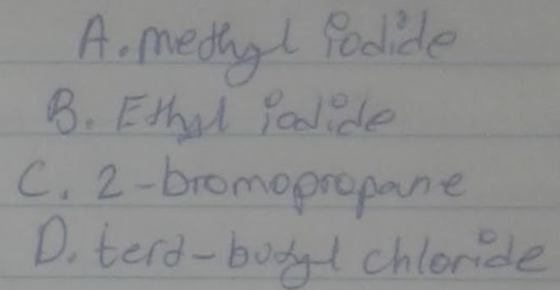
1.8 Which of the following alkyl halides undergoes the fastest solvolysis reaction with formic acid,HCOOH?
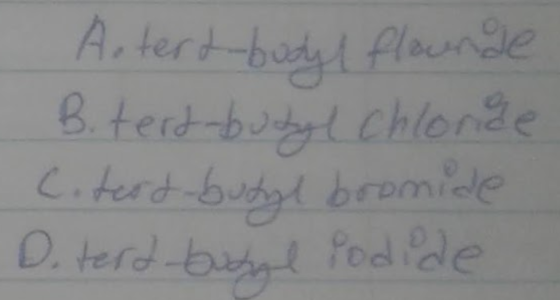
1.9 Which of the following alkyl halides undergoes the fastest solvolysis reaction with methanol,CH3OH?
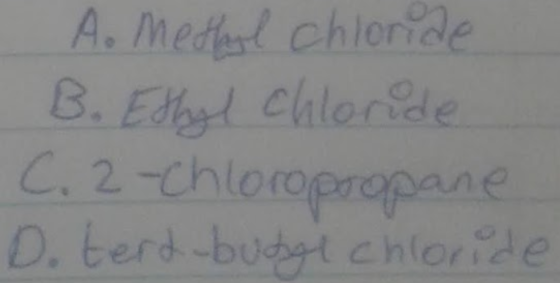
1.10 Which of the following alkyl halides undergoes the fastest solvolysis reaction with ethanol,CH3CH2OH?
Homework Answers
Request Answer!
We need at least 10 more requests to produce the answer.
0 / 10 have requested this problem solution
The more requests, the faster the answer.
Add Answer to:
1.1 What is the equation for the rate of formation of tert-butyl
alcohol from the reaction...
answer all please. 23. What is the equation for the rate of formation of tert-butyl alcohol...
 answer all please.
23. What is the equation for the rate of formation of tert-butyl alcohol from the reaction of tert-butyl bromide (t-BuBr) with water by an Syl mechanism? A) Rate -k [t-BuBr] B) Rate = k [t-BuBr] [H,O] C) Rate k [H2O D) Rate k [t-BuBr] 24. Which of the following statements related to Ssl reactions is not true? A) The SN1 reaction can be described as a heterolytic bond cleavage followed by nucleophilic attack. B) Carbocations are electrophilic....
answer all please.
23. What is the equation for the rate of formation of tert-butyl alcohol from the reaction of tert-butyl bromide (t-BuBr) with water by an Syl mechanism? A) Rate -k [t-BuBr] B) Rate = k [t-BuBr] [H,O] C) Rate k [H2O D) Rate k [t-BuBr] 24. Which of the following statements related to Ssl reactions is not true? A) The SN1 reaction can be described as a heterolytic bond cleavage followed by nucleophilic attack. B) Carbocations are electrophilic....
Please answer all 6 multiquestions and show work! Useful Information DMSO H₃C гсн 요 Acetone PK,...
 Please answer all 6 multiquestions and show work!
Useful Information DMSO H₃C гсн 요 Acetone PK, NH3 = 38 Part 1: Multiple Choice: 1) Which atomic orbitals overlap to form the carbon-carbon triple bond of an alkyne? a) 2s + 2s; sp + sp; 2p + 2p b) sp + sp; sp + sp; 2p + 2p c) sp + sp; 2p + 2p; 2p + 2p d) sp + sp?; sp + sp; 2p + 2p 2. In a...
Please answer all 6 multiquestions and show work!
Useful Information DMSO H₃C гсн 요 Acetone PK, NH3 = 38 Part 1: Multiple Choice: 1) Which atomic orbitals overlap to form the carbon-carbon triple bond of an alkyne? a) 2s + 2s; sp + sp; 2p + 2p b) sp + sp; sp + sp; 2p + 2p c) sp + sp; 2p + 2p; 2p + 2p d) sp + sp?; sp + sp; 2p + 2p 2. In a...
28) The reaction of tert-butyl bromide, (CH,)CBr, with ethanol affords the substitution product tert-butyl ethyl ether,...
 28) The reaction of tert-butyl bromide, (CH,)CBr, with ethanol affords the substitution product tert-butyl ethyl ether, (CH)1COCH CH, in acidic conditions. What would happen to the rate of the reaction if the concentration of ethanol was doubled? A) The rate remains the same. B) The rate decreases by a factor of 2 C) The rate increases by a factor of 2. D) The rate increases by a factor of 4. Circle the following alkyl halide that will undergo the fastest...
Which of the following alkyl halides undergoes the fastest SN2 reaction with sodium cyanide, NaCN? ID:...
 Which of the following alkyl halides undergoes the fastest SN2
reaction with sodium cyanide, NaCN?
ID: A 10. Which ot the tollowing aakyi nauraes undergoes the tastest sNL reacuon wnun soarum cyaniue. Ra a. methyl iodide b. ethyl iodide c. 2-iodopropane d. tert-butyl iodide
Which of the following alkyl halides undergoes the fastest SN2
reaction with sodium cyanide, NaCN?
ID: A 10. Which ot the tollowing aakyi nauraes undergoes the tastest sNL reacuon wnun soarum cyaniue. Ra a. methyl iodide b. ethyl iodide c. 2-iodopropane d. tert-butyl iodide
2.Data Table. Arrange the alkyl halides from Figure 3 in the order of expected reactivity (most reactive first) in...
 2.Data Table. Arrange the alkyl halides from Figure 3 in the order of expected reactivity (most reactive first) in EtOH/AgNO. Repeat the process for acetone/NaI. In both rankings, represent the molecules with both skeletal structures and name. Don't forget to include non-bonded electrons. D.OUTLA n-butyl chloride sec-butyl chloride tert-butyl chloride isobutyl chloride Вг. Br crotyl chloride n-butyl bromide ethyl iodide sec-butyl bromide
1. The next several questions of this post-lab will relate to your lab procedure. Please refer...
 1. The next several questions of this post-lab will relate to your lab procedure. Please refer to your notebook pages for values you recorded during lab. (16 pts) a. Based on the data you collected, did tert-butyl bromide or tert-butyl chloride react faster? b. Based on the data you collected, did tert-butyl bromide or 2-bromopropane react faster? C. Based on the data you collected, which solvent provided the fastest reaction rate? d. Based on the data you collected, how did...
1.1 In which of the following solvents would the reaction of 1-bromobutane with sodium azide,NaN3, proceed...
 1.1 In which of the following solvents would the reaction of
1-bromobutane with sodium azide,NaN3, proceed the fastest?
a.aceticacid
b.ethanol
c.water
d.acetonitrile
1.2 Which of the following solvents is the best choice for the
reaction of 1-chlorohexane with sodium bromide?
a.dimethylsulfoxide
b.water
c.hexane
d.toluene,PhCH3
1.3 Which of the following is most likely to undergo
rearrangement during reaction with methanol?
1.4 Name which energy diagrams represents the course of an
exothermic SN1, SN2,E1, or E2 reaction?
1.5 Which of the following...
1.1 In which of the following solvents would the reaction of
1-bromobutane with sodium azide,NaN3, proceed the fastest?
a.aceticacid
b.ethanol
c.water
d.acetonitrile
1.2 Which of the following solvents is the best choice for the
reaction of 1-chlorohexane with sodium bromide?
a.dimethylsulfoxide
b.water
c.hexane
d.toluene,PhCH3
1.3 Which of the following is most likely to undergo
rearrangement during reaction with methanol?
1.4 Name which energy diagrams represents the course of an
exothermic SN1, SN2,E1, or E2 reaction?
1.5 Which of the following...
13 SN1: Synthesis of tert-Butyl Chloride Alkyl halides can be prepared from their corresponding alcohols via...
 13 SN1: Synthesis of tert-Butyl Chloride Alkyl halides can be prepared from their corresponding alcohols via an acid catalyzed substitution reaction. The mechanism of these acid catalyzed substitution reactions are labeled as Syl (substitution, nucleophilic, unimolecular) and S2 (substitution, nucleophilic, bimolecular). Tertiary alcohols follow the Snl route, primary alcohols follow the S2 route, and secondary alcohols can follow either path. Under acidic conditions, the mechanism (Figure 1) of the Sul reaction involves rapid protonation of the alcohol, followed by the...
Factors Effecting the Rate of Nucleophilic Substitution of Alkyl Halides - The Effect of Substrate Type...
Factors Effecting the Rate of Nucleophilic Substitution of Alkyl Halides - The Effect of Substrate Type Tert-butyl chloride is mixed with acetone. Separately, 0.1M NaOH, bromothymol blue indicator and water are mixed. The two mixtures are combined and a timer is started. The timer is stopped as soon as the solution turns yellow. The temperature of the final solution is measured. This is repeated twice more, replacing the tert-butyl chloride with sec-butyl chloride and sec-butyl iodide. 1. What effect...
13 SN1: Synthesis of tert-Butyl Chloride Alkyl halides can be prepared from their corresponding alcohols via...
 13 SN1: Synthesis of tert-Butyl Chloride Alkyl halides can be prepared from their corresponding alcohols via an acid catalyzed substitution reaction. The mechanism of these acid catalyzed substitution reactions are labeled as SNI (substitution, nucleophilic, unimolecular) and S 2 (substitution, nucleophilic, bimolecular). Tertiary alcohols follow the Syl route, primary alcohols follow the Sy2 route, and secondary alcohols can follow either path. Under acidic conditions, the mechanism (Figure 1) of the Syl reaction involves rapid protonation of the alcohol, followed by...
 answer all please.
23. What is the equation for the rate of formation of tert-butyl alcohol from the reaction of tert-butyl bromide (t-BuBr) with water by an Syl mechanism? A) Rate -k [t-BuBr] B) Rate = k [t-BuBr] [H,O] C) Rate k [H2O D) Rate k [t-BuBr] 24. Which of the following statements related to Ssl reactions is not true? A) The SN1 reaction can be described as a heterolytic bond cleavage followed by nucleophilic attack. B) Carbocations are electrophilic....
answer all please.
23. What is the equation for the rate of formation of tert-butyl alcohol from the reaction of tert-butyl bromide (t-BuBr) with water by an Syl mechanism? A) Rate -k [t-BuBr] B) Rate = k [t-BuBr] [H,O] C) Rate k [H2O D) Rate k [t-BuBr] 24. Which of the following statements related to Ssl reactions is not true? A) The SN1 reaction can be described as a heterolytic bond cleavage followed by nucleophilic attack. B) Carbocations are electrophilic....
 Please answer all 6 multiquestions and show work!
Useful Information DMSO H₃C гсн 요 Acetone PK, NH3 = 38 Part 1: Multiple Choice: 1) Which atomic orbitals overlap to form the carbon-carbon triple bond of an alkyne? a) 2s + 2s; sp + sp; 2p + 2p b) sp + sp; sp + sp; 2p + 2p c) sp + sp; 2p + 2p; 2p + 2p d) sp + sp?; sp + sp; 2p + 2p 2. In a...
Please answer all 6 multiquestions and show work!
Useful Information DMSO H₃C гсн 요 Acetone PK, NH3 = 38 Part 1: Multiple Choice: 1) Which atomic orbitals overlap to form the carbon-carbon triple bond of an alkyne? a) 2s + 2s; sp + sp; 2p + 2p b) sp + sp; sp + sp; 2p + 2p c) sp + sp; 2p + 2p; 2p + 2p d) sp + sp?; sp + sp; 2p + 2p 2. In a...
 28) The reaction of tert-butyl bromide, (CH,)CBr, with ethanol affords the substitution product tert-butyl ethyl ether, (CH)1COCH CH, in acidic conditions. What would happen to the rate of the reaction if the concentration of ethanol was doubled? A) The rate remains the same. B) The rate decreases by a factor of 2 C) The rate increases by a factor of 2. D) The rate increases by a factor of 4. Circle the following alkyl halide that will undergo the fastest...
 Which of the following alkyl halides undergoes the fastest SN2
reaction with sodium cyanide, NaCN?
ID: A 10. Which ot the tollowing aakyi nauraes undergoes the tastest sNL reacuon wnun soarum cyaniue. Ra a. methyl iodide b. ethyl iodide c. 2-iodopropane d. tert-butyl iodide
Which of the following alkyl halides undergoes the fastest SN2
reaction with sodium cyanide, NaCN?
ID: A 10. Which ot the tollowing aakyi nauraes undergoes the tastest sNL reacuon wnun soarum cyaniue. Ra a. methyl iodide b. ethyl iodide c. 2-iodopropane d. tert-butyl iodide
 2.Data Table. Arrange the alkyl halides from Figure 3 in the order of expected reactivity (most reactive first) in EtOH/AgNO. Repeat the process for acetone/NaI. In both rankings, represent the molecules with both skeletal structures and name. Don't forget to include non-bonded electrons. D.OUTLA n-butyl chloride sec-butyl chloride tert-butyl chloride isobutyl chloride Вг. Br crotyl chloride n-butyl bromide ethyl iodide sec-butyl bromide
 1. The next several questions of this post-lab will relate to your lab procedure. Please refer to your notebook pages for values you recorded during lab. (16 pts) a. Based on the data you collected, did tert-butyl bromide or tert-butyl chloride react faster? b. Based on the data you collected, did tert-butyl bromide or 2-bromopropane react faster? C. Based on the data you collected, which solvent provided the fastest reaction rate? d. Based on the data you collected, how did...
 1.1 In which of the following solvents would the reaction of
1-bromobutane with sodium azide,NaN3, proceed the fastest?
a.aceticacid
b.ethanol
c.water
d.acetonitrile
1.2 Which of the following solvents is the best choice for the
reaction of 1-chlorohexane with sodium bromide?
a.dimethylsulfoxide
b.water
c.hexane
d.toluene,PhCH3
1.3 Which of the following is most likely to undergo
rearrangement during reaction with methanol?
1.4 Name which energy diagrams represents the course of an
exothermic SN1, SN2,E1, or E2 reaction?
1.5 Which of the following...
1.1 In which of the following solvents would the reaction of
1-bromobutane with sodium azide,NaN3, proceed the fastest?
a.aceticacid
b.ethanol
c.water
d.acetonitrile
1.2 Which of the following solvents is the best choice for the
reaction of 1-chlorohexane with sodium bromide?
a.dimethylsulfoxide
b.water
c.hexane
d.toluene,PhCH3
1.3 Which of the following is most likely to undergo
rearrangement during reaction with methanol?
1.4 Name which energy diagrams represents the course of an
exothermic SN1, SN2,E1, or E2 reaction?
1.5 Which of the following...
 13 SN1: Synthesis of tert-Butyl Chloride Alkyl halides can be prepared from their corresponding alcohols via an acid catalyzed substitution reaction. The mechanism of these acid catalyzed substitution reactions are labeled as Syl (substitution, nucleophilic, unimolecular) and S2 (substitution, nucleophilic, bimolecular). Tertiary alcohols follow the Snl route, primary alcohols follow the S2 route, and secondary alcohols can follow either path. Under acidic conditions, the mechanism (Figure 1) of the Sul reaction involves rapid protonation of the alcohol, followed by the...
 13 SN1: Synthesis of tert-Butyl Chloride Alkyl halides can be prepared from their corresponding alcohols via an acid catalyzed substitution reaction. The mechanism of these acid catalyzed substitution reactions are labeled as SNI (substitution, nucleophilic, unimolecular) and S 2 (substitution, nucleophilic, bimolecular). Tertiary alcohols follow the Syl route, primary alcohols follow the Sy2 route, and secondary alcohols can follow either path. Under acidic conditions, the mechanism (Figure 1) of the Syl reaction involves rapid protonation of the alcohol, followed by...
Most questions answered within 3 hours.
-
Where is the error in this code sequence?
String s1 = "Hello";
String s2 = "ello";...
asked 11 months ago -
Financial data for Joel de Paris, Inc., for last year
follow:
Joel de Paris, Inc.
Balance...
asked 11 months ago -
Consider this reaction:
Al2(SO4)3 (aq)+ BaCl3
(aq) Al2Cl6 (aq)- +
3BaSO4(s) . What is the...
asked 11 months ago -
Suppose that Savneet is considering increasing her
recent random sample from 20 car rentals to 40...
asked 11 months ago -
Trucks arrive at an unloading terminal at an average rate of 120
per hour.
Trucks arrive...
asked 11 months ago -
Why are methanol and ethanol completely soluble in water while
octanol is not very little soluble....
asked 11 months ago -
A facilities manager at a university reads in a research report
that the mean amount of...
asked 11 months ago -
When the CuSO4 is rehydrated by adding water to the anhydrous
compound, is this an endothermic...
asked 11 months ago -
A ray of sunlight is passing from diamond into crown glass; the
angle of incidence is...
asked 11 months ago -
A block of mass 0.249 kg is placed on top of a light, vertical
spring of...
asked 11 months ago -
how do the kidneys compensate in the presences of acidosis
a) trigger hyperventilate
b) reserve acid...
asked 11 months ago -
Question 501 pts
The rental rate of capital to the firm increases. Which of the
following...
asked 11 months ago