
Homework Answers
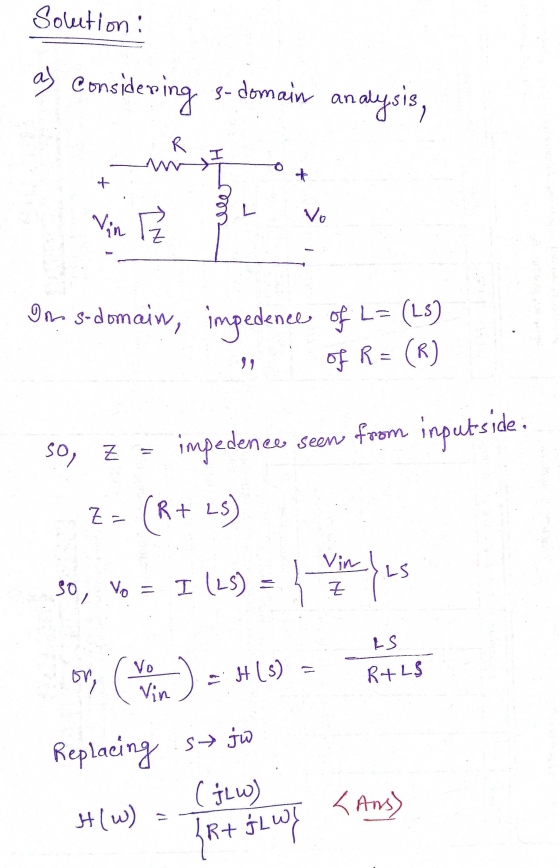
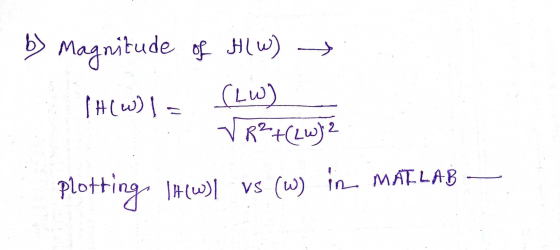
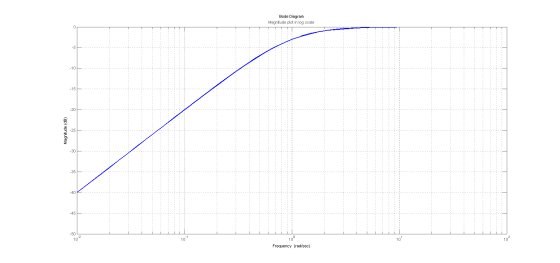
Plot: (Considering L =1H , R = 1 ohm)

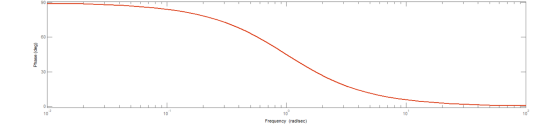
Plot:
Add Answer to:
Problem 1: /25 For the circuit shown below, use frequency-domain circuit analysis techniques to determine (a)...
Problem 3: /25 For the circuit shown below, use frequency-domain circuit analysis techniques to determine (a)...
 Problem 3: /25 For the circuit shown below, use frequency-domain circuit analysis techniques to determine (a) the voltage transfer function Ho) of the circuit; (b) the magnitude response H(@) of the circuit; and (c) the phase response (0) of the circuit. (d) Based on the results of parts (a) - (c), identify the type of filter circuit shown. с R + + Vin(t) 0000 L Vout(t)
Problem 4: /25 For the circuit shown below, use frequency-domain circuit analysis techniques to determine (a)...
 Problem 4: /25 For the circuit shown below, use frequency-domain circuit analysis techniques to determine (a) the voltage transfer function Hw) of the circuit; (b) the magnitude response H(o) of the circuit; and (c) the phase response (0) of the circuit. (d) Based on the results of parts (a) - (c), identify the type of filter circuit shown. R L 10000 + + Vout(t)
Problem 2: /25 For the circuit shown below, use frequency-domain circuit analysis techniques to determine (a)...
 Problem 2: /25 For the circuit shown below, use frequency-domain circuit analysis techniques to determine (a) the voltage transfer function H(o) of the circuit; (b) the magnitude response H(o) of the circuit; and (c) the phase response (0) of the circuit. (d) Based on the results of parts (a) - (c), identify the type of filter circuit shown. L 10000 + + R Vout(t)
the circuit shown, 1. Find the transfer function H(jw) 2. If R R2 12 and L1mH, plot the frequency response (both the ga...
 the circuit shown, 1. Find the transfer function H(jw) 2. If R R2 12 and L1mH, plot the frequency response (both the gain and the phase shift) of the circuit; 3. Identify the type of filter the circuit is, and state the break (cut off) frequency. R1 v(t)Vcos(ut) L1 R2 Figure 1
the circuit shown, 1. Find the transfer function H(jw) 2. If R R2 12 and L1mH, plot the frequency response (both the gain and the phase shift) of...
the circuit shown, 1. Find the transfer function H(jw) 2. If R R2 12 and L1mH, plot the frequency response (both the gain and the phase shift) of the circuit; 3. Identify the type of filter the circuit is, and state the break (cut off) frequency. R1 v(t)Vcos(ut) L1 R2 Figure 1
the circuit shown, 1. Find the transfer function H(jw) 2. If R R2 12 and L1mH, plot the frequency response (both the gain and the phase shift) of...
Please answer all parts thank you 6. [15 POINTS] Consider a passive low-pass filter as shown...
 Please answer all parts thank
you
6. [15 POINTS] Consider a passive low-pass filter as shown below. 1k2 + - m - + Vin(t) 1 mF Vout(t) a) Derive a transfer function for the above circuit. b) Derive a time-domain expression for the unit impulse response of the circuit. Also, plot the impulse response as a function of time. c) Derive a time-domain expression for the unit step response of the circuit. Also, plot the step response as a function...
Please answer all parts thank
you
6. [15 POINTS] Consider a passive low-pass filter as shown below. 1k2 + - m - + Vin(t) 1 mF Vout(t) a) Derive a transfer function for the above circuit. b) Derive a time-domain expression for the unit impulse response of the circuit. Also, plot the impulse response as a function of time. c) Derive a time-domain expression for the unit step response of the circuit. Also, plot the step response as a function...
Purpose: Use Laplace transforms to find the time domain response of a RLC band-pass filter to...
 Purpose: Use Laplace transforms to find the time domain response of a RLC band-pass filter to step and impulse inputs Vout Vin L=27 mH For the RLC circuit above Find the s-domain transfer function: Find the impulse response h(t) H(s) = Vout(s)/Vin(s) · These operations must be performed by hand using Laplace transforms, do not use MATLAB or a circuit simulator. We will verify your hand calculations in lab. Hints: To find the transfer function, find the equivalent impedance of...
Question 8: 1. Redraw the circuit shown below with the s domain equivalent models, where V1(t)...
 Question 8: 1. Redraw the circuit shown below with the s domain equivalent models, where V1(t) is a step function from 0 to 1V at t-0 2. Find transfer function in the s domain H( 3. Write the s-domain equation for Vout(s) if V1(s) is a 1V step function. 4. Write the equation of r of the circuit in terms of R's and C 5. Write the equation for the step response in the time domain. 6. You can either...
1. The circuit below, which uses one inductor and two identical resistors, (30 pts] can be...
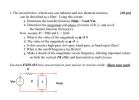 1. The circuit below, which uses one inductor and two identical resistors, (30 pts] can be described as a filter. Using this circuit: a. Determine the transfer function, H(@) = Vout/Vin. b. Determine the magnitude and phase (in terms of R, L, and o) of the transfer function from part a. Now, assume R = 5022 and L = 2mH c. What is the value of the magnitude as 0 0 d. The value of the magnitude as → e....
Problem 4: For the following RLC circuit, R-1.01 kQ, 100 mH and C-0.1 μF. 1. Find...
 Problem 4: For the following RLC circuit, R-1.01 kQ, 100 mH and C-0.1 μF. 1. Find the transfer function H(jo) = Vo(jo)Vi(jo) 2. Find the gain of the transfer function | H(o) 3. Determin 4. Find the phase Ф(c) of the transfer function 5. Find Vo(t) if Vi(t) 100 cos(102 t) +60 cos (101 t) + 10 cos(106t) e the type of the filter. b) c) RVout Lo VoutVin Vin Vin Vin Vout Vout
 Problem 3: /25 For the circuit shown below, use frequency-domain circuit analysis techniques to determine (a) the voltage transfer function Ho) of the circuit; (b) the magnitude response H(@) of the circuit; and (c) the phase response (0) of the circuit. (d) Based on the results of parts (a) - (c), identify the type of filter circuit shown. с R + + Vin(t) 0000 L Vout(t)
 Problem 4: /25 For the circuit shown below, use frequency-domain circuit analysis techniques to determine (a) the voltage transfer function Hw) of the circuit; (b) the magnitude response H(o) of the circuit; and (c) the phase response (0) of the circuit. (d) Based on the results of parts (a) - (c), identify the type of filter circuit shown. R L 10000 + + Vout(t)
 Problem 2: /25 For the circuit shown below, use frequency-domain circuit analysis techniques to determine (a) the voltage transfer function H(o) of the circuit; (b) the magnitude response H(o) of the circuit; and (c) the phase response (0) of the circuit. (d) Based on the results of parts (a) - (c), identify the type of filter circuit shown. L 10000 + + R Vout(t)
 the circuit shown, 1. Find the transfer function H(jw) 2. If R R2 12 and L1mH, plot the frequency response (both the gain and the phase shift) of the circuit; 3. Identify the type of filter the circuit is, and state the break (cut off) frequency. R1 v(t)Vcos(ut) L1 R2 Figure 1
the circuit shown, 1. Find the transfer function H(jw) 2. If R R2 12 and L1mH, plot the frequency response (both the gain and the phase shift) of...
the circuit shown, 1. Find the transfer function H(jw) 2. If R R2 12 and L1mH, plot the frequency response (both the gain and the phase shift) of the circuit; 3. Identify the type of filter the circuit is, and state the break (cut off) frequency. R1 v(t)Vcos(ut) L1 R2 Figure 1
the circuit shown, 1. Find the transfer function H(jw) 2. If R R2 12 and L1mH, plot the frequency response (both the gain and the phase shift) of...
 Please answer all parts thank
you
6. [15 POINTS] Consider a passive low-pass filter as shown below. 1k2 + - m - + Vin(t) 1 mF Vout(t) a) Derive a transfer function for the above circuit. b) Derive a time-domain expression for the unit impulse response of the circuit. Also, plot the impulse response as a function of time. c) Derive a time-domain expression for the unit step response of the circuit. Also, plot the step response as a function...
Please answer all parts thank
you
6. [15 POINTS] Consider a passive low-pass filter as shown below. 1k2 + - m - + Vin(t) 1 mF Vout(t) a) Derive a transfer function for the above circuit. b) Derive a time-domain expression for the unit impulse response of the circuit. Also, plot the impulse response as a function of time. c) Derive a time-domain expression for the unit step response of the circuit. Also, plot the step response as a function...
 Purpose: Use Laplace transforms to find the time domain response of a RLC band-pass filter to step and impulse inputs Vout Vin L=27 mH For the RLC circuit above Find the s-domain transfer function: Find the impulse response h(t) H(s) = Vout(s)/Vin(s) · These operations must be performed by hand using Laplace transforms, do not use MATLAB or a circuit simulator. We will verify your hand calculations in lab. Hints: To find the transfer function, find the equivalent impedance of...
 Question 8: 1. Redraw the circuit shown below with the s domain equivalent models, where V1(t) is a step function from 0 to 1V at t-0 2. Find transfer function in the s domain H( 3. Write the s-domain equation for Vout(s) if V1(s) is a 1V step function. 4. Write the equation of r of the circuit in terms of R's and C 5. Write the equation for the step response in the time domain. 6. You can either...
 1. The circuit below, which uses one inductor and two identical resistors, (30 pts] can be described as a filter. Using this circuit: a. Determine the transfer function, H(@) = Vout/Vin. b. Determine the magnitude and phase (in terms of R, L, and o) of the transfer function from part a. Now, assume R = 5022 and L = 2mH c. What is the value of the magnitude as 0 0 d. The value of the magnitude as → e....
 Problem 4: For the following RLC circuit, R-1.01 kQ, 100 mH and C-0.1 μF. 1. Find the transfer function H(jo) = Vo(jo)Vi(jo) 2. Find the gain of the transfer function | H(o) 3. Determin 4. Find the phase Ф(c) of the transfer function 5. Find Vo(t) if Vi(t) 100 cos(102 t) +60 cos (101 t) + 10 cos(106t) e the type of the filter. b) c) RVout Lo VoutVin Vin Vin Vin Vout Vout
Most questions answered within 3 hours.
-
Where is the error in this code sequence?
String s1 = "Hello";
String s2 = "ello";...
asked 10 months ago -
Financial data for Joel de Paris, Inc., for last year
follow:
Joel de Paris, Inc.
Balance...
asked 10 months ago -
Consider this reaction:
Al2(SO4)3 (aq)+ BaCl3
(aq) Al2Cl6 (aq)- +
3BaSO4(s) . What is the...
asked 10 months ago -
Suppose that Savneet is considering increasing her
recent random sample from 20 car rentals to 40...
asked 10 months ago -
Trucks arrive at an unloading terminal at an average rate of 120
per hour.
Trucks arrive...
asked 10 months ago -
Why are methanol and ethanol completely soluble in water while
octanol is not very little soluble....
asked 10 months ago -
A facilities manager at a university reads in a research report
that the mean amount of...
asked 10 months ago -
When the CuSO4 is rehydrated by adding water to the anhydrous
compound, is this an endothermic...
asked 10 months ago -
A ray of sunlight is passing from diamond into crown glass; the
angle of incidence is...
asked 10 months ago -
A block of mass 0.249 kg is placed on top of a light, vertical
spring of...
asked 10 months ago -
how do the kidneys compensate in the presences of acidosis
a) trigger hyperventilate
b) reserve acid...
asked 10 months ago -
Question 501 pts
The rental rate of capital to the firm increases. Which of the
following...
asked 10 months ago