
Homework Answers

Add Answer to:
A hot fluid of specific heat 4100 J/kg K flows through a parallel flow heat exchanger...
Hot water flows thorough a parallel flow heat exchanger at a rate of 10 kg/min and...
Hot water flows thorough a parallel flow heat exchanger at a rate of 10 kg/min and is cooled by a cold water stream of flow rate 25 kg/min. The inlet temperatures of hot and cold water streams are 70 oC and 25 oC, respectively. The outlet temperature of the hot water is expected to be 50 oC. The individual convective heat transfer coefficient on both sides of the heat transfer area is 600 W/m2 .K. Take the specific heat for...
Determine the effectiveness of the concentric tube heat exchanger. The working fluid through the heat exchanger...
 Determine the effectiveness of the concentric tube heat exchanger. The working fluid through the heat exchanger is water and is flowing at 1 m/min for both cold and hot pipes. The hot water temperature at the tube inlet is 90°C and the temperature at the tube outlet is 60°C. The cold water temperature at the tube inlet is 50°C and the temperature at the tube outlet is 80°C. Assume the density and the specific heat of water are 988.1 kg/m3...
[10] Design Problem As shown in the figure below, a double-pipe parallel-flow heat exchanger is used...
 [10] Design Problem As shown in the figure below, a double-pipe parallel-flow heat exchanger is used to heat cold fluid which is water (Cp = 4180 J/(kg.K), p = 1000 kg/m) from 20°C to 80°C at a rate of 0.15 kg/s. The heating is to be accomplished by hot fluid, which is geothermal water (Cp = 4310 J/(kg.K), p = 1050 kg/m²) available at 130°C at a mass flow rate of 0.25 kg/s. The inner tube has an inner diameter...
11.20 Heat exchanger of counter flow arrangement with temperatures at inlet of hot and cold fluids...
 11.20 Heat exchanger of counter flow arrangement with temperatures at inlet of hot and cold fluids are (200°C) and (60°C) gave outlet temperature of (110°C) for both sides as the surfaces were clean. After long time of use for same the inlet temperatures and flow rate, the hot fluid outlet was (130°C). Find the change in the overall heat transfer coefficient and the heat transfer values by percentage. Ans.: -37.4%, -22.2% 11.21 A liquid with a specific heat of (3200J/kg....
A heat exchanger is to cool oil (specific heat 2200 J/kg K) at a mass flow...
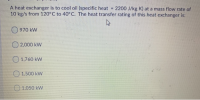 A heat exchanger is to cool oil (specific heat 2200 J/kg K) at a mass flow rate of 10 kg/s from 120°C to 40°C. The heat transfer rating of this heat exchanger is: 970 kW 2,000 kW O 1,760 kW 1,500 kW 1,050 kW
An engineer operates a counter-flow shell-and-tube heat exchanger. It is known that the A fluid (specific...
An engineer operates a counter-flow shell-and-tube heat exchanger. It is known that the A fluid (specific heat is 1.0 J/g*°C) flows into the outside of the tube at a mass flow rate of 100 g/hr. The inlet temperature is 90 ° C and the outlet temperature is At 70 ° C, the B fluid flows into the tube. The inlet temperature is 20 ° C and the outlet temperature is 65 ° C. If the heat transfer effective area is...
this problem in heat exchanger, please solve. . In a parallel flow heat exchanger, hot liquid...
 this problem in heat exchanger, please solve.
. In a parallel flow heat exchanger, hot liquid enters at 400°C and leaves at 250°C. Cold fluid enters at 50°C and leaves at 110°C. The inside and outside heat transfer coefficients are 120W/m2 K and 190 W/m2 K respectively. The inside and outside diameters of tube are 0.06 m and 0.08 m respectively. If the heat transferred per hour is 1.6x 10⁵ kJ. Determine the length of tube required. Ans:12.5 m
this problem in heat exchanger, please solve.
. In a parallel flow heat exchanger, hot liquid enters at 400°C and leaves at 250°C. Cold fluid enters at 50°C and leaves at 110°C. The inside and outside heat transfer coefficients are 120W/m2 K and 190 W/m2 K respectively. The inside and outside diameters of tube are 0.06 m and 0.08 m respectively. If the heat transferred per hour is 1.6x 10⁵ kJ. Determine the length of tube required. Ans:12.5 m
A heat exchanger is being investigated as a waste heat recovery device. A heat exchanger is commo...
A heat exchanger is being investigated as a waste heat recovery device. A heat exchanger is common device for using a hot fluid to heat a cold fluid without the fluids mixing. The cold fluid stream of liquid A enters at 294.2 K and leaves the device at a temperature of 330.91 K. Liquid A flows at a rate of 0.006 Kg/s and has a specific heat of 4180 J/(Kg K) and a specific volume of 0.00102 m3/Kg. Liquid B...
Consider a cross-flow heat exchanger with a surface area of 10 m². The cold fluid has...
 Consider a cross-flow heat exchanger with a surface area of 10 m². The cold fluid has a heat capacity rate of 2310 W/K and inlet and outlet temperatures of 25°C and 150°C respectively. The hot fluid has a heat capacity rate of 2000 W/K and an inlet temperature of 325°C. If the cold fluid can be considered mixed and the hot fluid unmixed, find the overall heat transfer coefficient, u, in W/m2.K, and the outlet temperature, in °C, of the...
Tubular heat exchanger design A liquid food (with specific heat 3.9 kJ/[kg °C]) flows in the...
Tubular heat exchanger design A liquid food (with specific heat 3.9 kJ/[kg °C]) flows in the inner pipe of a double pipe heat exchanger. The liquid food enters the heat exchanger at 72°C and exits at 6°C at a flow rate of 0.5 kg/s. In the annular section, cold water at 2°C enters the heat exchanger and flows concurrently at a flow rate of 12 kg/s. The average specific heat of water is 4.10 kJ/(kg °C). Assuming steady-state conditions. a)...
 Determine the effectiveness of the concentric tube heat exchanger. The working fluid through the heat exchanger is water and is flowing at 1 m/min for both cold and hot pipes. The hot water temperature at the tube inlet is 90°C and the temperature at the tube outlet is 60°C. The cold water temperature at the tube inlet is 50°C and the temperature at the tube outlet is 80°C. Assume the density and the specific heat of water are 988.1 kg/m3...
 [10] Design Problem As shown in the figure below, a double-pipe parallel-flow heat exchanger is used to heat cold fluid which is water (Cp = 4180 J/(kg.K), p = 1000 kg/m) from 20°C to 80°C at a rate of 0.15 kg/s. The heating is to be accomplished by hot fluid, which is geothermal water (Cp = 4310 J/(kg.K), p = 1050 kg/m²) available at 130°C at a mass flow rate of 0.25 kg/s. The inner tube has an inner diameter...
 11.20 Heat exchanger of counter flow arrangement with temperatures at inlet of hot and cold fluids are (200°C) and (60°C) gave outlet temperature of (110°C) for both sides as the surfaces were clean. After long time of use for same the inlet temperatures and flow rate, the hot fluid outlet was (130°C). Find the change in the overall heat transfer coefficient and the heat transfer values by percentage. Ans.: -37.4%, -22.2% 11.21 A liquid with a specific heat of (3200J/kg....
 A heat exchanger is to cool oil (specific heat 2200 J/kg K) at a mass flow rate of 10 kg/s from 120°C to 40°C. The heat transfer rating of this heat exchanger is: 970 kW 2,000 kW O 1,760 kW 1,500 kW 1,050 kW
 this problem in heat exchanger, please solve.
. In a parallel flow heat exchanger, hot liquid enters at 400°C and leaves at 250°C. Cold fluid enters at 50°C and leaves at 110°C. The inside and outside heat transfer coefficients are 120W/m2 K and 190 W/m2 K respectively. The inside and outside diameters of tube are 0.06 m and 0.08 m respectively. If the heat transferred per hour is 1.6x 10⁵ kJ. Determine the length of tube required. Ans:12.5 m
this problem in heat exchanger, please solve.
. In a parallel flow heat exchanger, hot liquid enters at 400°C and leaves at 250°C. Cold fluid enters at 50°C and leaves at 110°C. The inside and outside heat transfer coefficients are 120W/m2 K and 190 W/m2 K respectively. The inside and outside diameters of tube are 0.06 m and 0.08 m respectively. If the heat transferred per hour is 1.6x 10⁵ kJ. Determine the length of tube required. Ans:12.5 m
 Consider a cross-flow heat exchanger with a surface area of 10 m². The cold fluid has a heat capacity rate of 2310 W/K and inlet and outlet temperatures of 25°C and 150°C respectively. The hot fluid has a heat capacity rate of 2000 W/K and an inlet temperature of 325°C. If the cold fluid can be considered mixed and the hot fluid unmixed, find the overall heat transfer coefficient, u, in W/m2.K, and the outlet temperature, in °C, of the...
Most questions answered within 3 hours.
-
Where is the error in this code sequence?
String s1 = "Hello";
String s2 = "ello";...
asked 11 months ago -
Financial data for Joel de Paris, Inc., for last year
follow:
Joel de Paris, Inc.
Balance...
asked 11 months ago -
Consider this reaction:
Al2(SO4)3 (aq)+ BaCl3
(aq) Al2Cl6 (aq)- +
3BaSO4(s) . What is the...
asked 11 months ago -
Suppose that Savneet is considering increasing her
recent random sample from 20 car rentals to 40...
asked 11 months ago -
Trucks arrive at an unloading terminal at an average rate of 120
per hour.
Trucks arrive...
asked 11 months ago -
Why are methanol and ethanol completely soluble in water while
octanol is not very little soluble....
asked 11 months ago -
A facilities manager at a university reads in a research report
that the mean amount of...
asked 11 months ago -
When the CuSO4 is rehydrated by adding water to the anhydrous
compound, is this an endothermic...
asked 11 months ago -
A ray of sunlight is passing from diamond into crown glass; the
angle of incidence is...
asked 11 months ago -
A block of mass 0.249 kg is placed on top of a light, vertical
spring of...
asked 11 months ago -
how do the kidneys compensate in the presences of acidosis
a) trigger hyperventilate
b) reserve acid...
asked 11 months ago -
Question 501 pts
The rental rate of capital to the firm increases. Which of the
following...
asked 11 months ago