Using Kirchhoff’s Laws in the circuit below, you obtained these
equations. Solve for I1, I2, and I3. Show all procedure. 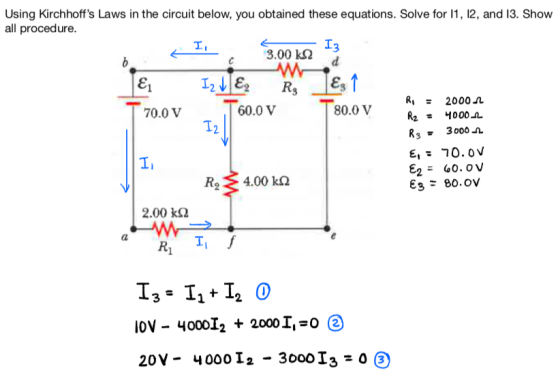
Homework Answers
Add Answer to:
Using Kirchhoff’s Laws in the circuit below, you obtained theseequations. Solve for I1, I2, and...
Using Kirchhoff's Laws, find the currents I1, I2, and I3 in the circuit shown
 Using Kirchhoff's Laws, find the currents I1, I2, and I3 in the circuit shown. Hint: Use both junction rule and voltage rule from the two loops.
For the circuit shown in the figure below,we wish to find the currents I1, I2, and...
 For the circuit shown in the figure below,we wish to find the
currents I1, I2, and
I3.
(a) Use Kirchhoff's rules to complete the equation for the upper
loop. (Use any variable or symbol stated above as necessary. All
currents are given in amperes. Do not enter any units.)
30 V =?
(b) Use Kirchhoff's rules to complete the equation for the lower
loop. (Use any variable or symbol stated above as necessary. All
currents are given in amperes. Do...
For the circuit shown in the figure below,we wish to find the
currents I1, I2, and
I3.
(a) Use Kirchhoff's rules to complete the equation for the upper
loop. (Use any variable or symbol stated above as necessary. All
currents are given in amperes. Do not enter any units.)
30 V =?
(b) Use Kirchhoff's rules to complete the equation for the lower
loop. (Use any variable or symbol stated above as necessary. All
currents are given in amperes. Do...
Solve for the currents I1, I2, and I3 Answers: I1 = 2.87A , I2 = -0.42A...
 Solve for the currents I1, I2, and
I3
Answers: I1 = 2.87A , I2 = -0.42A ,
I3 = 3.29A
Answers are provided but I do not know how to solve for them.
Please show work and explanations if possible.
Solve for the currents I1, I2, and
I3
Answers: I1 = 2.87A , I2 = -0.42A ,
I3 = 3.29A
Answers are provided but I do not know how to solve for them.
Please show work and explanations if possible.
Consider the circuit shown below. All resistances are in Ohms.
 1a) Mesh AnalysisConsider the circuit shown below. All resistances are in Ohms. i) Write down the KVL in the super mesh based on the mesh currents (i1, i2 and i3) given on the circuit. Do not solve the equations. ii) Write down other equations in terms of mesh currents (i1, i2 and i3) arising from the circuit that will allow you to solve the circuit.
At a Circuit Node, where I1 is defined as the Input Current at the node, I2...
At a Circuit Node, where I1 is defined as the Input Current at the node, I2 is an Output Current at the node and I3 is an Output Current at the node, which of the following is true due to KCL? I1 = I2 + I3 I1 = I2 – I3 I1 = 2* (I2 – I3) I1 = I2 / I3
For the DC circuit shown here, Kirchhoff’s Rules and Ohm’s Law tell us the following relationships...
For the DC circuit shown here, Kirchhoff’s Rules and Ohm’s Law tell us the following relationships between the currents I1, I2, I3, I4, the resistances R1, R2, R3, and the voltage V provided by the battery: I2+ I3=I1 I2+ I3=I4 I1R1+ I3R3=V I1R1+ I2R2=V Write a function find_current.m which takes as inputs the values for V , R1, R2, and R3, and returns as output a column vector containing the values of the currents I1, I2, I3, I4, in that...
Consider the circuit shown in the figure below. Calculate the currents I1, I2, and I3.
 Consider the circuit shown in the figure below. Calculate the currents I1, I2, and I3.
1. The op amp in the circuit above is ideal. Solve for the i1, i2, i3,...
 1.
The op amp in the circuit above is ideal. Solve for the
i1, i2,
i3, andVo.
is 40 kΩ 5 kΩ Ο Ι + 2V 1VI -I -16V υξ10 ΚΩ
1.
The op amp in the circuit above is ideal. Solve for the
i1, i2,
i3, andVo.
is 40 kΩ 5 kΩ Ο Ι + 2V 1VI -I -16V υξ10 ΚΩ
The following equations describe an electric circuit. −I1(233 Ω) + 5.80 V − I2(389 Ω) =...
The following equations describe an electric circuit. −I1(233 Ω) + 5.80 V − I2(389 Ω) = 0 I2(389 Ω) + I3(150 Ω) − 3.10 V = 0 I1 + I3 − I2 = 0 Calculate the unknowns (in mA). With respect to the 5.8 V battery, consider current moving toward the positive pole as positive and current moving toward the negative pole as negative. I1= ________mA I2= ________mA I3= ________mA
The following equations describe an electric circuit. −I1(236 Ω) + 5.80 V − I2(400 Ω) =...
The following equations describe an electric circuit. −I1(236 Ω) + 5.80 V − I2(400 Ω) = 0 I2(400 Ω) + I3(150 Ω) − 3.10 V = 0 I1 + I3 − I2 = 0 (a) Draw diagram of the circuit. Identify the physical meaning of each unknown on your drawing. (b) Calculate the unknowns (in mA). With respect to the 5.8 V battery, consider current moving toward the positive pole as positive and current moving toward the negative pole as...
 For the circuit shown in the figure below,we wish to find the
currents I1, I2, and
I3.
(a) Use Kirchhoff's rules to complete the equation for the upper
loop. (Use any variable or symbol stated above as necessary. All
currents are given in amperes. Do not enter any units.)
30 V =?
(b) Use Kirchhoff's rules to complete the equation for the lower
loop. (Use any variable or symbol stated above as necessary. All
currents are given in amperes. Do...
For the circuit shown in the figure below,we wish to find the
currents I1, I2, and
I3.
(a) Use Kirchhoff's rules to complete the equation for the upper
loop. (Use any variable or symbol stated above as necessary. All
currents are given in amperes. Do not enter any units.)
30 V =?
(b) Use Kirchhoff's rules to complete the equation for the lower
loop. (Use any variable or symbol stated above as necessary. All
currents are given in amperes. Do...
 Solve for the currents I1, I2, and
I3
Answers: I1 = 2.87A , I2 = -0.42A ,
I3 = 3.29A
Answers are provided but I do not know how to solve for them.
Please show work and explanations if possible.
Solve for the currents I1, I2, and
I3
Answers: I1 = 2.87A , I2 = -0.42A ,
I3 = 3.29A
Answers are provided but I do not know how to solve for them.
Please show work and explanations if possible.
 Consider the circuit shown in the figure below. Calculate the currents I1, I2, and I3.
 1.
The op amp in the circuit above is ideal. Solve for the
i1, i2,
i3, andVo.
is 40 kΩ 5 kΩ Ο Ι + 2V 1VI -I -16V υξ10 ΚΩ
1.
The op amp in the circuit above is ideal. Solve for the
i1, i2,
i3, andVo.
is 40 kΩ 5 kΩ Ο Ι + 2V 1VI -I -16V υξ10 ΚΩ
Most questions answered within 3 hours.
-
Where is the error in this code sequence?
String s1 = "Hello";
String s2 = "ello";...
asked 10 months ago -
Financial data for Joel de Paris, Inc., for last year
follow:
Joel de Paris, Inc.
Balance...
asked 10 months ago -
Consider this reaction:
Al2(SO4)3 (aq)+ BaCl3
(aq) Al2Cl6 (aq)- +
3BaSO4(s) . What is the...
asked 10 months ago -
Suppose that Savneet is considering increasing her
recent random sample from 20 car rentals to 40...
asked 10 months ago -
Trucks arrive at an unloading terminal at an average rate of 120
per hour.
Trucks arrive...
asked 10 months ago -
Why are methanol and ethanol completely soluble in water while
octanol is not very little soluble....
asked 10 months ago -
A facilities manager at a university reads in a research report
that the mean amount of...
asked 10 months ago -
When the CuSO4 is rehydrated by adding water to the anhydrous
compound, is this an endothermic...
asked 10 months ago -
A ray of sunlight is passing from diamond into crown glass; the
angle of incidence is...
asked 10 months ago -
A block of mass 0.249 kg is placed on top of a light, vertical
spring of...
asked 10 months ago -
how do the kidneys compensate in the presences of acidosis
a) trigger hyperventilate
b) reserve acid...
asked 10 months ago -
Question 501 pts
The rental rate of capital to the firm increases. Which of the
following...
asked 10 months ago