
Homework Answers
Add Answer to:
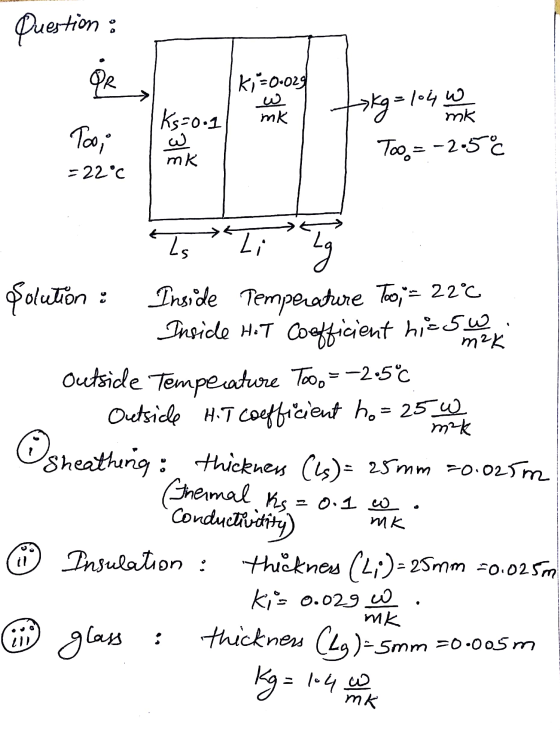
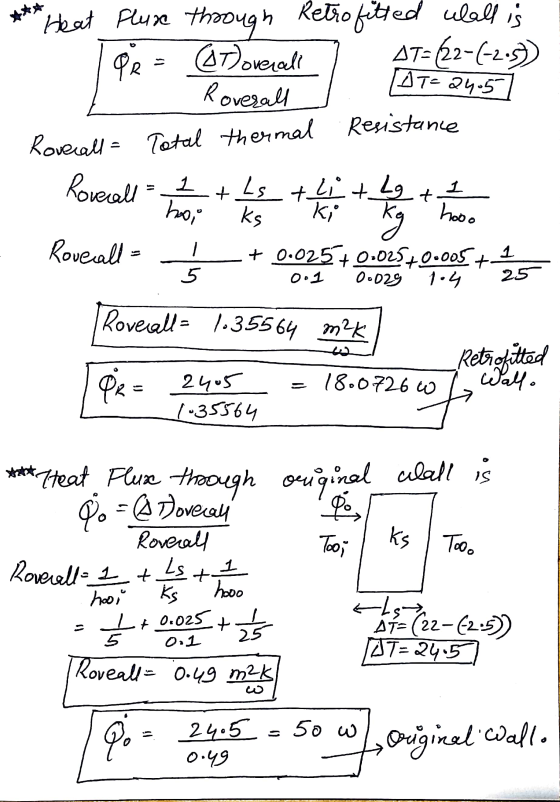
A dormitory at a large university, built 50 years ago, has exterior walls constructed of L,...
Questions 6-9 The walls of a refrigerator are typically constructed by sandwiching a layer of insulation...
 Questions 6-9 The walls of a refrigerator are typically constructed by sandwiching a layer of insulation between sheet metal panels. Consider a wall made from fiberglass insulation of thermal conductivity ki = 0.046 W/mK and thickness Li 50 mm and steel panels, each of thermal conductivity kp = 60 W/m. K and thickness Lp = 3 mm. If the wall separates refrigerated air at Too,i = 4°C from ambient air at T0o,0 = 25°C, what is the heat gain per...
A house has a composite wall of wood (exterior) (k = 0.12 W m-1 K -1...
A house has a composite wall of wood (exterior) (k = 0.12 W m-1 K -1 , 20 mm thick), fibreglass insulation (k = 0.045 W m-1 K -1 , 70 mm thick) and plasterboard (interior) (k = 0.25 W m-1 K -1 , 10 mm thick). Determine the total heat loss through the wall when the inside temperature is 20 °C, the outside temperature is -10 °C, the inside heat transfer coefficient is 15 W m-2 K -1, and...
A cylindrical hot water tank has thermal insulation between an inner and an outer wall of...
A cylindrical hot water tank has thermal insulation between an inner and an outer wall of thin metal sheets, both on the sidewalls and the end walls. The inner diameter and height is 0.95 m and 2.6 m respectively. The insulation thickness is 64 mm and its thermal conductivity is λ = 0.051 [W/mK]. The inner wall consists of 3.0 mm stainless steel with λ = 25 [W/mK], and the outer wall consists of 1.3 mm steel sheet with λ...
Hot CO2 gas at a temperature T-1 = 250°C is flowing through a steel pipe (kı...
 Hot CO2 gas at a temperature T-1 = 250°C is flowing through a steel pipe (kı = 70 W/(m.K)) whose inner and outer radiuses are 12 cm and 14 cm, respectively, in a cold environment at Tm2 = -10°C. As shown in the figure below, the steel pipe is insulated with 7.0 cm thick spray-foam insulation (k2 = 0.03 W/(m.K)) and 5.0 cm thick glassfiber insulation (k3 = 0.05 W/(m.K)). Consider the heat transfer coefficients of CO2 gas and the...
Problem 3.002 x Your answer is incorrect. Try again. A new building to be located in...
 Problem 3.002 x Your answer is incorrect. Try again. A new building to be located in a cold climate is being designed with a basement that has an L-200-mm-thick wall. Inner and outer basement wall temperatures are T- 20°C and T. 0°C, respectively. The architect can specify the wall material to be either aerated concrete block with kac = 0.45 W/mK, or stone mix concrete. To reduce the conduction heat flux through the stone mix wall to a level equivalent...
1. one wall is formed by two materials, the first one is 15cm thick and has...
 1. one wall is formed by two materials, the first one is 15cm thick and has a thermal conductivity of 1W/mk and the second one is cork with an unknown thick. If the temperature of the inner wall is 22°C and the temperature of the outer surface is -10°C find: a) the necessary thick of the cork to maintain a heat loss of 8W. Consider an area of 1m2! b) the interface temperature. Note: use a scheme that represents the...
Please show steps, thank you A4: A refrigerator door has a height and width of H...
 Please show steps, thank you
A4: A refrigerator door has a height and width of H = 1 m and W = 0.65 m, respectively, and is situated in a large room for which the air and walls are at T. = Tu = 25°C. The door consists of a layer of polystyrene insulation (k = 0.03 W/m $ K) sandwiched between thin sheets of steel (E = 0.6) and polypropylene. Under normal operating conditions, the inner surface of the...
Please show steps, thank you
A4: A refrigerator door has a height and width of H = 1 m and W = 0.65 m, respectively, and is situated in a large room for which the air and walls are at T. = Tu = 25°C. The door consists of a layer of polystyrene insulation (k = 0.03 W/m $ K) sandwiched between thin sheets of steel (E = 0.6) and polypropylene. Under normal operating conditions, the inner surface of the...
The one-dimensional plane wall, shown in the figure below, is of thickness L =75 mm and...
 The one-dimensional plane wall, shown in the figure below, is of thickness L =75 mm and thermal conductivity k = 15 W/ mK. The fluid temperatures are T, 200°C and T2 = 100°C, respectively. Using the minimum and maximum typical values of the convection heat! transfer coefficients listed in the table below, determine the minimum and maximum steady-state heat fluxes through the wall for free convection in gases and free convection in liquids. Typical values of the convection heat transfer...
P1 (50 pts.) - A large plane wall has a thickness L-60 cm and thermal conductivity...
 P1 (50 pts.) - A large plane wall has a thickness L-60 cm and thermal conductivity k 25 W/m-K. On the left surface (x-0), it is subjected to a uniform heat flux qo while the surface temperature To is constant. On the right surface, it experiences convection and radiation heat transfer while the surface temperature is TL-225°C and the surrounding temperature is 25°C. The emissivity and the convection heat transfer coefficient on the right surface are 0.7 and 15 W/m2-K,...
A flue passing hot exhaust gases has a square cross section, 300 mm to a side....
 A flue passing hot exhaust gases has a square cross section, 300
mm to a side. The walls are constructed of refractory brick 150 mm
thick with a thermal conductivity of 1.6 W/m·K. Calculate the heat
loss from the flue per unit length when the interior and exterior
surfaces are maintained at 350 and 25°C, respectively. Use a grid
spacing of 75 mm. Assume the temperature in nodes 2 and 3 are given
as T2 = 108.3°C, T3 =
162.2°C....
A flue passing hot exhaust gases has a square cross section, 300
mm to a side. The walls are constructed of refractory brick 150 mm
thick with a thermal conductivity of 1.6 W/m·K. Calculate the heat
loss from the flue per unit length when the interior and exterior
surfaces are maintained at 350 and 25°C, respectively. Use a grid
spacing of 75 mm. Assume the temperature in nodes 2 and 3 are given
as T2 = 108.3°C, T3 =
162.2°C....
 Questions 6-9 The walls of a refrigerator are typically constructed by sandwiching a layer of insulation between sheet metal panels. Consider a wall made from fiberglass insulation of thermal conductivity ki = 0.046 W/mK and thickness Li 50 mm and steel panels, each of thermal conductivity kp = 60 W/m. K and thickness Lp = 3 mm. If the wall separates refrigerated air at Too,i = 4°C from ambient air at T0o,0 = 25°C, what is the heat gain per...
 Hot CO2 gas at a temperature T-1 = 250°C is flowing through a steel pipe (kı = 70 W/(m.K)) whose inner and outer radiuses are 12 cm and 14 cm, respectively, in a cold environment at Tm2 = -10°C. As shown in the figure below, the steel pipe is insulated with 7.0 cm thick spray-foam insulation (k2 = 0.03 W/(m.K)) and 5.0 cm thick glassfiber insulation (k3 = 0.05 W/(m.K)). Consider the heat transfer coefficients of CO2 gas and the...
 Problem 3.002 x Your answer is incorrect. Try again. A new building to be located in a cold climate is being designed with a basement that has an L-200-mm-thick wall. Inner and outer basement wall temperatures are T- 20°C and T. 0°C, respectively. The architect can specify the wall material to be either aerated concrete block with kac = 0.45 W/mK, or stone mix concrete. To reduce the conduction heat flux through the stone mix wall to a level equivalent...
 1. one wall is formed by two materials, the first one is 15cm thick and has a thermal conductivity of 1W/mk and the second one is cork with an unknown thick. If the temperature of the inner wall is 22°C and the temperature of the outer surface is -10°C find: a) the necessary thick of the cork to maintain a heat loss of 8W. Consider an area of 1m2! b) the interface temperature. Note: use a scheme that represents the...
 Please show steps, thank you
A4: A refrigerator door has a height and width of H = 1 m and W = 0.65 m, respectively, and is situated in a large room for which the air and walls are at T. = Tu = 25°C. The door consists of a layer of polystyrene insulation (k = 0.03 W/m $ K) sandwiched between thin sheets of steel (E = 0.6) and polypropylene. Under normal operating conditions, the inner surface of the...
Please show steps, thank you
A4: A refrigerator door has a height and width of H = 1 m and W = 0.65 m, respectively, and is situated in a large room for which the air and walls are at T. = Tu = 25°C. The door consists of a layer of polystyrene insulation (k = 0.03 W/m $ K) sandwiched between thin sheets of steel (E = 0.6) and polypropylene. Under normal operating conditions, the inner surface of the...
 The one-dimensional plane wall, shown in the figure below, is of thickness L =75 mm and thermal conductivity k = 15 W/ mK. The fluid temperatures are T, 200°C and T2 = 100°C, respectively. Using the minimum and maximum typical values of the convection heat! transfer coefficients listed in the table below, determine the minimum and maximum steady-state heat fluxes through the wall for free convection in gases and free convection in liquids. Typical values of the convection heat transfer...
 P1 (50 pts.) - A large plane wall has a thickness L-60 cm and thermal conductivity k 25 W/m-K. On the left surface (x-0), it is subjected to a uniform heat flux qo while the surface temperature To is constant. On the right surface, it experiences convection and radiation heat transfer while the surface temperature is TL-225°C and the surrounding temperature is 25°C. The emissivity and the convection heat transfer coefficient on the right surface are 0.7 and 15 W/m2-K,...
 A flue passing hot exhaust gases has a square cross section, 300
mm to a side. The walls are constructed of refractory brick 150 mm
thick with a thermal conductivity of 1.6 W/m·K. Calculate the heat
loss from the flue per unit length when the interior and exterior
surfaces are maintained at 350 and 25°C, respectively. Use a grid
spacing of 75 mm. Assume the temperature in nodes 2 and 3 are given
as T2 = 108.3°C, T3 =
162.2°C....
A flue passing hot exhaust gases has a square cross section, 300
mm to a side. The walls are constructed of refractory brick 150 mm
thick with a thermal conductivity of 1.6 W/m·K. Calculate the heat
loss from the flue per unit length when the interior and exterior
surfaces are maintained at 350 and 25°C, respectively. Use a grid
spacing of 75 mm. Assume the temperature in nodes 2 and 3 are given
as T2 = 108.3°C, T3 =
162.2°C....
Most questions answered within 3 hours.
-
Where is the error in this code sequence?
String s1 = "Hello";
String s2 = "ello";...
asked 10 months ago -
Financial data for Joel de Paris, Inc., for last year
follow:
Joel de Paris, Inc.
Balance...
asked 10 months ago -
Consider this reaction:
Al2(SO4)3 (aq)+ BaCl3
(aq) Al2Cl6 (aq)- +
3BaSO4(s) . What is the...
asked 10 months ago -
Suppose that Savneet is considering increasing her
recent random sample from 20 car rentals to 40...
asked 10 months ago -
Trucks arrive at an unloading terminal at an average rate of 120
per hour.
Trucks arrive...
asked 10 months ago -
Why are methanol and ethanol completely soluble in water while
octanol is not very little soluble....
asked 10 months ago -
A facilities manager at a university reads in a research report
that the mean amount of...
asked 10 months ago -
When the CuSO4 is rehydrated by adding water to the anhydrous
compound, is this an endothermic...
asked 10 months ago -
A ray of sunlight is passing from diamond into crown glass; the
angle of incidence is...
asked 10 months ago -
A block of mass 0.249 kg is placed on top of a light, vertical
spring of...
asked 10 months ago -
how do the kidneys compensate in the presences of acidosis
a) trigger hyperventilate
b) reserve acid...
asked 10 months ago -
Question 501 pts
The rental rate of capital to the firm increases. Which of the
following...
asked 10 months ago