
Homework Answers
(a) This is a converging lens, because the way rays are moving they will at some point form a real image which a diverging lens can never make.
(b)
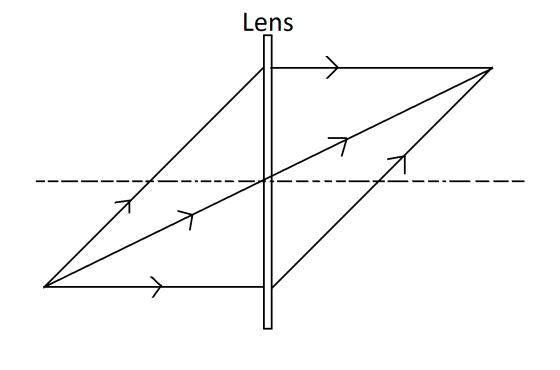
(c) The image formed will be real, as the rays are meeting after passing through the lens. Rays are not appearing to meet but are really meeting.
Add Answer to:
The vertical rectangle in the figure represents a thin lens. The dashed line is the optical...
Could you explain how to figure out what lens or mirror is used from these two...
 Could you explain how to figure out what lens or mirror is
used from these two principal rays?
5. A mirror or lens is placed at the location of the gray box. The solid black indicates the optical axis. The dashed vertical line is the location of the optical device. Each box represents 1.00 cm. Two principal rays from the tip of the object are shown. → a. Which type of optical device is used here? i. Concave mirror ii....
Could you explain how to figure out what lens or mirror is
used from these two principal rays?
5. A mirror or lens is placed at the location of the gray box. The solid black indicates the optical axis. The dashed vertical line is the location of the optical device. Each box represents 1.00 cm. Two principal rays from the tip of the object are shown. → a. Which type of optical device is used here? i. Concave mirror ii....
Ray Optics 4 Problem Statement A thin converging lens is found to form an image of...
 Ray Optics 4 Problem Statement A thin converging lens is found to form an image of a distant building 24 cm from the lens. If an insect is now placed 16 cm from this lens, how far FROM THE INSECT will its image be formed? Visual Representation • Draw an optical axis with the lens centered on the axis. • Represent the object at the correct distance from the lens • Draw the three "special rays" from the top of...
Ray Optics 4 Problem Statement A thin converging lens is found to form an image of...
 Ray Optics 4 Problem Statement A thin converging lens is found to form an image of a distant building 24 cm from the lens. If an insect is now placed 16 cm from this lens, how far FROM THE INSECT will its image be formed? Visual Representation • Draw an optical axis with the lens centered on the axis. Represent the object at the correct distance from the lens • Draw the three "special rays" from the top of the...
(optical engr) An optical imaging system includes two thin lenses. The first lens has focal lengt...
(optical engr) An optical imaging system includes two thin lenses. The first lens has focal lengths f1 = 5 cm and f2 = 10 cm. The distance between the 2 lenses is 5 cm. An object with height h = 2.5 cm is placed 15 cm before (to the left of) the first lens. A. Use the lens equations to compute final image location and image size of the object in this two lens optical imaging system B. Plot an...
**Please Do Not Forget The Visual Representation. Thank You!!** Problem Statement A thin converging lens is...
 **Please Do Not Forget The Visual Representation. Thank
You!!**
Problem Statement A thin converging lens is found to form an image of a distant building 24 cm from the lens. If an insect is now placed 16 cm from this lens, how far FROM THE INSECT will its image be formed? Visual Representation Draw an optical axis with the lens centered on the axis. Represent the object at the correct distance from the lens • Draw the three “special rays”...
**Please Do Not Forget The Visual Representation. Thank
You!!**
Problem Statement A thin converging lens is found to form an image of a distant building 24 cm from the lens. If an insect is now placed 16 cm from this lens, how far FROM THE INSECT will its image be formed? Visual Representation Draw an optical axis with the lens centered on the axis. Represent the object at the correct distance from the lens • Draw the three “special rays”...
Problem Statement A thin converging lens is found to form an image of a distant building...
 Problem Statement A thin converging lens is found to form an image of a distant building 24 cm from the lens. If an insect is now placed 16 em from this lens, how far FROM THE INSECT will its image be formed? Visual Representation • Draw an optical axis with the lens centered on the axis. Represent the object at the correct distance from the lens • Draw the three "special rays" from the top of the object Extend the...
A thin converging lens is found to form an image of a distant building 24 cm...
 A thin converging lens is found to form an image of a distant building 24 cm from the lens. If an insect is now placed 16 cm from this lens, how far FROM THE INSECT will its image be formed? • Draw an optical axis with the lens centered on the axis. Represent the object at the correct distance from the lens • Draw the three "special rays” from the top of the object Extend the rays until they converge....
A thin converging lens is found to form an image of a distant building 24 cm...
A thin converging lens is found to form an image of a distant building 24 cm from the lens. If an insect is now placed 16 cm from this lens, how far FROM THE INSECT will its image be formed? Draw an optical axis with the lens centered on the axis. • Represent the object at the correct distance from the lens • Draw the three “special rays” from the top of the object • Extend the rays until they...
A thin converging lens is found to form an image of a distant building 24 cm...
A thin converging lens is found to form an image of a distant building 24 cm from the lens. If an insect is now placed 16 cm from this lens. Draw the Visual Representation Draw an optical axis with the lens centered on the axis. Represent the object at the correct distance from the lens Draw the three “special rays” from the top of the object Extend the rays until they converge. Draw the image.
3. Figure shows an object and its image formed by a thin lens. (a) What is...
 3. Figure shows an object and its image formed by a thin lens. (a) What is the focal length of the lens and what type of lens (converging or diverging) is it? (b) What is the height of the image? Is it real or virtual? Draw a principal-ray diagram showing the formation of the image. -35.0 cm- Optic Object 15 Lens El crn Image 4. Figure shows an object and its image formed by a thin lens. (a) What is...
 Could you explain how to figure out what lens or mirror is
used from these two principal rays?
5. A mirror or lens is placed at the location of the gray box. The solid black indicates the optical axis. The dashed vertical line is the location of the optical device. Each box represents 1.00 cm. Two principal rays from the tip of the object are shown. → a. Which type of optical device is used here? i. Concave mirror ii....
Could you explain how to figure out what lens or mirror is
used from these two principal rays?
5. A mirror or lens is placed at the location of the gray box. The solid black indicates the optical axis. The dashed vertical line is the location of the optical device. Each box represents 1.00 cm. Two principal rays from the tip of the object are shown. → a. Which type of optical device is used here? i. Concave mirror ii....
 Ray Optics 4 Problem Statement A thin converging lens is found to form an image of a distant building 24 cm from the lens. If an insect is now placed 16 cm from this lens, how far FROM THE INSECT will its image be formed? Visual Representation • Draw an optical axis with the lens centered on the axis. • Represent the object at the correct distance from the lens • Draw the three "special rays" from the top of...
 Ray Optics 4 Problem Statement A thin converging lens is found to form an image of a distant building 24 cm from the lens. If an insect is now placed 16 cm from this lens, how far FROM THE INSECT will its image be formed? Visual Representation • Draw an optical axis with the lens centered on the axis. Represent the object at the correct distance from the lens • Draw the three "special rays" from the top of the...
 **Please Do Not Forget The Visual Representation. Thank
You!!**
Problem Statement A thin converging lens is found to form an image of a distant building 24 cm from the lens. If an insect is now placed 16 cm from this lens, how far FROM THE INSECT will its image be formed? Visual Representation Draw an optical axis with the lens centered on the axis. Represent the object at the correct distance from the lens • Draw the three “special rays”...
**Please Do Not Forget The Visual Representation. Thank
You!!**
Problem Statement A thin converging lens is found to form an image of a distant building 24 cm from the lens. If an insect is now placed 16 cm from this lens, how far FROM THE INSECT will its image be formed? Visual Representation Draw an optical axis with the lens centered on the axis. Represent the object at the correct distance from the lens • Draw the three “special rays”...
 Problem Statement A thin converging lens is found to form an image of a distant building 24 cm from the lens. If an insect is now placed 16 em from this lens, how far FROM THE INSECT will its image be formed? Visual Representation • Draw an optical axis with the lens centered on the axis. Represent the object at the correct distance from the lens • Draw the three "special rays" from the top of the object Extend the...
 A thin converging lens is found to form an image of a distant building 24 cm from the lens. If an insect is now placed 16 cm from this lens, how far FROM THE INSECT will its image be formed? • Draw an optical axis with the lens centered on the axis. Represent the object at the correct distance from the lens • Draw the three "special rays” from the top of the object Extend the rays until they converge....
 3. Figure shows an object and its image formed by a thin lens. (a) What is the focal length of the lens and what type of lens (converging or diverging) is it? (b) What is the height of the image? Is it real or virtual? Draw a principal-ray diagram showing the formation of the image. -35.0 cm- Optic Object 15 Lens El crn Image 4. Figure shows an object and its image formed by a thin lens. (a) What is...
Most questions answered within 3 hours.
-
Where is the error in this code sequence?
String s1 = "Hello";
String s2 = "ello";...
asked 10 months ago -
Financial data for Joel de Paris, Inc., for last year
follow:
Joel de Paris, Inc.
Balance...
asked 10 months ago -
Consider this reaction:
Al2(SO4)3 (aq)+ BaCl3
(aq) Al2Cl6 (aq)- +
3BaSO4(s) . What is the...
asked 10 months ago -
Suppose that Savneet is considering increasing her
recent random sample from 20 car rentals to 40...
asked 10 months ago -
Trucks arrive at an unloading terminal at an average rate of 120
per hour.
Trucks arrive...
asked 10 months ago -
Why are methanol and ethanol completely soluble in water while
octanol is not very little soluble....
asked 10 months ago -
A facilities manager at a university reads in a research report
that the mean amount of...
asked 10 months ago -
When the CuSO4 is rehydrated by adding water to the anhydrous
compound, is this an endothermic...
asked 10 months ago -
A ray of sunlight is passing from diamond into crown glass; the
angle of incidence is...
asked 10 months ago -
A block of mass 0.249 kg is placed on top of a light, vertical
spring of...
asked 10 months ago -
how do the kidneys compensate in the presences of acidosis
a) trigger hyperventilate
b) reserve acid...
asked 10 months ago -
Question 501 pts
The rental rate of capital to the firm increases. Which of the
following...
asked 10 months ago