A hydrogen atom is excited to a 3? electronic state. Two photons are emitted, one after...
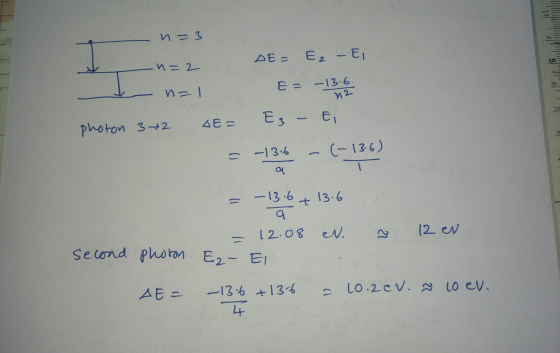
A hydrogen atom is excited to a 3? electronic state. Two photons are emitted, one after the other. For ten points each what are their (positive) energies, in eV (two digit accuracy)
Homework Answers
Add Answer to:
A
hydrogen atom is excited to a 3? electronic state.
Two photons are emitted, one after...
A hydrogen atom is excited to a 3? electronic state. Two photons are emitted, one after...
A hydrogen atom is excited to a 3? electronic state. Two photons are emitted, one after the other. For ten points each, what are their (positive) energies, in eV (two digit accuracy is fine)?
(20 pts) A hydrogen atom is excited to a 3d electronic state. Two photons are emitted,...
 (20 pts) A hydrogen atom is excited to a 3d electronic state. Two photons are emitted, one after the other. For ten points each, what are their (positive) energies, in eV (two digit accuracy is fine)? Photon energy/eV Photon energy/eV
2, (20 pts) A hydrogen atom is excited to a 3d electronic state. Two photons are...
 2, (20 pts) A hydrogen atom is excited to a 3d electronic state. Two photons are emitted, one after the other. For ten points each, what are their (positive) energies, in eV (two digit accuracy is fine)? Photon energy/eV Photon energy/eV
Two photons are emitted right after each other from a Hydrogen atom at the 3d electronic...
Two photons are emitted right after each other from a Hydrogen atom at the 3d electronic state. What are the energies of the two photons (in eV)?
Please show all your work in the space provided. 1. (15 pts) in the LCAO-MO approach,...
 Please show all your work in the space provided. 1. (15 pts) in the LCAO-MO approach, there are three important characteristics that two atomic orbitals, on different atoms, must share in order to come together to form a molecular orbital. What are these three things, for five points each? Condition #1: Condition #2: 2, Condition #3: (20 pts) A hydrogen atom is excited to a 3d electronic state. Two photons are emitted, one after the other. For ten points each,...
An electron in an excited state of a hydrogen atom emits two photons in succession, the...
An electron in an excited state of a hydrogen atom emits two photons in succession, the first at 2624 nm and the second at 97.20 nm, to return to the ground state (n=1). For a given transition, the wavelength of the emitted photon corresponds to the difference in energy between the two energy levels. What were the principal quantum numbers of the initial and intermediate excited states involved?
Electrons in an unknown atom(not hydrogen) are excited from the ground state to the n=3 energy...
Electrons in an unknown atom(not hydrogen) are excited from the ground state to the n=3 energy level. As these electrons make quantum jumps back to the ground state, photons of three different energies are emitted. The most energetic photon has an associated wavelength of 62.2 nm and the least energetic photon has an associated wavelength of 207 nm. What is the associated wavelength of the other type pf photon? The answer is 3-1 (20 eV), 3-2 (6 eV) and 2-1...
A hydrogen atom is excited from its ground state to the n = 3 state. The...
 A hydrogen atom is excited from its ground state to the n = 3 state. The atom subsequently emits two photons. Calculate the longer wavelength photon emitted. Value Units Submit Request Answer Part B Calculate the shorter wavelength photon emitted. MÅ O 2 ? Value Units Submit Request Answer
A H-atom is in an excited state represented by a dot. What are the possible energies...
 A H-atom is in an excited state represented by a dot. What are the possible energies of emitted photons? 10.se -3.4ev -13.6V 0.65 eV, 0.85 eV 0.85 eV, 1.9eV 3.4 eV, 1.9 eV 1.9 eV, 10.2eV 1.9 eV, 10.2eV, 12.1eV QUESTION 2 3.4ev A 12.0 eV electron collides with an H-atom in its ground state. What is the energy of the electron after the collision? -13.6ev 12.0 eV 10.5 eV 8.6 eV 1.8 eV 1.6 eV QUESTION 3 A collection...
For the hydrogen atom, its energy at ground state is 13.6 eV, at first excited state...
 For the hydrogen atom, its energy at ground state is 13.6 eV, at first excited state is 3.4 eV at second excited state is 1.5 eV and at the third excited state is 0.85 eV. i) Give the energy value for the first two states in Joule (J). [1eV =1.6 x 10⁻¹⁹ J] (2 marks) ii) With the aid of schematic diagram, determine the energy of emitted photon when the atom jumps from the first and third excited states to...
 (20 pts) A hydrogen atom is excited to a 3d electronic state. Two photons are emitted, one after the other. For ten points each, what are their (positive) energies, in eV (two digit accuracy is fine)? Photon energy/eV Photon energy/eV
 2, (20 pts) A hydrogen atom is excited to a 3d electronic state. Two photons are emitted, one after the other. For ten points each, what are their (positive) energies, in eV (two digit accuracy is fine)? Photon energy/eV Photon energy/eV
 Please show all your work in the space provided. 1. (15 pts) in the LCAO-MO approach, there are three important characteristics that two atomic orbitals, on different atoms, must share in order to come together to form a molecular orbital. What are these three things, for five points each? Condition #1: Condition #2: 2, Condition #3: (20 pts) A hydrogen atom is excited to a 3d electronic state. Two photons are emitted, one after the other. For ten points each,...
 A hydrogen atom is excited from its ground state to the n = 3 state. The atom subsequently emits two photons. Calculate the longer wavelength photon emitted. Value Units Submit Request Answer Part B Calculate the shorter wavelength photon emitted. MÅ O 2 ? Value Units Submit Request Answer
 A H-atom is in an excited state represented by a dot. What are the possible energies of emitted photons? 10.se -3.4ev -13.6V 0.65 eV, 0.85 eV 0.85 eV, 1.9eV 3.4 eV, 1.9 eV 1.9 eV, 10.2eV 1.9 eV, 10.2eV, 12.1eV QUESTION 2 3.4ev A 12.0 eV electron collides with an H-atom in its ground state. What is the energy of the electron after the collision? -13.6ev 12.0 eV 10.5 eV 8.6 eV 1.8 eV 1.6 eV QUESTION 3 A collection...
 For the hydrogen atom, its energy at ground state is 13.6 eV, at first excited state is 3.4 eV at second excited state is 1.5 eV and at the third excited state is 0.85 eV. i) Give the energy value for the first two states in Joule (J). [1eV =1.6 x 10⁻¹⁹ J] (2 marks) ii) With the aid of schematic diagram, determine the energy of emitted photon when the atom jumps from the first and third excited states to...
Most questions answered within 3 hours.
-
Where is the error in this code sequence?
String s1 = "Hello";
String s2 = "ello";...
asked 10 months ago -
Financial data for Joel de Paris, Inc., for last year
follow:
Joel de Paris, Inc.
Balance...
asked 10 months ago -
Consider this reaction:
Al2(SO4)3 (aq)+ BaCl3
(aq) Al2Cl6 (aq)- +
3BaSO4(s) . What is the...
asked 10 months ago -
Suppose that Savneet is considering increasing her
recent random sample from 20 car rentals to 40...
asked 10 months ago -
Trucks arrive at an unloading terminal at an average rate of 120
per hour.
Trucks arrive...
asked 10 months ago -
Why are methanol and ethanol completely soluble in water while
octanol is not very little soluble....
asked 10 months ago -
A facilities manager at a university reads in a research report
that the mean amount of...
asked 10 months ago -
When the CuSO4 is rehydrated by adding water to the anhydrous
compound, is this an endothermic...
asked 10 months ago -
A ray of sunlight is passing from diamond into crown glass; the
angle of incidence is...
asked 10 months ago -
A block of mass 0.249 kg is placed on top of a light, vertical
spring of...
asked 10 months ago -
how do the kidneys compensate in the presences of acidosis
a) trigger hyperventilate
b) reserve acid...
asked 10 months ago -
Question 501 pts
The rental rate of capital to the firm increases. Which of the
following...
asked 10 months ago