
Homework Answers
Heat is provided only during the process from B to C, because here volume increases and the process is non-adiabatic.
Therefore, heat provided =  .
.
Now, work done in the process from A to B =  [since A to B is an adiabatic process]
Work done in the process from B to C =  [since B to C is an isobaric process]
Work done in the process from C to D =  [since C to D is an adiabatic process]
Work done in the process from D to A = 0 [since D to A is an isochoric process].
Therefore, total work done = 


Now, efficiency = Total work done / heat provided

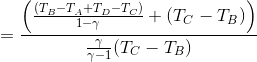



 .
[Hence proved]
.
[Hence proved]
Add Answer to:
An idealized diesel engine operates in a cycle known as the air-standard diesel cycle shown in...
2. Analyze an Audi 3.0-liter TDI V6 Biturbo diesel engine using an air-standard Diesel cycle that...
 2. Analyze an Audi 3.0-liter TDI V6 Biturbo diesel engine using an air-standard Diesel cycle that addresses the "real" effects of non-isentropic compression/expansion, air-fuel ratio, fuel heating value, incomplete combustion, exhaust residual, and heat loss. The engine is four-stroke, has six cylinders with a compression ratio of 16.0, and develops maximum power at 4250 rpm. Assume the following: the diesel fuel heating value is Quv 42,600 kJ/kg, the air-to-fuel ratio (AF) at maximum power is 25, and the combustion efficiency...
A four-stroke 2.0 Litre compression ignition engine operates on a Diesel cycle with a compression ratio...
 A four-stroke 2.0 Litre compression ignition engine operates on a Diesel cycle with a compression ratio of 20 and a cut-off ratio of 1.8. Air is at 30°C and 100 kPa at the beginning of the compression process. It may be assumed that for the air, the specific heat, Cp and gas constant, R are 1.005 and 0.287 kJ/kg.K, respectively. Calculate: the temperature (K) of the air at the end of the following processes: (i) (a) compression (ii) combustion, (ii...
A gasoline engine operates on the air standard Otto cycle. The air intake to the engine...
 A gasoline engine operates on the air standard Otto cycle. The air intake to the engine is at 300K and 95kPa (State 1). The air is compressed in the engine to an unknown pressure. Heat is then added during combustion at an amount of 1100 kJ/kg. At the end of the heat addition process, the temperature reaches 2200K. Compute the following: (a) the temperature at the end of the compression process, (b) the volumetric compression ratio of this engine, (c)...
Rebelmatk Cycle bewo Veas 3) The Diesel... .I mean, Rebelmatic engine is used in vehicles across...
 Rebelmatk Cycle bewo Veas 3) The Diesel... .I mean, Rebelmatic engine is used in vehicles across the globe. A diatomic, ideal gas (γ 7/5) undergoes adiabatic compression from point 1 (Vii P), followed by isobaric expansion as the fuel is burned, then adiabatic expansion to point 4, and finally the pressure is released at constant volume back to point 1. a) The compression ratio for this engine is Vi/V2 18, what is the ratio of the temperatures 72 and Ti...
An automobile has a 3.2 liter, five cylinders, four stroke cycle diesel engine operating at 2400...
An automobile has a 3.2 liter, five cylinders, four stroke cycle diesel engine operating at 2400 rpm. Fuel injection occurs from 200 BTDC to 50 ATDC. The engine has a volumetric efficiency of 0.95 and operates with fuel equivalence ratio of 0.80. Light diesel fuel is used for the operation. The engine has a compression ratio of 18:1 and operates on an air-standard dual cycle. At the same speed, combustion starts at 7° BTDC and lasts for 42° of engine...
A turbocharged, 6.4-liter, V8 SI engine operates on an air-standard Otto cycle at WOT with an eng...
 A turbocharged, 6.4-liter, V8 SI engine operates on an air-standard Otto cycle at WOT with an engine speed of 5500 RPM. The compression ratio is Te10.4:1, and condi- tions in the cylinders at the start of compression are 65°C and 120 kPa. Crevice volume is equal to 2.8% of clearance volume and has pressure equal to cylinder pressure and temperature equal to 185°C Calculate: (a) Total engine crevice volume. [cm31 (b) Percent of fuel that is trapped in the crevice...
Problem 8: Consider the reversible Carnot's cycle of an ideal monatomic gas in the cold cylinder...
 Problem 8: Consider the reversible Carnot's cycle of an ideal monatomic gas in the cold cylinder of 290 K corresponding to the isothermal compression step. Then the volume of the gas is further compressed by a factor of 7.5 in the adiabatic compression step. a) Find the temperature at the final step of the adiabatic compression. b) What is Thot for the isothermal expansion step? c) What is the maximum thermodynamic efficiency for this engine? d) How much would the...
A Diesel engine is approximated by a pressure limited (dual) cycle. The data is as follows:...
 A Diesel engine is approximated by a pressure limited (dual)
cycle. The data is as follows:
A Diesel engine is approximated by a pressure limited (dual) cycle. The data is as follows: Inlet temperature and pressure: P1 = 100 kPa, T1 = 298 K Compression ratio = 16:1 Heat added during combustion = 44000 kJ/kgfuel (please note that this value is per kg fuel) A/F = 23 kg/kgf 40% of the heat is added in the constant volume combustion part....
A Diesel engine is approximated by a pressure limited (dual)
cycle. The data is as follows:
A Diesel engine is approximated by a pressure limited (dual) cycle. The data is as follows: Inlet temperature and pressure: P1 = 100 kPa, T1 = 298 K Compression ratio = 16:1 Heat added during combustion = 44000 kJ/kgfuel (please note that this value is per kg fuel) A/F = 23 kg/kgf 40% of the heat is added in the constant volume combustion part....
İdi ner An ideal diesel engine The state of air at the beginning of the e maximum temperature in the eycle air) (us...
 İdi ner An ideal diesel engine The state of air at the beginning of the e maximum temperature in the eycle air) (using variable specific hea a) Draw the P- has a compression ratio of 20 and uses air as the com 2200K and the cutoff ratio is 1.2. is is 100 kPa and 27C he t) (25marks) V diagram of the diesel cyele termine the internal energies at the beginning and the end of the com pression, end of...
2. The following information is known for a turbocharged 4-stroke Diesel engine, when running at a...
 2. The following information is known for a turbocharged 4-stroke Diesel engine, when running at a certain operating point onboard a vessel: (Geometric) compression ratio: Volumetric ratio: Combustion efficiency Heat input efficiency: Mechanical efficiency Entrapped air efficiency: Intake manifold pressure: Intake manifold temperature: v2 / v, = 20 comb = 98% = 75% m = 90% trap = 100% 3.5 bar (abs) 50°C In the above (see also the figure given at the bottom of the back page). VI: Volume...
 2. Analyze an Audi 3.0-liter TDI V6 Biturbo diesel engine using an air-standard Diesel cycle that addresses the "real" effects of non-isentropic compression/expansion, air-fuel ratio, fuel heating value, incomplete combustion, exhaust residual, and heat loss. The engine is four-stroke, has six cylinders with a compression ratio of 16.0, and develops maximum power at 4250 rpm. Assume the following: the diesel fuel heating value is Quv 42,600 kJ/kg, the air-to-fuel ratio (AF) at maximum power is 25, and the combustion efficiency...
 A four-stroke 2.0 Litre compression ignition engine operates on a Diesel cycle with a compression ratio of 20 and a cut-off ratio of 1.8. Air is at 30°C and 100 kPa at the beginning of the compression process. It may be assumed that for the air, the specific heat, Cp and gas constant, R are 1.005 and 0.287 kJ/kg.K, respectively. Calculate: the temperature (K) of the air at the end of the following processes: (i) (a) compression (ii) combustion, (ii...
 A gasoline engine operates on the air standard Otto cycle. The air intake to the engine is at 300K and 95kPa (State 1). The air is compressed in the engine to an unknown pressure. Heat is then added during combustion at an amount of 1100 kJ/kg. At the end of the heat addition process, the temperature reaches 2200K. Compute the following: (a) the temperature at the end of the compression process, (b) the volumetric compression ratio of this engine, (c)...
 Rebelmatk Cycle bewo Veas 3) The Diesel... .I mean, Rebelmatic engine is used in vehicles across the globe. A diatomic, ideal gas (γ 7/5) undergoes adiabatic compression from point 1 (Vii P), followed by isobaric expansion as the fuel is burned, then adiabatic expansion to point 4, and finally the pressure is released at constant volume back to point 1. a) The compression ratio for this engine is Vi/V2 18, what is the ratio of the temperatures 72 and Ti...
 A turbocharged, 6.4-liter, V8 SI engine operates on an air-standard Otto cycle at WOT with an engine speed of 5500 RPM. The compression ratio is Te10.4:1, and condi- tions in the cylinders at the start of compression are 65°C and 120 kPa. Crevice volume is equal to 2.8% of clearance volume and has pressure equal to cylinder pressure and temperature equal to 185°C Calculate: (a) Total engine crevice volume. [cm31 (b) Percent of fuel that is trapped in the crevice...
 Problem 8: Consider the reversible Carnot's cycle of an ideal monatomic gas in the cold cylinder of 290 K corresponding to the isothermal compression step. Then the volume of the gas is further compressed by a factor of 7.5 in the adiabatic compression step. a) Find the temperature at the final step of the adiabatic compression. b) What is Thot for the isothermal expansion step? c) What is the maximum thermodynamic efficiency for this engine? d) How much would the...
 A Diesel engine is approximated by a pressure limited (dual)
cycle. The data is as follows:
A Diesel engine is approximated by a pressure limited (dual) cycle. The data is as follows: Inlet temperature and pressure: P1 = 100 kPa, T1 = 298 K Compression ratio = 16:1 Heat added during combustion = 44000 kJ/kgfuel (please note that this value is per kg fuel) A/F = 23 kg/kgf 40% of the heat is added in the constant volume combustion part....
A Diesel engine is approximated by a pressure limited (dual)
cycle. The data is as follows:
A Diesel engine is approximated by a pressure limited (dual) cycle. The data is as follows: Inlet temperature and pressure: P1 = 100 kPa, T1 = 298 K Compression ratio = 16:1 Heat added during combustion = 44000 kJ/kgfuel (please note that this value is per kg fuel) A/F = 23 kg/kgf 40% of the heat is added in the constant volume combustion part....
 İdi ner An ideal diesel engine The state of air at the beginning of the e maximum temperature in the eycle air) (using variable specific hea a) Draw the P- has a compression ratio of 20 and uses air as the com 2200K and the cutoff ratio is 1.2. is is 100 kPa and 27C he t) (25marks) V diagram of the diesel cyele termine the internal energies at the beginning and the end of the com pression, end of...
 2. The following information is known for a turbocharged 4-stroke Diesel engine, when running at a certain operating point onboard a vessel: (Geometric) compression ratio: Volumetric ratio: Combustion efficiency Heat input efficiency: Mechanical efficiency Entrapped air efficiency: Intake manifold pressure: Intake manifold temperature: v2 / v, = 20 comb = 98% = 75% m = 90% trap = 100% 3.5 bar (abs) 50°C In the above (see also the figure given at the bottom of the back page). VI: Volume...
Most questions answered within 3 hours.
-
Where is the error in this code sequence?
String s1 = "Hello";
String s2 = "ello";...
asked 10 months ago -
Financial data for Joel de Paris, Inc., for last year
follow:
Joel de Paris, Inc.
Balance...
asked 10 months ago -
Consider this reaction:
Al2(SO4)3 (aq)+ BaCl3
(aq) Al2Cl6 (aq)- +
3BaSO4(s) . What is the...
asked 10 months ago -
Suppose that Savneet is considering increasing her
recent random sample from 20 car rentals to 40...
asked 10 months ago -
Trucks arrive at an unloading terminal at an average rate of 120
per hour.
Trucks arrive...
asked 10 months ago -
Why are methanol and ethanol completely soluble in water while
octanol is not very little soluble....
asked 10 months ago -
A facilities manager at a university reads in a research report
that the mean amount of...
asked 10 months ago -
When the CuSO4 is rehydrated by adding water to the anhydrous
compound, is this an endothermic...
asked 10 months ago -
A ray of sunlight is passing from diamond into crown glass; the
angle of incidence is...
asked 10 months ago -
A block of mass 0.249 kg is placed on top of a light, vertical
spring of...
asked 10 months ago -
how do the kidneys compensate in the presences of acidosis
a) trigger hyperventilate
b) reserve acid...
asked 10 months ago -
Question 501 pts
The rental rate of capital to the firm increases. Which of the
following...
asked 10 months ago