Explain what happens to the interest rate if the money supply increases or decreases and the...
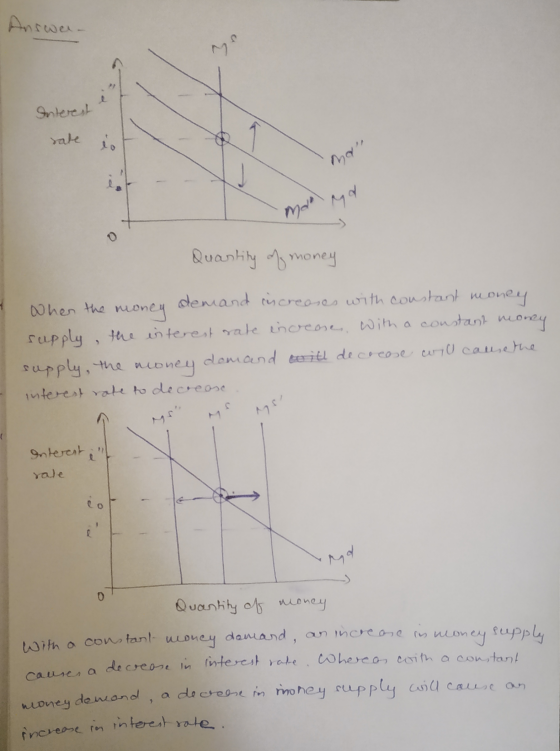
Explain what happens to the interest rate if the money supply increases or decreases and the money demand remains unchanged. Explain what happens to the interest rate if the money demand increases or decreases and the money supply remains unchanged.
Homework Answers
Add Answer to:
Explain what happens to the interest rate if
the money supply increases or decreases and the...
Respond to the following in a minimum of 175 words: Explain what happens to the interest...
 Respond to the following in a minimum of 175 words: Explain what happens to the interest rate if the money supply increases or decreases and the money demand remains unchanged. Explain what happens to the interest rate if the money demand increases or decreases and the money supply remains unchanged.
1) Explain: Who has control of the money supply in the US Economy? What happens to...
1) Explain: Who has control of the money supply in the US Economy? What happens to the interest rate if the money supply increases or decreases and the demand for money remains unchanged? 2) What are the "Tools" of the Federal Reserve? How are they used to increase the money Supply? How are they used to decrease the money supply? When would you use these policies? No less than 150 words each
The demand for money ________ when the ________. Select one: a. increases; supply of money decreases...
The demand for money ________ when the ________. Select one: a. increases; supply of money decreases b. increases; price level increases c. decreases; price level increases d. remains constant; price level increases e. increases; nominal interest rate increases
1. Explain, with the aid of a diagram, what happens to the money supply, money demand,...
1. Explain, with the aid of a diagram, what happens to the money supply, money demand, the value of money, and the price level if the Central Bank increases the money supply.
If demand decreases and supply increases, what happens to price and market quantity? Price definitely decreases...
 If demand decreases and supply increases, what happens to price and market quantity? Price definitely decreases while market quantity definitely increases due to the supply increase. The demand decrease counteracts the supply increase leading to no change in either price or market quantity. Market quantity definitely decreases while the impact on price is ambiguous. Price definitely decreases while the impact on market quantity is ambiguous. « Previous Next → 27 MacBook Air
An increase in the money supply: increases income and lowers the interest rate in both the short...
 An increase in the money supply: increases income and lowers the interest rate in both the short and long runs increases income in both the short and long runs, but leaves the interest rate unchanged in the long run lowers the interest rate in both the short and long runs, but leaves income unchanged in the long run.lowers the interest rate and increases income in the short run, but leaves both unchanged in the long run.
The following questions refer to the graph below. MO Interest Rate Moº - Quantity of Money...
 The following questions refer to the graph below. MO Interest Rate Moº - Quantity of Money a. Explain (and show in the diagram) why the Bank of Canada cannot independently set the money supply and the interest rate. (Hint: try explaining what would happen if the bank did try holding the money supply where it is and set the interest rate above or below the equilibrium above.) (4 marks) b. Suppose the Bank leaves the money supply unchanged but that...
"The money supply of an economy increases when the central bank simultaneously decreases the reserve requirement...
"The money supply of an economy increases when the central bank simultaneously decreases the reserve requirement and sells government bonds in open market." Explain whether this statement is true, false or uncertain. (6 marks) What should money growth rate be if real output grows 4% per year, velocity grows 2% per year, and the central bank targets inflation to be 2% per year? (4 marks) What is the inflation tax? Explain. (6 marks) Explain (with the aid of diagrams) whether...
The supply of money increases when___. Question 1 options: a) the interest rate increases. b) the...
The supply of money increases when___. Question 1 options: a) the interest rate increases. b) the price level falls. c) the Fed makes open-market purchases. d) money demand increases.
What happens to the Purchasing Power of Money, Prices and the Nominal Rate of Interest in...
What happens to the Purchasing Power of Money, Prices and the Nominal Rate of Interest in CASE 1: the case of an increasing supply of money and credit? CASE 2: the case of a decreasing supply of money and credit? CASE 3: the case of an increasing demand for money and credit? CASE 4: the case of a decreasing demand for money and credit?
 Respond to the following in a minimum of 175 words: Explain what happens to the interest rate if the money supply increases or decreases and the money demand remains unchanged. Explain what happens to the interest rate if the money demand increases or decreases and the money supply remains unchanged.
 If demand decreases and supply increases, what happens to price and market quantity? Price definitely decreases while market quantity definitely increases due to the supply increase. The demand decrease counteracts the supply increase leading to no change in either price or market quantity. Market quantity definitely decreases while the impact on price is ambiguous. Price definitely decreases while the impact on market quantity is ambiguous. « Previous Next → 27 MacBook Air
 An increase in the money supply: increases income and lowers the interest rate in both the short and long runs increases income in both the short and long runs, but leaves the interest rate unchanged in the long run lowers the interest rate in both the short and long runs, but leaves income unchanged in the long run.lowers the interest rate and increases income in the short run, but leaves both unchanged in the long run.
 The following questions refer to the graph below. MO Interest Rate Moº - Quantity of Money a. Explain (and show in the diagram) why the Bank of Canada cannot independently set the money supply and the interest rate. (Hint: try explaining what would happen if the bank did try holding the money supply where it is and set the interest rate above or below the equilibrium above.) (4 marks) b. Suppose the Bank leaves the money supply unchanged but that...
Most questions answered within 3 hours.
-
Where is the error in this code sequence?
String s1 = "Hello";
String s2 = "ello";...
asked 10 months ago -
Financial data for Joel de Paris, Inc., for last year
follow:
Joel de Paris, Inc.
Balance...
asked 10 months ago -
Consider this reaction:
Al2(SO4)3 (aq)+ BaCl3
(aq) Al2Cl6 (aq)- +
3BaSO4(s) . What is the...
asked 10 months ago -
Suppose that Savneet is considering increasing her
recent random sample from 20 car rentals to 40...
asked 10 months ago -
Trucks arrive at an unloading terminal at an average rate of 120
per hour.
Trucks arrive...
asked 10 months ago -
Why are methanol and ethanol completely soluble in water while
octanol is not very little soluble....
asked 10 months ago -
A facilities manager at a university reads in a research report
that the mean amount of...
asked 10 months ago -
When the CuSO4 is rehydrated by adding water to the anhydrous
compound, is this an endothermic...
asked 10 months ago -
A ray of sunlight is passing from diamond into crown glass; the
angle of incidence is...
asked 10 months ago -
A block of mass 0.249 kg is placed on top of a light, vertical
spring of...
asked 10 months ago -
how do the kidneys compensate in the presences of acidosis
a) trigger hyperventilate
b) reserve acid...
asked 10 months ago -
Question 501 pts
The rental rate of capital to the firm increases. Which of the
following...
asked 10 months ago