
Homework Answers
Mechanism for the reaction is as given below:

Description:
Step 1: Deprotonation of more acidic proton using the nucleophillic base 'ethoxide' to generate an enolate.
Step 2: Negatively charged carbon nucleophillically attacks on the electrophillic carbonyl carbon to generate a tetrahedral intermediate containing a negatively charged oxygen.
Step 3: Negative charge on the oxygen moves back to form double bond with the carbon and simultaneously the ethoxide group leaves in order to maintain the tetravalency of the carbon and the required product is obtained.
Reason why more substituted product is not formed:
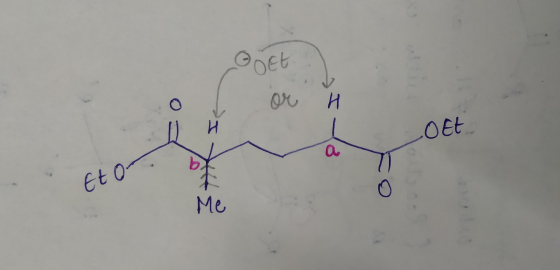
The given reactant had two sites for deprotonation marked as a and b. The site of deprotonation depends upon the stability of the enolate/carbanion formed after deprotonation. If any electron withdrawing group is present on on the negatively charged carbon then its its acidic strength increases beacuse electron withdrawing group can help to stabilise the negative charge after deprotonation. However the case is exactly opposite if an electron releasing group is present because such group will intensify the negative charge on the carbon making it less stable.
In the given molecule among the two sites available for deprotonation, the one marked as 'b' has an extra methyl group as compared to 'a'. Methyl group can intensify the negative charge on carbon via electron releasing inductive effect thereby decreasing the acidic strength on 'b'.
As acidic strength of 'b' is less than that of 'a' that's why the more substituted product will not be formed.
Add Answer to:
3. (3 pts) Provide a reasonable arrow-pushing mechanism for the following transformation. Why does the more...
3. (3 pts) Provide a reasonable arrow-pushing mechanism for the following transformation. Why does the more...
 3. (3 pts) Provide a reasonable arrow-pushing mechanism for the following transformation. Why does the more substituted cyclopentanone not form? in Me money OEU 1. NaOEt, EtOH * 2. NH4Cl (aq soln) Eto Me
3. (3 pts) Provide a reasonable arrow-pushing mechanism for the following transformation. OEt EIO EIO 1....
 3. (3 pts) Provide a reasonable arrow-pushing mechanism for the following transformation. OEt EIO EIO 1. NaOE, ETOH 2.NH.CI (aq soln) Me Me
3. (3 pts) Provide a reasonable arrow-pushing mechanism for the following transformation. D20+ ph CH₂ Ph...
 3. (3 pts) Provide a reasonable arrow-pushing mechanism for the following transformation. D20+ ph CH₂ Ph CD
I need help with this question Please Provide a reasonable arrow-pushing mechanism for the following transformation....
 I
need help with this question Please
Provide a reasonable arrow-pushing mechanism for the following transformation. (Hint! The reaction involves both intramolecular v. addition and aldol reactions. C1 is labeled in the starting material and product.) NaOE/EtOH но
I
need help with this question Please
Provide a reasonable arrow-pushing mechanism for the following transformation. (Hint! The reaction involves both intramolecular v. addition and aldol reactions. C1 is labeled in the starting material and product.) NaOE/EtOH но
3. Provide a detailed arrow pushing mechanism for the following transformation (2 pts). Me Me Me
 3. Provide a detailed arrow pushing mechanism for the following transformation (2 pts). Me Me Me
1. Provide a reasonable curved arrow mechanism for the following transformation. (20 points) 1) NaOEt EO...
 1. Provide a reasonable curved arrow mechanism for the following transformation. (20 points) 1) NaOEt EO VOEt Et EtOH Ph Ph 3)HCI, H20 DMSO, Heat
1. Draw a detailed arrow pushing mechanism for the following 2. Provide a reasonable synthesis for...
 1. Draw a detailed arrow pushing mechanism for the
following
2. Provide a reasonable synthesis for the following
1. Draw a detailed arrow pushing mechanism for the following: (6 pts) pTSA + HS SH 2. Provide a reasonable synthesis for the following: (4 pts) or On
1. Draw a detailed arrow pushing mechanism for the
following
2. Provide a reasonable synthesis for the following
1. Draw a detailed arrow pushing mechanism for the following: (6 pts) pTSA + HS SH 2. Provide a reasonable synthesis for the following: (4 pts) or On
Problem 6 Provide a detailed arrow-pushing mechanism for the following transformations. (A) 2 Me O OE...
 Problem 6 Provide a detailed arrow-pushing mechanism for the following transformations. (A) 2 Me O OE NaoEt, EtOH Eto, (B) Hint: The cyclohexadienone depicted in the brackets is an intermediate along the reaction pathway to the phenol. 0 315 MeOMe NaoMe, MeOH | MeO₂C CoMe Co-Me Problem 8 Provide a synthesis for the depicted tropinone derivative from the indicated starting materials and any other reagents needed. The best synthesis will require no more than 3 steps. - NH2 Hoza i...
1. Draw a detailed arrow pushing mechanism for the following: (5 pts) 2. Provide a reasonable...
 1. Draw a detailed arrow pushing mechanism for the following: (5 pts) 2. Provide a reasonable synthesis for the following: (5 pts)
V. Propose a reasonable arrow-pushing mechanism for the following transformation. HBr H3CCOOH
 V. Propose a reasonable arrow-pushing mechanism for the following transformation. HBr H3CCOOH
 3. (3 pts) Provide a reasonable arrow-pushing mechanism for the following transformation. Why does the more substituted cyclopentanone not form? in Me money OEU 1. NaOEt, EtOH * 2. NH4Cl (aq soln) Eto Me
 3. (3 pts) Provide a reasonable arrow-pushing mechanism for the following transformation. OEt EIO EIO 1. NaOE, ETOH 2.NH.CI (aq soln) Me Me
 3. (3 pts) Provide a reasonable arrow-pushing mechanism for the following transformation. D20+ ph CH₂ Ph CD
 I
need help with this question Please
Provide a reasonable arrow-pushing mechanism for the following transformation. (Hint! The reaction involves both intramolecular v. addition and aldol reactions. C1 is labeled in the starting material and product.) NaOE/EtOH но
I
need help with this question Please
Provide a reasonable arrow-pushing mechanism for the following transformation. (Hint! The reaction involves both intramolecular v. addition and aldol reactions. C1 is labeled in the starting material and product.) NaOE/EtOH но
 3. Provide a detailed arrow pushing mechanism for the following transformation (2 pts). Me Me Me
 1. Provide a reasonable curved arrow mechanism for the following transformation. (20 points) 1) NaOEt EO VOEt Et EtOH Ph Ph 3)HCI, H20 DMSO, Heat
 1. Draw a detailed arrow pushing mechanism for the
following
2. Provide a reasonable synthesis for the following
1. Draw a detailed arrow pushing mechanism for the following: (6 pts) pTSA + HS SH 2. Provide a reasonable synthesis for the following: (4 pts) or On
1. Draw a detailed arrow pushing mechanism for the
following
2. Provide a reasonable synthesis for the following
1. Draw a detailed arrow pushing mechanism for the following: (6 pts) pTSA + HS SH 2. Provide a reasonable synthesis for the following: (4 pts) or On
 Problem 6 Provide a detailed arrow-pushing mechanism for the following transformations. (A) 2 Me O OE NaoEt, EtOH Eto, (B) Hint: The cyclohexadienone depicted in the brackets is an intermediate along the reaction pathway to the phenol. 0 315 MeOMe NaoMe, MeOH | MeO₂C CoMe Co-Me Problem 8 Provide a synthesis for the depicted tropinone derivative from the indicated starting materials and any other reagents needed. The best synthesis will require no more than 3 steps. - NH2 Hoza i...
 1. Draw a detailed arrow pushing mechanism for the following: (5 pts) 2. Provide a reasonable synthesis for the following: (5 pts)
 V. Propose a reasonable arrow-pushing mechanism for the following transformation. HBr H3CCOOH
Most questions answered within 3 hours.
-
Where is the error in this code sequence?
String s1 = "Hello";
String s2 = "ello";...
asked 10 months ago -
Financial data for Joel de Paris, Inc., for last year
follow:
Joel de Paris, Inc.
Balance...
asked 10 months ago -
Consider this reaction:
Al2(SO4)3 (aq)+ BaCl3
(aq) Al2Cl6 (aq)- +
3BaSO4(s) . What is the...
asked 10 months ago -
Suppose that Savneet is considering increasing her
recent random sample from 20 car rentals to 40...
asked 10 months ago -
Trucks arrive at an unloading terminal at an average rate of 120
per hour.
Trucks arrive...
asked 10 months ago -
Why are methanol and ethanol completely soluble in water while
octanol is not very little soluble....
asked 10 months ago -
A facilities manager at a university reads in a research report
that the mean amount of...
asked 10 months ago -
When the CuSO4 is rehydrated by adding water to the anhydrous
compound, is this an endothermic...
asked 10 months ago -
A ray of sunlight is passing from diamond into crown glass; the
angle of incidence is...
asked 10 months ago -
A block of mass 0.249 kg is placed on top of a light, vertical
spring of...
asked 10 months ago -
how do the kidneys compensate in the presences of acidosis
a) trigger hyperventilate
b) reserve acid...
asked 10 months ago -
Question 501 pts
The rental rate of capital to the firm increases. Which of the
following...
asked 10 months ago