


Homework Answers
Add Answer to:
A charge, q=91.0000 microCoulombs on a particle with mass m=1.00000 milli- grams, moves through a pipe...
A charge, q=91.0000 microCoulombs on a particle with mass m=1.00000 milli- grams, moves through a pipe...
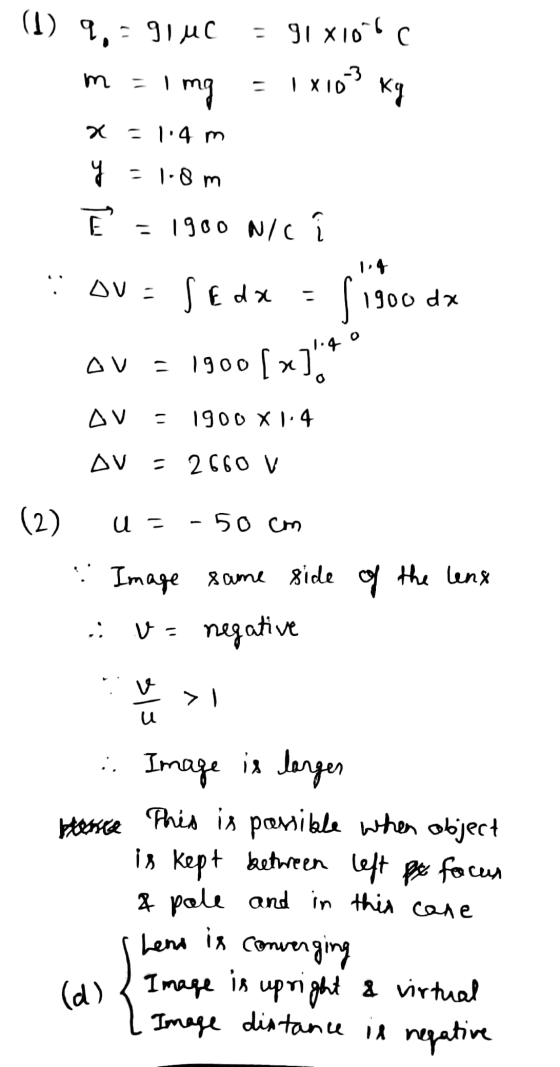
 A charge, q=91.0000 microCoulombs on a particle with mass m=1.00000 milli- grams, moves through a pipe from the origin to a point at coordinate x=1.40000m and y=1.8000m. All space is filled with a uniform electric field E=1,900.00000N/C and pointing parallel to the x axis. What is the change in electric potential as the mass moves from initial to final positions (in VOLTS)
A charge, q=71.0000 microCoulombs on a particle with mass m=10.00000 milli- grams, moves through a pipe...
 A charge, q=71.0000 microCoulombs on a particle with mass m=10.00000 milli- grams, moves through a pipe from the origin to a point at coordinate x=2.00000m and y=0.6000m. All space is filled with a uniform electric field E=400.00000N/C and pointing parallel to the x axis. What is the change in electric potential as the mass moves from initial to final positions (in VOLTS)
A charge, q=51.0000 microCoulombs on a particle with mass m=8.00000 milli- grams, moves through a pipe...
 A charge, q=51.0000 microCoulombs on a particle with mass m=8.00000 milli- grams, moves through a pipe from the origin to a point at coordinate x=1.00000m and y=0.2000m. All space is filled with a uniform electric field E=900.00000N/C and pointing parallel to the x axis. What is the change in electric potential as the mass moves from initial to final positions (in VOLTS) Your Answer:
An object is placed 50.0cm in front of a lens. The image forms on the same...
 An object is placed 50.0cm in front of a lens. The image forms on the same side of the lens and is larger than the object. The image is (upright or inverted), the lens is (converging/diverging), image distance is (positive/negative), the image is (real, virtual) O inverted, diverging, positive, real upright, converging, positive, virtual inverted, converging, positive, virtual upright, converging, positive, real upright, converging, negative, virtual upright, converging, negative, real inverted, converging, positive, real O inverted, diverging, negative, real
An object is placed 50.0cm in front of a lens. The image forms on the same...
 An object is placed 50.0cm in front of a lens. The image forms on the same side of the lens and is larger than the object. The image is (upright or inverted), the lens is (converging/diverging), image distance is (positive/negative), the image is (real, virtual) O upright, converging, positive, virtual O inverted, converging, positive, real inverted, diverging, negative, real O upright, converging, negative, virtual O inverted, diverging, positive, real O inverted, converging, positive, virtual O upright, converging, positive, real O...
Question 18 (8 points) An object is placed 50.0cm in front of a lens. The image...
 Question 18 (8 points) An object is placed 50.0cm in front of a lens. The image forms on the same side of the lens and is larger than the object. The image is (upright or inverted), the lens is (converging/diverging), image distance is (positive/negative), the image is (real, virtual) upright, converging, negative, real inverted, converging, positive, virtual upright, converging, negative, virtual upright, converging, positive, virtual upright, converging, positive, real O inverted, converging, positive, real inverted, diverging, positive, real inverted, diverging,...
Please help with this 4 part question Light with wavelength = 700.0000nm is incident on a...
 Please help with this 4 part question
Light with wavelength = 700.0000nm is incident on a double slit with spacing d=50.00000micrometers. The distance to the screed is 0.5000meters. What is the spacing between neighboring constructive fringes near the center of the screen? (in meters) Light with wavelength 500nm is incident upon a surface at an angle of 40.0 degrees, refracts and enters a second medium. The light that enters the second medium travels faster than in the first medium. Compared...
Please help with this 4 part question
Light with wavelength = 700.0000nm is incident on a double slit with spacing d=50.00000micrometers. The distance to the screed is 0.5000meters. What is the spacing between neighboring constructive fringes near the center of the screen? (in meters) Light with wavelength 500nm is incident upon a surface at an angle of 40.0 degrees, refracts and enters a second medium. The light that enters the second medium travels faster than in the first medium. Compared...
Single Lens System
 A lens located in the y-z plane at x = 0 forms an image of an arrow at x = x2 = 112.4 cm. The tip of the object arrow is located at(x,y) = (x1, y1) = (-45.9 cm, 4.91 cm). The index of refraction of the lens is n = 1.43.1) What is flens, the focal length of the lens? If the lens is converging flens is positive. It the lens is diverging, flens is negative.2) What is y2,...
Consider an object with s=12cm that produces an imagewith s′=15cm. Note that whenever you are...
Consider an object with s=12cm that produces an image with s′=15cm. Note that whenever you are working with a physical object, the object distance will be positive (in multiple optics setups, you will encounter "objects" that are actually images, but that is not a possibility in this problem). A positive image distance means that the image is formed on the side of the lens from which the light emerges.Part AFind the focal length of the lens that produces the image...
Choose true or false for each statement regarding a converging lens. true false If an object is...
Choose true or false for each statement regarding a converging lens. true false If an object is placed 7.9 cm from a converging lens with f = 4 cm, then its image will be reduced and real. true false If an object is placed 3.9 cm from a converging lens with f = 4 cm, then its image will be reduced and virtual. true false A converging lens produces an enlarged virtual image when the object is placed between the lens and its...
 A charge, q=91.0000 microCoulombs on a particle with mass m=1.00000 milli- grams, moves through a pipe from the origin to a point at coordinate x=1.40000m and y=1.8000m. All space is filled with a uniform electric field E=1,900.00000N/C and pointing parallel to the x axis. What is the change in electric potential as the mass moves from initial to final positions (in VOLTS)
 A charge, q=71.0000 microCoulombs on a particle with mass m=10.00000 milli- grams, moves through a pipe from the origin to a point at coordinate x=2.00000m and y=0.6000m. All space is filled with a uniform electric field E=400.00000N/C and pointing parallel to the x axis. What is the change in electric potential as the mass moves from initial to final positions (in VOLTS)
 A charge, q=51.0000 microCoulombs on a particle with mass m=8.00000 milli- grams, moves through a pipe from the origin to a point at coordinate x=1.00000m and y=0.2000m. All space is filled with a uniform electric field E=900.00000N/C and pointing parallel to the x axis. What is the change in electric potential as the mass moves from initial to final positions (in VOLTS) Your Answer:
 An object is placed 50.0cm in front of a lens. The image forms on the same side of the lens and is larger than the object. The image is (upright or inverted), the lens is (converging/diverging), image distance is (positive/negative), the image is (real, virtual) O inverted, diverging, positive, real upright, converging, positive, virtual inverted, converging, positive, virtual upright, converging, positive, real upright, converging, negative, virtual upright, converging, negative, real inverted, converging, positive, real O inverted, diverging, negative, real
 An object is placed 50.0cm in front of a lens. The image forms on the same side of the lens and is larger than the object. The image is (upright or inverted), the lens is (converging/diverging), image distance is (positive/negative), the image is (real, virtual) O upright, converging, positive, virtual O inverted, converging, positive, real inverted, diverging, negative, real O upright, converging, negative, virtual O inverted, diverging, positive, real O inverted, converging, positive, virtual O upright, converging, positive, real O...
 Question 18 (8 points) An object is placed 50.0cm in front of a lens. The image forms on the same side of the lens and is larger than the object. The image is (upright or inverted), the lens is (converging/diverging), image distance is (positive/negative), the image is (real, virtual) upright, converging, negative, real inverted, converging, positive, virtual upright, converging, negative, virtual upright, converging, positive, virtual upright, converging, positive, real O inverted, converging, positive, real inverted, diverging, positive, real inverted, diverging,...
 Please help with this 4 part question
Light with wavelength = 700.0000nm is incident on a double slit with spacing d=50.00000micrometers. The distance to the screed is 0.5000meters. What is the spacing between neighboring constructive fringes near the center of the screen? (in meters) Light with wavelength 500nm is incident upon a surface at an angle of 40.0 degrees, refracts and enters a second medium. The light that enters the second medium travels faster than in the first medium. Compared...
Please help with this 4 part question
Light with wavelength = 700.0000nm is incident on a double slit with spacing d=50.00000micrometers. The distance to the screed is 0.5000meters. What is the spacing between neighboring constructive fringes near the center of the screen? (in meters) Light with wavelength 500nm is incident upon a surface at an angle of 40.0 degrees, refracts and enters a second medium. The light that enters the second medium travels faster than in the first medium. Compared...
Most questions answered within 3 hours.
-
Where is the error in this code sequence?
String s1 = "Hello";
String s2 = "ello";...
asked 10 months ago -
Financial data for Joel de Paris, Inc., for last year
follow:
Joel de Paris, Inc.
Balance...
asked 10 months ago -
Consider this reaction:
Al2(SO4)3 (aq)+ BaCl3
(aq) Al2Cl6 (aq)- +
3BaSO4(s) . What is the...
asked 10 months ago -
Suppose that Savneet is considering increasing her
recent random sample from 20 car rentals to 40...
asked 10 months ago -
Trucks arrive at an unloading terminal at an average rate of 120
per hour.
Trucks arrive...
asked 10 months ago -
Why are methanol and ethanol completely soluble in water while
octanol is not very little soluble....
asked 10 months ago -
A facilities manager at a university reads in a research report
that the mean amount of...
asked 10 months ago -
When the CuSO4 is rehydrated by adding water to the anhydrous
compound, is this an endothermic...
asked 10 months ago -
A ray of sunlight is passing from diamond into crown glass; the
angle of incidence is...
asked 10 months ago -
A block of mass 0.249 kg is placed on top of a light, vertical
spring of...
asked 10 months ago -
how do the kidneys compensate in the presences of acidosis
a) trigger hyperventilate
b) reserve acid...
asked 10 months ago -
Question 501 pts
The rental rate of capital to the firm increases. Which of the
following...
asked 10 months ago