
Homework Answers

Add Answer to:
n=5
Question 4 5 pts Consider the equation nº X" () + X(T) - 0 with...
n=7 Question 4 5 pts Consider the equation nº X" () + X(T) - 0 with...
 n=7
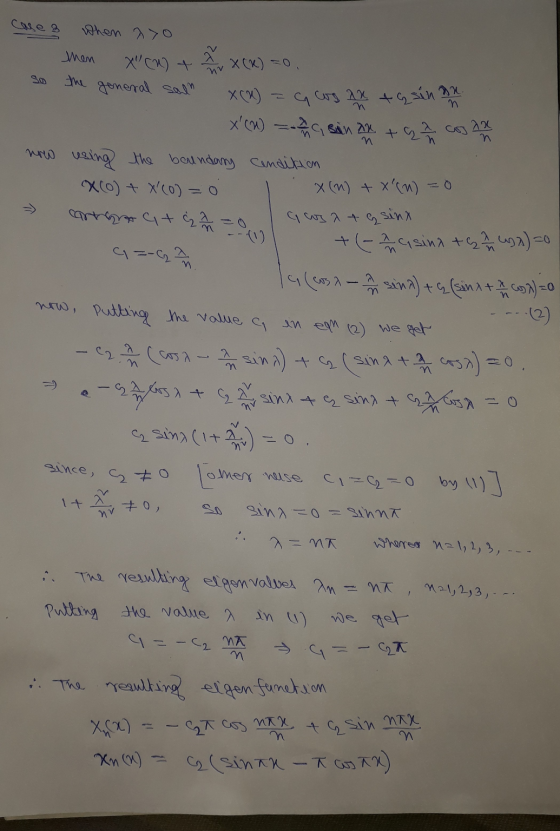
Question 4 5 pts Consider the equation nº X" () + X(T) - 0 with the following boundary conditions. X(0) + X'(0) -0, and X(n) + X'(n) - 0. 1. Write down the general solution to the equation for XC). 2. Write down the result of applying the boundary condition X(0) + X'(0) = 0 to the general solution 3. Write down the result of applying the remaining boundary condition X(n) - X'(n) = ( to the general solution....
n=7
Question 4 5 pts Consider the equation nº X" () + X(T) - 0 with the following boundary conditions. X(0) + X'(0) -0, and X(n) + X'(n) - 0. 1. Write down the general solution to the equation for XC). 2. Write down the result of applying the boundary condition X(0) + X'(0) = 0 to the general solution 3. Write down the result of applying the remaining boundary condition X(n) - X'(n) = ( to the general solution....
Consider the partial differential equation together with the boundary conditions u(0, t) 0 and u(1,t)0 for t20 and the initial condition u(z,0) = z(1-2) for 0 < x < 1. (a) If n is a positive in...
 Consider the partial differential equation together with the boundary conditions u(0, t) 0 and u(1,t)0 for t20 and the initial condition u(z,0) = z(1-2) for 0 < x < 1. (a) If n is a positive integer, show that the function , sin(x), satisfies the given partial differential equation and boundary conditions. (b) The general solution of the partial differential equation that satisfies the boundary conditions is Write down (but do not evaluate) an integral that can be used to...
1. (10 points, part I) Consider the following initial boundary value problem lU (la) (1b) (1c) 0L, t> 0 3 cos ( a(x, 0) (a) Classify the partial differential equation (1a) (b) What do the equation...
 1. (10 points, part I) Consider the following initial boundary value problem lU (la) (1b) (1c) 0L, t> 0 3 cos ( a(x, 0) (a) Classify the partial differential equation (1a) (b) What do the equations (la)-(1c) model? (Hint: Give an interpretation for the PDE, boundary conditions and intial condition.) c) Use the method of separation of variables to separate the above problem into two sub- problems (one that depends on space and the other only on time) (d) What...
solve the PDE +u= at2 on 3 € (0,L), t > 0, with boundary conditions au...
 solve the PDE
+u= at2 on 3 € (0,L), t > 0, with boundary conditions au 2x2 u(0,t) = 0, u(L, t) = 0 au and initial condition u(x,0) = f(x), at (x,0) = g(x) following the steps below. (a) Separate the variables and write differential equations for the functions (x) and h(t); pick the separation constant so that we recover a problem already studied. (b) Find the eigenfunctions and eigenvalues. (c) Write the general solution for this problem. (d)...
solve the PDE
+u= at2 on 3 € (0,L), t > 0, with boundary conditions au 2x2 u(0,t) = 0, u(L, t) = 0 au and initial condition u(x,0) = f(x), at (x,0) = g(x) following the steps below. (a) Separate the variables and write differential equations for the functions (x) and h(t); pick the separation constant so that we recover a problem already studied. (b) Find the eigenfunctions and eigenvalues. (c) Write the general solution for this problem. (d)...
2. Consider a thin rod of length L = π (so that 0 x-7) with a...
 2. Consider a thin rod of length L = π (so that 0 x-7) with a general internal source of heat, Q(a,t) Ot (10) subject to insulated boundary conditions The initial temperature of the bar is zero a(x, 0) = 0 (12) (a) (3pts) What is k in (10)? (b) (10pts) Assume a separable solution to the homogeneous version of the PDE and boundary conditions (10)-(11) of the form u(r, t)- o(x)G(t). Write down or find the eigenvalues λη and...
9. Consider the beam PDE for the transverse deflection u(x, t) of an elastic beam Utt...
 9. Consider the beam PDE for the transverse deflection u(x, t) of an elastic beam Utt + Kurz = 0 for 0 < x <L (30) where K > 0 is a constant. Suppose the boundary conditions are given by (31) u(0, t) = uz(0,t) = 0 Uwx (L, t) = Uzzz(L, t) = 0 (32) and the initial conditions are (33) u(x,0) = (x) u1(x,0) = V(x) (34) Use separation of variables to find the general solution to the...
4. Consider the boundary value problem defined by the partial differential equation д?и д?и = 0,...
 4. Consider the boundary value problem defined by the partial differential equation д?и д?и = 0, ду? y > 0, да? with boundary conditions u(0, y) = u(T,y) = 0, u(x, 0) = 1 and limy-v00 |u(x, y)|< 0o. (a) Use separation of variables to find the eigenvalues and general series solution in terms of the normal modes. (b) Impose the inhomogeneous boundary condition u(x,0) = 1 to find the constants in the general series solution and hence the solution...
2. Consider the initial-boundary value problem 0 0, t >0 Uz uェェ, Uz(0, t) _ u(0, t) = 0. a(z, 0...
 PDE questions. Please show all
steps in detail.
2. Consider the initial-boundary value problem 0
PDE questions. Please show all
steps in detail.
2. Consider the initial-boundary value problem 0
Consider the following second order PDE Uit – 9Uxx = 0, 0<x< < t > 0,...
 Consider the following second order PDE Uit – 9Uxx = 0, 0<x< < t > 0, (A) and the following boundary value/initial conditions: Ux(t,0) = uſt, 5) = 0, t>0, u(0, x) = 44(0, x) = 4 cos’ x, 0<x< (BC) (IC) for the function u= u(t, x). a. (5 points) Find ordinary differential equations for functions T = T(t) and X = X(x) such that the function u(t, x) = T(t)X(x) satisfies the PDE (A). b. (5 points) Find...
 n=7
Question 4 5 pts Consider the equation nº X" () + X(T) - 0 with the following boundary conditions. X(0) + X'(0) -0, and X(n) + X'(n) - 0. 1. Write down the general solution to the equation for XC). 2. Write down the result of applying the boundary condition X(0) + X'(0) = 0 to the general solution 3. Write down the result of applying the remaining boundary condition X(n) - X'(n) = ( to the general solution....
n=7
Question 4 5 pts Consider the equation nº X" () + X(T) - 0 with the following boundary conditions. X(0) + X'(0) -0, and X(n) + X'(n) - 0. 1. Write down the general solution to the equation for XC). 2. Write down the result of applying the boundary condition X(0) + X'(0) = 0 to the general solution 3. Write down the result of applying the remaining boundary condition X(n) - X'(n) = ( to the general solution....
 Consider the partial differential equation together with the boundary conditions u(0, t) 0 and u(1,t)0 for t20 and the initial condition u(z,0) = z(1-2) for 0 < x < 1. (a) If n is a positive integer, show that the function , sin(x), satisfies the given partial differential equation and boundary conditions. (b) The general solution of the partial differential equation that satisfies the boundary conditions is Write down (but do not evaluate) an integral that can be used to...
 1. (10 points, part I) Consider the following initial boundary value problem lU (la) (1b) (1c) 0L, t> 0 3 cos ( a(x, 0) (a) Classify the partial differential equation (1a) (b) What do the equations (la)-(1c) model? (Hint: Give an interpretation for the PDE, boundary conditions and intial condition.) c) Use the method of separation of variables to separate the above problem into two sub- problems (one that depends on space and the other only on time) (d) What...
 solve the PDE
+u= at2 on 3 € (0,L), t > 0, with boundary conditions au 2x2 u(0,t) = 0, u(L, t) = 0 au and initial condition u(x,0) = f(x), at (x,0) = g(x) following the steps below. (a) Separate the variables and write differential equations for the functions (x) and h(t); pick the separation constant so that we recover a problem already studied. (b) Find the eigenfunctions and eigenvalues. (c) Write the general solution for this problem. (d)...
solve the PDE
+u= at2 on 3 € (0,L), t > 0, with boundary conditions au 2x2 u(0,t) = 0, u(L, t) = 0 au and initial condition u(x,0) = f(x), at (x,0) = g(x) following the steps below. (a) Separate the variables and write differential equations for the functions (x) and h(t); pick the separation constant so that we recover a problem already studied. (b) Find the eigenfunctions and eigenvalues. (c) Write the general solution for this problem. (d)...
 2. Consider a thin rod of length L = π (so that 0 x-7) with a general internal source of heat, Q(a,t) Ot (10) subject to insulated boundary conditions The initial temperature of the bar is zero a(x, 0) = 0 (12) (a) (3pts) What is k in (10)? (b) (10pts) Assume a separable solution to the homogeneous version of the PDE and boundary conditions (10)-(11) of the form u(r, t)- o(x)G(t). Write down or find the eigenvalues λη and...
 9. Consider the beam PDE for the transverse deflection u(x, t) of an elastic beam Utt + Kurz = 0 for 0 < x <L (30) where K > 0 is a constant. Suppose the boundary conditions are given by (31) u(0, t) = uz(0,t) = 0 Uwx (L, t) = Uzzz(L, t) = 0 (32) and the initial conditions are (33) u(x,0) = (x) u1(x,0) = V(x) (34) Use separation of variables to find the general solution to the...
 4. Consider the boundary value problem defined by the partial differential equation д?и д?и = 0, ду? y > 0, да? with boundary conditions u(0, y) = u(T,y) = 0, u(x, 0) = 1 and limy-v00 |u(x, y)|< 0o. (a) Use separation of variables to find the eigenvalues and general series solution in terms of the normal modes. (b) Impose the inhomogeneous boundary condition u(x,0) = 1 to find the constants in the general series solution and hence the solution...
 PDE questions. Please show all
steps in detail.
2. Consider the initial-boundary value problem 0
PDE questions. Please show all
steps in detail.
2. Consider the initial-boundary value problem 0
 Consider the following second order PDE Uit – 9Uxx = 0, 0<x< < t > 0, (A) and the following boundary value/initial conditions: Ux(t,0) = uſt, 5) = 0, t>0, u(0, x) = 44(0, x) = 4 cos’ x, 0<x< (BC) (IC) for the function u= u(t, x). a. (5 points) Find ordinary differential equations for functions T = T(t) and X = X(x) such that the function u(t, x) = T(t)X(x) satisfies the PDE (A). b. (5 points) Find...
Most questions answered within 3 hours.
-
Where is the error in this code sequence?
String s1 = "Hello";
String s2 = "ello";...
asked 10 months ago -
Financial data for Joel de Paris, Inc., for last year
follow:
Joel de Paris, Inc.
Balance...
asked 10 months ago -
Consider this reaction:
Al2(SO4)3 (aq)+ BaCl3
(aq) Al2Cl6 (aq)- +
3BaSO4(s) . What is the...
asked 10 months ago -
Suppose that Savneet is considering increasing her
recent random sample from 20 car rentals to 40...
asked 10 months ago -
Trucks arrive at an unloading terminal at an average rate of 120
per hour.
Trucks arrive...
asked 10 months ago -
Why are methanol and ethanol completely soluble in water while
octanol is not very little soluble....
asked 10 months ago -
A facilities manager at a university reads in a research report
that the mean amount of...
asked 10 months ago -
When the CuSO4 is rehydrated by adding water to the anhydrous
compound, is this an endothermic...
asked 10 months ago -
A ray of sunlight is passing from diamond into crown glass; the
angle of incidence is...
asked 10 months ago -
A block of mass 0.249 kg is placed on top of a light, vertical
spring of...
asked 10 months ago -
how do the kidneys compensate in the presences of acidosis
a) trigger hyperventilate
b) reserve acid...
asked 10 months ago -
Question 501 pts
The rental rate of capital to the firm increases. Which of the
following...
asked 10 months ago