

Homework Answers
Add Answer to:
m. A. Predict the products for the following reaction and write a rational mechanism. HO -NH2...
m). A. Predict the products for the following reaction and write a rational mechanism. HO -NH2...
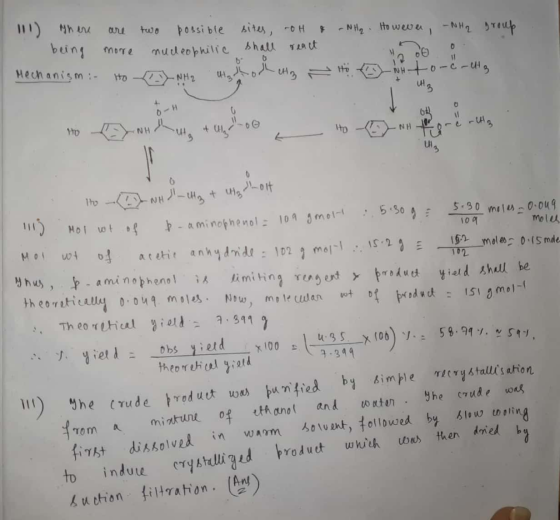
 m). A. Predict the products for the following reaction and write a rational mechanism. HO -NH2 (CH3CO)20 Mechanism:
help please! 13) Write a rational mechanism for the reaction of 3,4-Dichloronitrobenzene with Sodium Methoxide (30...
 help please!
13) Write a rational mechanism for the reaction of 3,4-Dichloronitrobenzene with Sodium Methoxide (30 points) 14) Indicate the limiting reagent and calculate the percent yield in the following reaction (30 points) NH2 NHCCH3 i + CH3C-0—CCH3 OH p-aminophenol OH acetaminophen p-aminophenol: molecular weight = 109.13 g/mol; grams utilized=0.6 acetic anhydride: molecular weight = 102.09 g/mol; density = 1.08 g/mL; mL utilized = 0.70 acetaminophen: molecular weight = 151.17 g/mol; grams obtained = 0.62 15) If lane 1 is...
help please!
13) Write a rational mechanism for the reaction of 3,4-Dichloronitrobenzene with Sodium Methoxide (30 points) 14) Indicate the limiting reagent and calculate the percent yield in the following reaction (30 points) NH2 NHCCH3 i + CH3C-0—CCH3 OH p-aminophenol OH acetaminophen p-aminophenol: molecular weight = 109.13 g/mol; grams utilized=0.6 acetic anhydride: molecular weight = 102.09 g/mol; density = 1.08 g/mL; mL utilized = 0.70 acetaminophen: molecular weight = 151.17 g/mol; grams obtained = 0.62 15) If lane 1 is...
preditct the product and provide a rational mechanism III). A. Predict the products for the following...
 preditct the product and provide a rational mechanism
III). A. Predict the products for the following reaction and write a rational mechanism. HO -NH2 (CH3CO)20 Mechanism:
preditct the product and provide a rational mechanism
III). A. Predict the products for the following reaction and write a rational mechanism. HO -NH2 (CH3CO)20 Mechanism:
1. A. Predict the products for the following reaction and write a rational mechanism. OCH3 (CH3CO20...
 1. A. Predict the products for the following reaction and write a rational mechanism. OCH3 (CH3CO20 AICI: Mechanism: 1. B. Why are much larger quantities of aluminum chloride required for Friedel-Crafts acylation reactions than for alkylation reactions? T.C. A student reacted anisole with acetic anhydride in dichloromethane using aluminum chloride as a catalyst. The student used the experimental procedure as described in the laboratory manual. At the end of the experiment the student failed to get +- methoxyacetophenone. Give reasons...
A similar pain reliever to aspirin is acetaminophen, which can be synthesized following a similar reaction scheme se...
 A similar pain reliever to aspirin is acetaminophen, which can be synthesized following a similar reaction scheme seen below. - H₂C H₂C HO NH. MH =0 + o + -cн, но p-Aminophenol нас Acetic anhydride Acetaminophen Acetic Acid a. If 2.00g of p-Aminophenol ( 109.1 g/mol) reacts with 5.00 mL of acetic anhydride (102.1 g/mol and density - 1.08 g/mL), what mass of acetaminophen (180.2 g/mol) would be made? Show all calculations. Mass of acetaminophen: b. If you only isolated...
predit the products for the followig reaction and write a rational mechanism 1. A. Predict the...
 predit the products for the followig reaction and write a
rational mechanism
1. A. Predict the products for the following reaction and write a rational mechanism. OCH (CH3CORO AICI: Mechanism:
predit the products for the followig reaction and write a
rational mechanism
1. A. Predict the products for the following reaction and write a rational mechanism. OCH (CH3CORO AICI: Mechanism:
Synthesis of Acetaminophen Postlab Questions During the crystallization of acetaminophen, why was...
 Synthesis of Acetaminophen Postlab Questions During the crystallization of acetaminophen, why was the mixture cooled in an ice bath? 1. In the reaction between p-aminophenol and acetic anhydride to form acetaminophen, 0.450 mL of water was added. What was the purpose of the water? 2. Why should you use a minimum amount of water to rinse the conical vial while transferring the purified acetaminophen to the Hirsch funnel? 3. If 0.130 g of p-aminophenol is allowed to react with excess...
You work for a pharmaceutical company and are in charge with the production of acetaminophen. Currently,...
You work for a pharmaceutical company and are in charge with the production of acetaminophen. Currently, 2.85 tons of acetaminophen are produced when using 5.50x10² gallons of acetic anhydride and 2.75 metric tons of p-aminophenol . What is the percent yield of the reaction? Write answer to three significant figures.
Draw a mechanism for the acetylation of p-methylaniline in reaction 3. Reaction 3: Acetylation NH2 NH2...
 Draw a mechanism for the acetylation of p-methylaniline
in reaction 3.
Reaction 3: Acetylation NH2 NH2 + NH2 (acetic anhydride) NH2 NH2 m-methylaniline p-methylaniline O-methylaniline m-methylaniline HN o-methylaniline O p-methylacetanilide Procedure for Reaction 3: 1) The solution of the three isomers of methylaniline in ethyl acetate was cooled to 0 °C. 2) An equimolar amount of acetic anhydride to the quantity of p-methylaniline theoretically present in the solution was added dropwise with stirring. 3) The stirring was continued for 15...
Draw a mechanism for the acetylation of p-methylaniline
in reaction 3.
Reaction 3: Acetylation NH2 NH2 + NH2 (acetic anhydride) NH2 NH2 m-methylaniline p-methylaniline O-methylaniline m-methylaniline HN o-methylaniline O p-methylacetanilide Procedure for Reaction 3: 1) The solution of the three isomers of methylaniline in ethyl acetate was cooled to 0 °C. 2) An equimolar amount of acetic anhydride to the quantity of p-methylaniline theoretically present in the solution was added dropwise with stirring. 3) The stirring was continued for 15...
13. In step 5 of reaction 3, the reaction mixture containing the products shown below in...
 13. In step 5 of reaction 3, the reaction mixture containing the products shown below in ethyl acetate is extracted twice with HCI. NH2 NH2 HN o-methylaniline m-methylaniline p-methylacetanilide a) Which products (shown above) from reaction 3 can react with HCl in an acid-base reaction? Show the mechanism for this acid-base reaction and give the structures that would result from the protonation of these products. Which phase (organic or aqueous) would these protonated products be soluble in? (6 points) b)...
 m). A. Predict the products for the following reaction and write a rational mechanism. HO -NH2 (CH3CO)20 Mechanism:
 help please!
13) Write a rational mechanism for the reaction of 3,4-Dichloronitrobenzene with Sodium Methoxide (30 points) 14) Indicate the limiting reagent and calculate the percent yield in the following reaction (30 points) NH2 NHCCH3 i + CH3C-0—CCH3 OH p-aminophenol OH acetaminophen p-aminophenol: molecular weight = 109.13 g/mol; grams utilized=0.6 acetic anhydride: molecular weight = 102.09 g/mol; density = 1.08 g/mL; mL utilized = 0.70 acetaminophen: molecular weight = 151.17 g/mol; grams obtained = 0.62 15) If lane 1 is...
help please!
13) Write a rational mechanism for the reaction of 3,4-Dichloronitrobenzene with Sodium Methoxide (30 points) 14) Indicate the limiting reagent and calculate the percent yield in the following reaction (30 points) NH2 NHCCH3 i + CH3C-0—CCH3 OH p-aminophenol OH acetaminophen p-aminophenol: molecular weight = 109.13 g/mol; grams utilized=0.6 acetic anhydride: molecular weight = 102.09 g/mol; density = 1.08 g/mL; mL utilized = 0.70 acetaminophen: molecular weight = 151.17 g/mol; grams obtained = 0.62 15) If lane 1 is...
 preditct the product and provide a rational mechanism
III). A. Predict the products for the following reaction and write a rational mechanism. HO -NH2 (CH3CO)20 Mechanism:
preditct the product and provide a rational mechanism
III). A. Predict the products for the following reaction and write a rational mechanism. HO -NH2 (CH3CO)20 Mechanism:
 1. A. Predict the products for the following reaction and write a rational mechanism. OCH3 (CH3CO20 AICI: Mechanism: 1. B. Why are much larger quantities of aluminum chloride required for Friedel-Crafts acylation reactions than for alkylation reactions? T.C. A student reacted anisole with acetic anhydride in dichloromethane using aluminum chloride as a catalyst. The student used the experimental procedure as described in the laboratory manual. At the end of the experiment the student failed to get +- methoxyacetophenone. Give reasons...
 A similar pain reliever to aspirin is acetaminophen, which can be synthesized following a similar reaction scheme seen below. - H₂C H₂C HO NH. MH =0 + o + -cн, но p-Aminophenol нас Acetic anhydride Acetaminophen Acetic Acid a. If 2.00g of p-Aminophenol ( 109.1 g/mol) reacts with 5.00 mL of acetic anhydride (102.1 g/mol and density - 1.08 g/mL), what mass of acetaminophen (180.2 g/mol) would be made? Show all calculations. Mass of acetaminophen: b. If you only isolated...
 predit the products for the followig reaction and write a
rational mechanism
1. A. Predict the products for the following reaction and write a rational mechanism. OCH (CH3CORO AICI: Mechanism:
predit the products for the followig reaction and write a
rational mechanism
1. A. Predict the products for the following reaction and write a rational mechanism. OCH (CH3CORO AICI: Mechanism:
 Synthesis of Acetaminophen Postlab Questions During the crystallization of acetaminophen, why was the mixture cooled in an ice bath? 1. In the reaction between p-aminophenol and acetic anhydride to form acetaminophen, 0.450 mL of water was added. What was the purpose of the water? 2. Why should you use a minimum amount of water to rinse the conical vial while transferring the purified acetaminophen to the Hirsch funnel? 3. If 0.130 g of p-aminophenol is allowed to react with excess...
 Draw a mechanism for the acetylation of p-methylaniline
in reaction 3.
Reaction 3: Acetylation NH2 NH2 + NH2 (acetic anhydride) NH2 NH2 m-methylaniline p-methylaniline O-methylaniline m-methylaniline HN o-methylaniline O p-methylacetanilide Procedure for Reaction 3: 1) The solution of the three isomers of methylaniline in ethyl acetate was cooled to 0 °C. 2) An equimolar amount of acetic anhydride to the quantity of p-methylaniline theoretically present in the solution was added dropwise with stirring. 3) The stirring was continued for 15...
Draw a mechanism for the acetylation of p-methylaniline
in reaction 3.
Reaction 3: Acetylation NH2 NH2 + NH2 (acetic anhydride) NH2 NH2 m-methylaniline p-methylaniline O-methylaniline m-methylaniline HN o-methylaniline O p-methylacetanilide Procedure for Reaction 3: 1) The solution of the three isomers of methylaniline in ethyl acetate was cooled to 0 °C. 2) An equimolar amount of acetic anhydride to the quantity of p-methylaniline theoretically present in the solution was added dropwise with stirring. 3) The stirring was continued for 15...
 13. In step 5 of reaction 3, the reaction mixture containing the products shown below in ethyl acetate is extracted twice with HCI. NH2 NH2 HN o-methylaniline m-methylaniline p-methylacetanilide a) Which products (shown above) from reaction 3 can react with HCl in an acid-base reaction? Show the mechanism for this acid-base reaction and give the structures that would result from the protonation of these products. Which phase (organic or aqueous) would these protonated products be soluble in? (6 points) b)...
Most questions answered within 3 hours.
-
Where is the error in this code sequence?
String s1 = "Hello";
String s2 = "ello";...
asked 10 months ago -
Financial data for Joel de Paris, Inc., for last year
follow:
Joel de Paris, Inc.
Balance...
asked 10 months ago -
Consider this reaction:
Al2(SO4)3 (aq)+ BaCl3
(aq) Al2Cl6 (aq)- +
3BaSO4(s) . What is the...
asked 10 months ago -
Suppose that Savneet is considering increasing her
recent random sample from 20 car rentals to 40...
asked 10 months ago -
Trucks arrive at an unloading terminal at an average rate of 120
per hour.
Trucks arrive...
asked 10 months ago -
Why are methanol and ethanol completely soluble in water while
octanol is not very little soluble....
asked 10 months ago -
A facilities manager at a university reads in a research report
that the mean amount of...
asked 10 months ago -
When the CuSO4 is rehydrated by adding water to the anhydrous
compound, is this an endothermic...
asked 10 months ago -
A ray of sunlight is passing from diamond into crown glass; the
angle of incidence is...
asked 10 months ago -
A block of mass 0.249 kg is placed on top of a light, vertical
spring of...
asked 10 months ago -
how do the kidneys compensate in the presences of acidosis
a) trigger hyperventilate
b) reserve acid...
asked 10 months ago -
Question 501 pts
The rental rate of capital to the firm increases. Which of the
following...
asked 10 months ago