Can someone please help solve this, its econ with stats
Homework Answers
Answer (14):
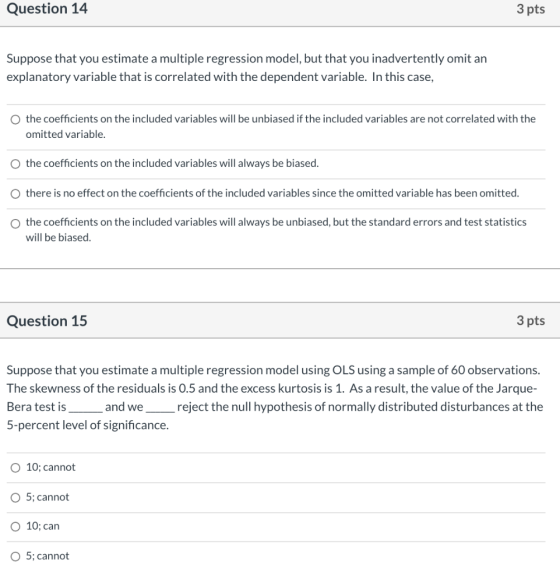
When you omit a expalnatory variable which is correlated with the dependnet variable, you commit a problem of ommision of relevant variables. Suppose the true model is:
Y = B1 + B2X2 + B3X3 + u
But you estimate the below model instead:
Y = A1 + A2X2 + u
Here you ommited X3, thus omitting a relevant variable.
The consequences of this is that the estimators will be biased i.e.
E(a1) = A1 ≠ B1 and E(a2) = A2 ≠ B2
Thus, the correct answer is the coefficients of the included variables will always be biased.
Answer (15):
The hypothesis for jarque bera test is:
H0: The residuals are normal
H1: The residuals are not normal
The test statistic for Jarque Bera test is:
JB = (n/6) * [S2 + (K-3)2/4 ]
where, n = sample size = 60
S = skewness = 0.5
K-3 = excess kurtosis = 1
So, JB = (60/6) * [0.52 + (1)2/4] = 10 * [0.25 + 0.25] = 5
This distribution follows chi-square distribution with 2 degrees of freedom.
At 5% level of significance, chi-square = 5.99
As JB(=5) < 5.99, we cannot Reject H0 at % level of significance.
Thus, the answers are 5 and cannot.
Add Answer to:
Can someone please help solve this, its econ with stats
Question 14 3 pts Suppose that...
Question 14 3 pts Suppose that you estimate a multiple regression model, but that you inadvertently...
 Question 14 3 pts Suppose that you estimate a multiple regression model, but that you inadvertently omit an explanatory variable that is correlated with the dependent variable. In this case, the coefficients on the included variables will always be biased. the coefficients on the included variables will always be unbiased, but the standard errors and test statistics will be biased. there is no effect on the coefficients of the included variables since the omitted variable has been omitted. the coefficients...
Question 13 3 pts Consider three data series, each a random sample of seven observations (n...
 Question 13 3 pts Consider three data series, each a random sample of seven observations (n = 7): Series 1: {1, 1, 1, 3, 5, 5, 5} Series 2: {1, 1, 3, 3, 3, 5, 5} Series 3: {1, 3, 3, 3, 3, 3, 5} The interquartile range of Series 3 is: 4 0 3 2 Question 14 3 pts Suppose that you estimate a multiple regression model, but that you inadvertently omit an explanatory variable that is correlated with...
Question 14 3 pts Suppose that you estimate a multiple regression model, but that you inadvertently...
 Question 14 3 pts Suppose that you estimate a multiple regression model, but that you inadvertently omit an explanatory variable that is correlated with the dependent variable. In this case, the coefficients on the included variables will always be unbiased, but the standard errors and test statistics will be biased. there is no effect on the coefficients of the included variables since the omitted variable has been omitted. the coefficients on the included variables will always be biased. the coefficients...
Suppose that you estimate a multiple regression model, but that you inadvertently omit an explanatory variable...
Suppose that you estimate a multiple regression model, but that you inadvertently omit an explanatory variable that is correlated with the dependent variable. In this case, the coefficients on the included variables will always be unbiased, but the standard errors and test statistics will be biased. the coefficients on the included variables will always be biased. there is no effect on the coefficients of the included variables since the omitted variable has been omitted. the coefficients on the included variables...
Question 15 3 pts Suppose that you estimate a multiple regression model using OLS using a...
 Question 15 3 pts Suppose that you estimate a multiple regression model using OLS using a sample of 120 observations. The skewness of the residuals is 0.5 and the excess kurtosis is 1. As a result, the value of the Jarque-Bera test is __and we reject the null hypothesis of normally distributed disturbances at the 5-percent level of significance. 5; cannot O 10; cannot 10; can 5; cannot
Question 15 3 pts Suppose that you estimate a multiple regression model using OLS using a...
 Question 15 3 pts Suppose that you estimate a multiple regression model using OLS using a sample of 120 observations. The skewness of the residuals is 0.5 and the excess kurtosis is 1. As a result, the value of the Jarque-Bera test is __and we reject the null hypothesis of normally distributed disturbances at the 5-percent level of significance. O 5; cannot O 10; can 5; cannot 10: cannot Question 16 3 pts
Suppose that you estimate a multiple regression model using OLS using a sample of 60 observations....
Suppose that you estimate a multiple regression model using OLS using a sample of 60 observations. The skewness of the residuals is 0.5 and the excess kurtosis is 1. As a result, the value of the Jarque-Bera test is _______ and we ______ reject the null hypothesis of normally distributed disturbances at the 5-percent level of significance. 10; cannot 10; can 5; cannot 5; cannot
Imagine that you regressed the earnings of individuals on a constant, a binary variable (“Male”) which...
Imagine that you regressed the earnings of individuals on a constant, a binary variable (“Male”) which takes on the value of 1 for males and is 0 otherwise, and another binary variable (“Female”) which takes on the value of 1 for female and is 0 otherwise. Because females typically earn less than males, you would expect: Group of answer choices autocorrelation or serial correlation to be a serious problem. the estimated coefficient for Male to have a positive sign, and...
Question 8 3 pts Suppose you estimate a multiple regression model using OLS and the coefficient...
 Question 8 3 pts Suppose you estimate a multiple regression model using OLS and the coefficient of determination is very high (above 0.8), while none of the estimated coefficients are (individually) statistically different from zero at the 5-percent level of significance. The most likely reason for this result is: O multicollinearity. omitted variable bias. O serial correlation. spurious regression. 3 pts Question 9
Question 8 3 pts Suppose you estimate a multiple regression model using OLS and the coefficient...
 Question 8 3 pts Suppose you estimate a multiple regression model using OLS and the coefficient of determination is very high (above 0.8), while none of the estimated coefficients are (individually) statistically different from zero at the 5-percent level of significance. The most likely reason for this result is: omitted variable bias. o serial correlation. spurious regression. o multicollinearity.
 Question 14 3 pts Suppose that you estimate a multiple regression model, but that you inadvertently omit an explanatory variable that is correlated with the dependent variable. In this case, the coefficients on the included variables will always be biased. the coefficients on the included variables will always be unbiased, but the standard errors and test statistics will be biased. there is no effect on the coefficients of the included variables since the omitted variable has been omitted. the coefficients...
 Question 13 3 pts Consider three data series, each a random sample of seven observations (n = 7): Series 1: {1, 1, 1, 3, 5, 5, 5} Series 2: {1, 1, 3, 3, 3, 5, 5} Series 3: {1, 3, 3, 3, 3, 3, 5} The interquartile range of Series 3 is: 4 0 3 2 Question 14 3 pts Suppose that you estimate a multiple regression model, but that you inadvertently omit an explanatory variable that is correlated with...
 Question 14 3 pts Suppose that you estimate a multiple regression model, but that you inadvertently omit an explanatory variable that is correlated with the dependent variable. In this case, the coefficients on the included variables will always be unbiased, but the standard errors and test statistics will be biased. there is no effect on the coefficients of the included variables since the omitted variable has been omitted. the coefficients on the included variables will always be biased. the coefficients...
 Question 15 3 pts Suppose that you estimate a multiple regression model using OLS using a sample of 120 observations. The skewness of the residuals is 0.5 and the excess kurtosis is 1. As a result, the value of the Jarque-Bera test is __and we reject the null hypothesis of normally distributed disturbances at the 5-percent level of significance. 5; cannot O 10; cannot 10; can 5; cannot
 Question 15 3 pts Suppose that you estimate a multiple regression model using OLS using a sample of 120 observations. The skewness of the residuals is 0.5 and the excess kurtosis is 1. As a result, the value of the Jarque-Bera test is __and we reject the null hypothesis of normally distributed disturbances at the 5-percent level of significance. O 5; cannot O 10; can 5; cannot 10: cannot Question 16 3 pts
 Question 8 3 pts Suppose you estimate a multiple regression model using OLS and the coefficient of determination is very high (above 0.8), while none of the estimated coefficients are (individually) statistically different from zero at the 5-percent level of significance. The most likely reason for this result is: O multicollinearity. omitted variable bias. O serial correlation. spurious regression. 3 pts Question 9
 Question 8 3 pts Suppose you estimate a multiple regression model using OLS and the coefficient of determination is very high (above 0.8), while none of the estimated coefficients are (individually) statistically different from zero at the 5-percent level of significance. The most likely reason for this result is: omitted variable bias. o serial correlation. spurious regression. o multicollinearity.
Most questions answered within 3 hours.
-
Where is the error in this code sequence?
String s1 = "Hello";
String s2 = "ello";...
asked 10 months ago -
Financial data for Joel de Paris, Inc., for last year
follow:
Joel de Paris, Inc.
Balance...
asked 10 months ago -
Consider this reaction:
Al2(SO4)3 (aq)+ BaCl3
(aq) Al2Cl6 (aq)- +
3BaSO4(s) . What is the...
asked 10 months ago -
Suppose that Savneet is considering increasing her
recent random sample from 20 car rentals to 40...
asked 10 months ago -
Trucks arrive at an unloading terminal at an average rate of 120
per hour.
Trucks arrive...
asked 10 months ago -
Why are methanol and ethanol completely soluble in water while
octanol is not very little soluble....
asked 10 months ago -
A facilities manager at a university reads in a research report
that the mean amount of...
asked 10 months ago -
When the CuSO4 is rehydrated by adding water to the anhydrous
compound, is this an endothermic...
asked 10 months ago -
A ray of sunlight is passing from diamond into crown glass; the
angle of incidence is...
asked 10 months ago -
A block of mass 0.249 kg is placed on top of a light, vertical
spring of...
asked 10 months ago -
how do the kidneys compensate in the presences of acidosis
a) trigger hyperventilate
b) reserve acid...
asked 10 months ago -
Question 501 pts
The rental rate of capital to the firm increases. Which of the
following...
asked 10 months ago