Give the degree measure of θ. θ = csc^-1 (-2) θ = arctan(-√3/3) θ = arcsin...
Give the degree measure of θ.
θ = csc^-1 (-2) θ = arctan(-√3/3) θ = arcsin (-1)
Homework Answers
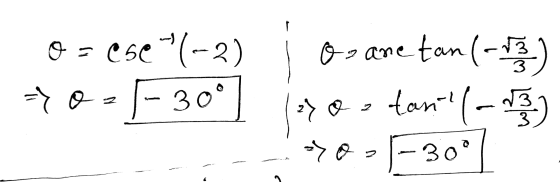
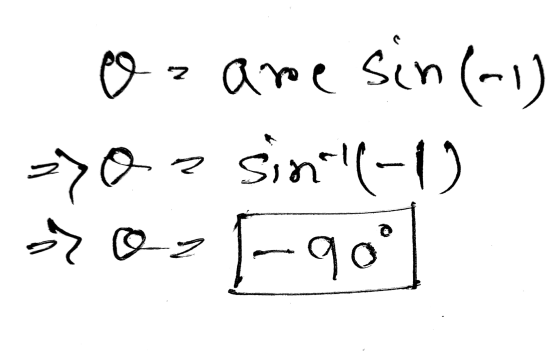
Hope it helps.
Add Answer to:
Give the degree measure of θ.
θ = csc^-1 (-2) θ = arctan(-√3/3) θ = arcsin...
Evaluate cos(arcsin 3/5-arctan 3)
Evaluate cos(arcsin 3/5-arctan 3)
5. Evaluate the value of arcsin (-2) 6. Evaluate the expression sin (arcsin (-3)). 7. Evaluate...
 5. Evaluate the value of arcsin (-2) 6. Evaluate the expression sin (arcsin (-3)). 7. Evaluate the expression arctan(cos(it)). 8. Evaluate the expression tan (arcsin (-2)
plzz help (1 point) Simplify each expression. (csc(t) – 1)(csc(t) + 1) = cot?(t) (sec(t) –...
 plzz help
(1 point) Simplify each expression. (csc(t) – 1)(csc(t) + 1) = cot?(t) (sec(t) – 1)(sec(t) + 1) = (1 – sin(t))(1 + sin(t)) = cos? (t) (1 point) Simplify the expression as much as possible. 1 - sin(t) Ti n ( = help (formulas) (1 point) Match the functions with their graphs. 1. f(x) = cos(x) 2. f(x) = sin(x) 3. f(x) = tan(x) 4. f(x) = arcsin(x) 5. f(x) = arccos(x) 6. f(x) = arctan(x)
plzz help
(1 point) Simplify each expression. (csc(t) – 1)(csc(t) + 1) = cot?(t) (sec(t) – 1)(sec(t) + 1) = (1 – sin(t))(1 + sin(t)) = cos? (t) (1 point) Simplify the expression as much as possible. 1 - sin(t) Ti n ( = help (formulas) (1 point) Match the functions with their graphs. 1. f(x) = cos(x) 2. f(x) = sin(x) 3. f(x) = tan(x) 4. f(x) = arcsin(x) 5. f(x) = arccos(x) 6. f(x) = arctan(x)
Solve the equation in the interval [0°, 360°). 4 sin^2θ = 3 csc θ = 1...
Solve the equation in the interval [0°, 360°). 4 sin^2θ = 3 csc θ = 1 + cot θ 3 sin^2θ - sin θ - 4 = 0 2 cos^3θ = cos θ
help with this questions. N/B show the working 1 Calculate maximum value of y= arctan )...
 help with this questions. N/B show the working
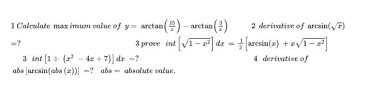
1 Calculate maximum value of y= arctan ) - ) 2 derivative of arcsin(7) 3 prove int(V1 – 2x2] da = [arcsin(x) + x V1 – x2] 3 int(1 : (x? - 4x + 7) dx =? 4 derivative of abs (arcsin(abs (2))] =? abs = absolute value.
help with this questions. N/B show the working
1 Calculate maximum value of y= arctan ) - ) 2 derivative of arcsin(7) 3 prove int(V1 – 2x2] da = [arcsin(x) + x V1 – x2] 3 int(1 : (x? - 4x + 7) dx =? 4 derivative of abs (arcsin(abs (2))] =? abs = absolute value.
(3 marks) In the 17th century, Machin obtained the formula π-arctan (1)-aret an (2,9) - arctain 239 Use the Taylor polynomial of degree 5 to approximate 4 arctan () - arcta235) (3 marks) Explain why...
 (3 marks) In the 17th century, Machin obtained the formula π-arctan (1)-aret an (2,9) - arctain 239 Use the Taylor polynomial of degree 5 to approximate 4 arctan () - arcta235) (3 marks) Explain why the convergence to π is so rapid in part (e) whereas in part (d), the convergence is slow
(3 marks) In the 17th century, Machin obtained the formula π-arctan (1)-aret an (2,9) - arctain 239 Use the Taylor polynomial of degree 5 to approximate 4...
(3 marks) In the 17th century, Machin obtained the formula π-arctan (1)-aret an (2,9) - arctain 239 Use the Taylor polynomial of degree 5 to approximate 4 arctan () - arcta235) (3 marks) Explain why the convergence to π is so rapid in part (e) whereas in part (d), the convergence is slow
(3 marks) In the 17th century, Machin obtained the formula π-arctan (1)-aret an (2,9) - arctain 239 Use the Taylor polynomial of degree 5 to approximate 4...
Evaluate: cos (sec s(sec(2) + arctan (-3)). Give an exact answer.
 Evaluate: cos (sec s(sec(2) + arctan (-3)). Give an exact answer.
answer the 2 questiojs 2. Use trigonometry identities to show that 2.41-61+ , where θ 1s an angle in 120] radians 3. Prove whether y=arctan x 1s even, odd or [10] neither 2. Use trigonometry...
 answer the 2 questiojs
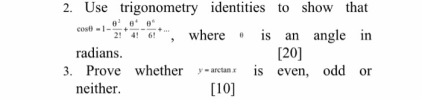
2. Use trigonometry identities to show that 2.41-61+ , where θ 1s an angle in 120] radians 3. Prove whether y=arctan x 1s even, odd or [10] neither
2. Use trigonometry identities to show that 2.41-61+ , where θ 1s an angle in 120] radians 3. Prove whether y=arctan x 1s even, odd or [10] neither
answer the 2 questiojs
2. Use trigonometry identities to show that 2.41-61+ , where θ 1s an angle in 120] radians 3. Prove whether y=arctan x 1s even, odd or [10] neither
2. Use trigonometry identities to show that 2.41-61+ , where θ 1s an angle in 120] radians 3. Prove whether y=arctan x 1s even, odd or [10] neither
1. Why does ?????? (sin (7pi/6)) give an answer, but ??? (arcsin (7pi/6)) is undefined? 2....
1. Why does ?????? (sin (7pi/6)) give an answer, but ??? (arcsin (7pi/6)) is undefined? 2. Solve 2 cos theta −?= 0 for 0°≤ theta < 360°
4. (a) Indicate where the series is (i) absolutely convergent, n-1 where it is (ii) conditionally convergent, and where it is (iii) divergent. Justify your answers Find f,(z) if f(x) = arctan (e* ) +...
 4. (a) Indicate where the series is (i) absolutely convergent, n-1 where it is (ii) conditionally convergent, and where it is (iii) divergent. Justify your answers Find f,(z) if f(x) = arctan (e* ) + arcsin V2x + 4. (b) (a) Set up (but do not evaluate) a definite integral that represents the area 5. of the region R inside the circle r = 4 sin θ and outside the circle r = 2. Carefully sketch the region R. (i)...
 5. Evaluate the value of arcsin (-2) 6. Evaluate the expression sin (arcsin (-3)). 7. Evaluate the expression arctan(cos(it)). 8. Evaluate the expression tan (arcsin (-2)
 plzz help
(1 point) Simplify each expression. (csc(t) – 1)(csc(t) + 1) = cot?(t) (sec(t) – 1)(sec(t) + 1) = (1 – sin(t))(1 + sin(t)) = cos? (t) (1 point) Simplify the expression as much as possible. 1 - sin(t) Ti n ( = help (formulas) (1 point) Match the functions with their graphs. 1. f(x) = cos(x) 2. f(x) = sin(x) 3. f(x) = tan(x) 4. f(x) = arcsin(x) 5. f(x) = arccos(x) 6. f(x) = arctan(x)
plzz help
(1 point) Simplify each expression. (csc(t) – 1)(csc(t) + 1) = cot?(t) (sec(t) – 1)(sec(t) + 1) = (1 – sin(t))(1 + sin(t)) = cos? (t) (1 point) Simplify the expression as much as possible. 1 - sin(t) Ti n ( = help (formulas) (1 point) Match the functions with their graphs. 1. f(x) = cos(x) 2. f(x) = sin(x) 3. f(x) = tan(x) 4. f(x) = arcsin(x) 5. f(x) = arccos(x) 6. f(x) = arctan(x)
 help with this questions. N/B show the working
1 Calculate maximum value of y= arctan ) - ) 2 derivative of arcsin(7) 3 prove int(V1 – 2x2] da = [arcsin(x) + x V1 – x2] 3 int(1 : (x? - 4x + 7) dx =? 4 derivative of abs (arcsin(abs (2))] =? abs = absolute value.
help with this questions. N/B show the working
1 Calculate maximum value of y= arctan ) - ) 2 derivative of arcsin(7) 3 prove int(V1 – 2x2] da = [arcsin(x) + x V1 – x2] 3 int(1 : (x? - 4x + 7) dx =? 4 derivative of abs (arcsin(abs (2))] =? abs = absolute value.
 (3 marks) In the 17th century, Machin obtained the formula π-arctan (1)-aret an (2,9) - arctain 239 Use the Taylor polynomial of degree 5 to approximate 4 arctan () - arcta235) (3 marks) Explain why the convergence to π is so rapid in part (e) whereas in part (d), the convergence is slow
(3 marks) In the 17th century, Machin obtained the formula π-arctan (1)-aret an (2,9) - arctain 239 Use the Taylor polynomial of degree 5 to approximate 4...
(3 marks) In the 17th century, Machin obtained the formula π-arctan (1)-aret an (2,9) - arctain 239 Use the Taylor polynomial of degree 5 to approximate 4 arctan () - arcta235) (3 marks) Explain why the convergence to π is so rapid in part (e) whereas in part (d), the convergence is slow
(3 marks) In the 17th century, Machin obtained the formula π-arctan (1)-aret an (2,9) - arctain 239 Use the Taylor polynomial of degree 5 to approximate 4...
 Evaluate: cos (sec s(sec(2) + arctan (-3)). Give an exact answer.
 answer the 2 questiojs
2. Use trigonometry identities to show that 2.41-61+ , where θ 1s an angle in 120] radians 3. Prove whether y=arctan x 1s even, odd or [10] neither
2. Use trigonometry identities to show that 2.41-61+ , where θ 1s an angle in 120] radians 3. Prove whether y=arctan x 1s even, odd or [10] neither
answer the 2 questiojs
2. Use trigonometry identities to show that 2.41-61+ , where θ 1s an angle in 120] radians 3. Prove whether y=arctan x 1s even, odd or [10] neither
2. Use trigonometry identities to show that 2.41-61+ , where θ 1s an angle in 120] radians 3. Prove whether y=arctan x 1s even, odd or [10] neither
 4. (a) Indicate where the series is (i) absolutely convergent, n-1 where it is (ii) conditionally convergent, and where it is (iii) divergent. Justify your answers Find f,(z) if f(x) = arctan (e* ) + arcsin V2x + 4. (b) (a) Set up (but do not evaluate) a definite integral that represents the area 5. of the region R inside the circle r = 4 sin θ and outside the circle r = 2. Carefully sketch the region R. (i)...
Most questions answered within 3 hours.
-
Where is the error in this code sequence?
String s1 = "Hello";
String s2 = "ello";...
asked 11 months ago -
Financial data for Joel de Paris, Inc., for last year
follow:
Joel de Paris, Inc.
Balance...
asked 11 months ago -
Consider this reaction:
Al2(SO4)3 (aq)+ BaCl3
(aq) Al2Cl6 (aq)- +
3BaSO4(s) . What is the...
asked 11 months ago -
Suppose that Savneet is considering increasing her
recent random sample from 20 car rentals to 40...
asked 11 months ago -
Trucks arrive at an unloading terminal at an average rate of 120
per hour.
Trucks arrive...
asked 11 months ago -
Why are methanol and ethanol completely soluble in water while
octanol is not very little soluble....
asked 11 months ago -
A facilities manager at a university reads in a research report
that the mean amount of...
asked 11 months ago -
When the CuSO4 is rehydrated by adding water to the anhydrous
compound, is this an endothermic...
asked 11 months ago -
A ray of sunlight is passing from diamond into crown glass; the
angle of incidence is...
asked 11 months ago -
A block of mass 0.249 kg is placed on top of a light, vertical
spring of...
asked 11 months ago -
how do the kidneys compensate in the presences of acidosis
a) trigger hyperventilate
b) reserve acid...
asked 11 months ago -
Question 501 pts
The rental rate of capital to the firm increases. Which of the
following...
asked 11 months ago