
Homework Answers

![E (x2) = Ex» f (x) 2 (-1) ² x 0.3 + DX 0.4 + (1) 0.3 Ixo.3 + o t ( xo-3 0.3 t 0.3 E (x²) = 0.6 So, V(X) = ECx²) - [E(X)]² 0.6](http://img.homeworklib.com/questions/932787f0-0db9-11eb-8c70-8b8f6014a486.png?x-oss-process=image/resize,w_560)

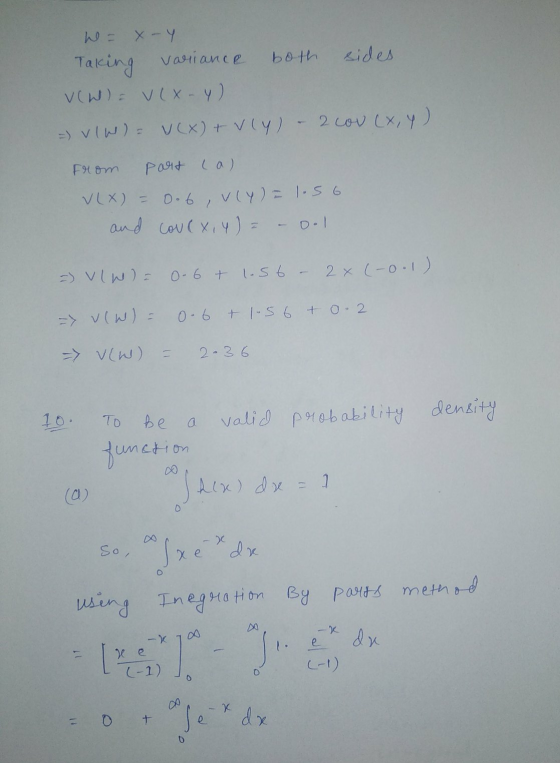
![у o 8 (-1) = (-1) Le eº] = (-1) Lo- 1] D + I So, it is a So, Ixe dx = 1 valid probability density function (6) By the definit](http://img.homeworklib.com/questions/96d91430-0db9-11eb-9398-1f09904e4984.png?x-oss-process=image/resize,w_560)
![= E(X) = B xl Elx) N1 3. [since (n-1)!] = E(X) 2! so, Elx) = 2 V(x) E (x²) - [E(X)] [E (x)] 2 2. e e dre so, E(X²) = x ng xe](http://img.homeworklib.com/questions/97f1f480-0db9-11eb-bd0f-b50b64878716.png?x-oss-process=image/resize,w_560)

Add Answer to:
1 3 4 9. Suppose the discrete random variables X and Y are jointly distributed according...
-1 1 9. Suppose the discrete random variables X and Y are jointly distributed according to...
 -1 1 9. Suppose the discrete random variables X and Y are jointly distributed according to the following table: 0 0.1 0.1 0.1 3 0 0.2 0.1 4 0.2 0.1 0.1 2x 1 a. Compute the expected values E(X) and E(Y), variances V(X) and V(Y), and covariance Cov(X,Y) of X and Y. [11] b. Let W = X – Y. Compute E(W) and V(W). [4]
9. Suppose the discrete random variables X and Y are jointly distributed according to the following...
 9. Suppose the discrete random variables X and Y are jointly distributed according to the following table: Y|Y -1 0 1 0.1 0.1 0.1 3 0 0.2 0.1 4. 0.2 0.1 0.1 1 a. Compute the expected values E(X) and E(Y), variances V(X) and V(Y), and covariance Cov(X,Y) of X and Y. [11] b. Let W = X – Y. Compute E(W) and V(W). [4]
3. Let the random variables X and Y have the joint probability density function 0 y...
 3. Let the random variables X and Y have the joint probability density function 0 y 1, 0 x < y fxy(x, y)y otherwise (a) Compute the joint expectation E(XY) (b) Compute the marginal expectations E(X) and E (Y) (c) Compute the covariance Cov(X, Y)
3. Let the random variables X and Y have the joint probability density function fxr (x,...
 3. Let the random variables X and Y have the joint probability density function fxr (x, y) = 0 <y<1, 0<xsy otherwise (a) Compute the joint expectation E(XY). (b) Compute the marginal expectations E(X) and E(Y). (c) Compute the covariance Cov(X,Y).
55. Let X and Y be jointly continuous random variables with joint density function fx.y(x,y) be-3y...
 55. Let X and Y be jointly continuous random variables with joint density function fx.y(x,y) be-3y -a < x < 2a, 0) < y < 00, otherwise. Assume that E[XY] = 1/6. (a) Find a and b such that fx,y is a valid joint pdf. You may want to use the fact that du = 1. u 6. и е (b) Find the conditional pdf of X given Y = y where 0 <y < . (c) Find Cov(X,Y). (d)...
2. Let X and Y be continuous random variables with joint probability density function fx,y(x,y) 0, otherwise (a) Compute the value of k that will make f(x, y) a legitimate joint probability density f...
 2. Let X and Y be continuous random variables with joint probability density function fx,y(x,y) 0, otherwise (a) Compute the value of k that will make f(x, y) a legitimate joint probability density function. Use f(x.y) with that value of k as the joint probability density function of X, Y in parts (b),(c).(d),(e (b) Find the probability density functions of X and Y. (c) Find the expected values of X, Y and XY (d) Compute the covariance Cov(X,Y) of X...
Question 4: Let X and Y be two discrete random variables with the following joint probability...
 Question 4: Let X and Y be two discrete random variables with the following joint probability distribution (mass) function Pxy(x, y): a) Complete the following probability table: Y 2 f(x)=P(X=x) 1 3 4 0 0 0.08 0.06 0.05 0.02 0.07 0.08 0.06 0.12 0.05 0.03 0.06 0.05 0.04 0.03 0.01 0.02 0.03 0.04 2 3 foy)=P(Y=y) 0.03 b) What is P(X s 2 and YS 3)? c) Find the marginal probability distribution (mass) function of X; [f(x)]. d) Find the...
Let the random variable X and Y have the joint probability density function. fxy(x,y) lo, 3....
 Let the random variable X and Y
have the joint probability density function.
fxy(x,y) lo, 3. Let the random variables X and Y have the joint probability density function fxy(x, y) = 0<y<1, 0<x<y otherwise (a) Compute the joint expectation E(XY). (b) Compute the marginal expectations E(X) and E(Y). (c) Compute the covariance Cov(X,Y).
Let the random variable X and Y
have the joint probability density function.
fxy(x,y) lo, 3. Let the random variables X and Y have the joint probability density function fxy(x, y) = 0<y<1, 0<x<y otherwise (a) Compute the joint expectation E(XY). (b) Compute the marginal expectations E(X) and E(Y). (c) Compute the covariance Cov(X,Y).
Two discrete random variables X and Y are jointly distributed.
 .1. Two discrete random variables X and Y are jointly distributed. The joint pmf is f(z, y) = 1/28 , SX = {0, 1, 2, 3, 4, 5,6}, and SY = {0, .... X), where Y is a non-negative integer a) Find the marginal pdfs of X and Y b) Caculate E(X) and E(Y). 2. Let the joint pdf of X aud Y be a) Draw the graph of the support of X and Y b) Determine c in the joint pdf. c) Find E(X +Y),...
Suppose that X and Y are jointly continuous random variables with joint probability density function f(x,y)...
 Suppose that X and Y are jointly continuous random variables with joint probability density function f(x,y) = {12rºy, 1 0, 0<x<a, 0<y<1 otherwise i) Determine the constant a ii) Find P(0<x<0.5, O Y<0.25) HE) Find the marginal PDFs fex) and y) iv) Find the expected value of X and Y. Le. E(X) and E(Y) v) Are X and Y independent? Justify your answer.
 -1 1 9. Suppose the discrete random variables X and Y are jointly distributed according to the following table: 0 0.1 0.1 0.1 3 0 0.2 0.1 4 0.2 0.1 0.1 2x 1 a. Compute the expected values E(X) and E(Y), variances V(X) and V(Y), and covariance Cov(X,Y) of X and Y. [11] b. Let W = X – Y. Compute E(W) and V(W). [4]
 9. Suppose the discrete random variables X and Y are jointly distributed according to the following table: Y|Y -1 0 1 0.1 0.1 0.1 3 0 0.2 0.1 4. 0.2 0.1 0.1 1 a. Compute the expected values E(X) and E(Y), variances V(X) and V(Y), and covariance Cov(X,Y) of X and Y. [11] b. Let W = X – Y. Compute E(W) and V(W). [4]
 3. Let the random variables X and Y have the joint probability density function 0 y 1, 0 x < y fxy(x, y)y otherwise (a) Compute the joint expectation E(XY) (b) Compute the marginal expectations E(X) and E (Y) (c) Compute the covariance Cov(X, Y)
 3. Let the random variables X and Y have the joint probability density function fxr (x, y) = 0 <y<1, 0<xsy otherwise (a) Compute the joint expectation E(XY). (b) Compute the marginal expectations E(X) and E(Y). (c) Compute the covariance Cov(X,Y).
 55. Let X and Y be jointly continuous random variables with joint density function fx.y(x,y) be-3y -a < x < 2a, 0) < y < 00, otherwise. Assume that E[XY] = 1/6. (a) Find a and b such that fx,y is a valid joint pdf. You may want to use the fact that du = 1. u 6. и е (b) Find the conditional pdf of X given Y = y where 0 <y < . (c) Find Cov(X,Y). (d)...
 2. Let X and Y be continuous random variables with joint probability density function fx,y(x,y) 0, otherwise (a) Compute the value of k that will make f(x, y) a legitimate joint probability density function. Use f(x.y) with that value of k as the joint probability density function of X, Y in parts (b),(c).(d),(e (b) Find the probability density functions of X and Y. (c) Find the expected values of X, Y and XY (d) Compute the covariance Cov(X,Y) of X...
 Question 4: Let X and Y be two discrete random variables with the following joint probability distribution (mass) function Pxy(x, y): a) Complete the following probability table: Y 2 f(x)=P(X=x) 1 3 4 0 0 0.08 0.06 0.05 0.02 0.07 0.08 0.06 0.12 0.05 0.03 0.06 0.05 0.04 0.03 0.01 0.02 0.03 0.04 2 3 foy)=P(Y=y) 0.03 b) What is P(X s 2 and YS 3)? c) Find the marginal probability distribution (mass) function of X; [f(x)]. d) Find the...
 Let the random variable X and Y
have the joint probability density function.
fxy(x,y) lo, 3. Let the random variables X and Y have the joint probability density function fxy(x, y) = 0<y<1, 0<x<y otherwise (a) Compute the joint expectation E(XY). (b) Compute the marginal expectations E(X) and E(Y). (c) Compute the covariance Cov(X,Y).
Let the random variable X and Y
have the joint probability density function.
fxy(x,y) lo, 3. Let the random variables X and Y have the joint probability density function fxy(x, y) = 0<y<1, 0<x<y otherwise (a) Compute the joint expectation E(XY). (b) Compute the marginal expectations E(X) and E(Y). (c) Compute the covariance Cov(X,Y).
 Suppose that X and Y are jointly continuous random variables with joint probability density function f(x,y) = {12rºy, 1 0, 0<x<a, 0<y<1 otherwise i) Determine the constant a ii) Find P(0<x<0.5, O Y<0.25) HE) Find the marginal PDFs fex) and y) iv) Find the expected value of X and Y. Le. E(X) and E(Y) v) Are X and Y independent? Justify your answer.
Most questions answered within 3 hours.
-
Where is the error in this code sequence?
String s1 = "Hello";
String s2 = "ello";...
asked 10 months ago -
Financial data for Joel de Paris, Inc., for last year
follow:
Joel de Paris, Inc.
Balance...
asked 10 months ago -
Consider this reaction:
Al2(SO4)3 (aq)+ BaCl3
(aq) Al2Cl6 (aq)- +
3BaSO4(s) . What is the...
asked 10 months ago -
Suppose that Savneet is considering increasing her
recent random sample from 20 car rentals to 40...
asked 10 months ago -
Trucks arrive at an unloading terminal at an average rate of 120
per hour.
Trucks arrive...
asked 10 months ago -
Why are methanol and ethanol completely soluble in water while
octanol is not very little soluble....
asked 10 months ago -
A facilities manager at a university reads in a research report
that the mean amount of...
asked 10 months ago -
When the CuSO4 is rehydrated by adding water to the anhydrous
compound, is this an endothermic...
asked 10 months ago -
A ray of sunlight is passing from diamond into crown glass; the
angle of incidence is...
asked 10 months ago -
A block of mass 0.249 kg is placed on top of a light, vertical
spring of...
asked 10 months ago -
how do the kidneys compensate in the presences of acidosis
a) trigger hyperventilate
b) reserve acid...
asked 10 months ago -
Question 501 pts
The rental rate of capital to the firm increases. Which of the
following...
asked 10 months ago