
Homework Answers
Add Answer to:
4 HW_2nd ODE Application Part A) Mass spring damper system as represented in the figure. If...
. Shies Paragraph HW 2-ODE Application Part Al Mass spring damper system as represented in the...
 .
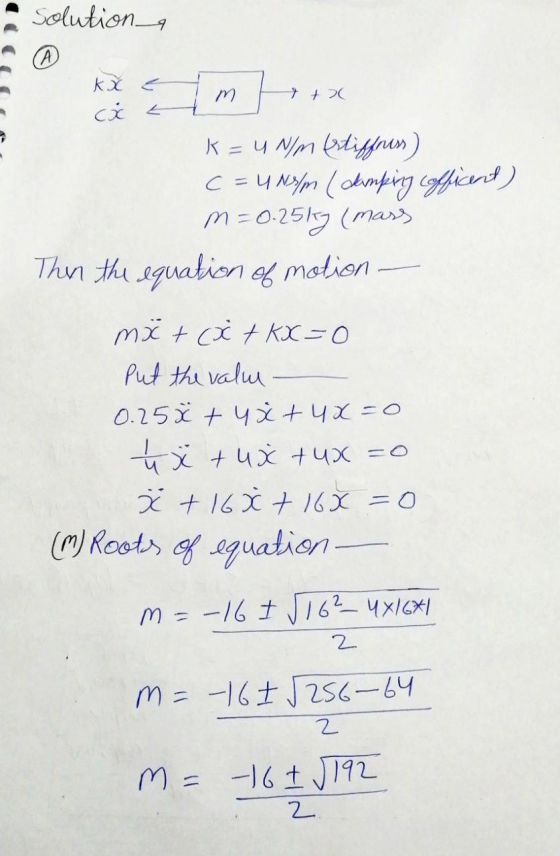
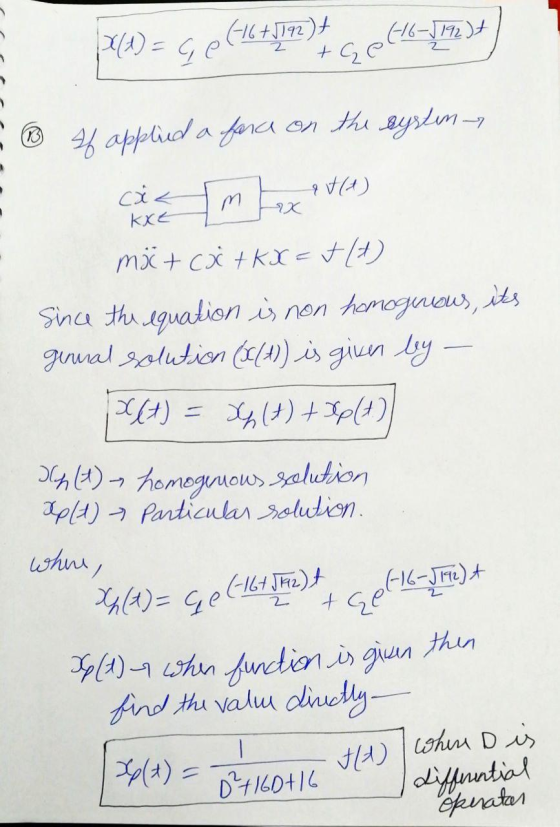
Shies Paragraph HW 2-ODE Application Part Al Mass spring damper system as represented in the figure. If the block has a mass of 0.25 g started vibrated freely from rest at the equilibrium position, the spring is a massless with a stiffness of (N/m) and the damping coefficient ciNs/m such that is less than 4 Na/m. Find all possible equations of motion (t) for the block Part If two DC motors applied an external force (t) = n(t) and...
.
Shies Paragraph HW 2-ODE Application Part Al Mass spring damper system as represented in the figure. If the block has a mass of 0.25 g started vibrated freely from rest at the equilibrium position, the spring is a massless with a stiffness of (N/m) and the damping coefficient ciNs/m such that is less than 4 Na/m. Find all possible equations of motion (t) for the block Part If two DC motors applied an external force (t) = n(t) and...
Please write legibly Consider an ideal mass-spring-damper system similar to Figure 3.2. Find the damping coefficient of the system if a mass of 380 g is used in combination with a spring with stif...
 Please write legibly
Consider an ideal mass-spring-damper system similar to Figure 3.2. Find the damping coefficient of the system if a mass of 380 g is used in combination with a spring with stiffness k = 17 N/m and a period of 0.945 s. If the system is released from rest 5 cm from it's equilibrium point at to = 0 s, find the trajectory of the position of the mass-spring-damper from it's release until t 3s Figure 3.2: Mass-spring-damper...
Please write legibly
Consider an ideal mass-spring-damper system similar to Figure 3.2. Find the damping coefficient of the system if a mass of 380 g is used in combination with a spring with stiffness k = 17 N/m and a period of 0.945 s. If the system is released from rest 5 cm from it's equilibrium point at to = 0 s, find the trajectory of the position of the mass-spring-damper from it's release until t 3s Figure 3.2: Mass-spring-damper...
1. Given the spring-mass-damper system in the figure below T3 T1 T2 b2 b1 k3 (a) Find the equatio...
 1. Given the spring-mass-damper system in the figure below T3 T1 T2 b2 b1 k3 (a) Find the equations of motion for each of the masses 脳. Fi(s) (b) Assume F1 0 and find the transfer function (c) Assume Fs 0 and find the transfer function (d) Write the equations in matrix-vector form: M.ї + Bi + Kx-F where z is a 3 x 1 vector with the displacements r,2, r3 as components, M is the mass matrix, B is...
Please show work 3. Given a mass-spring-damper system, the 2kg mass is connected to two linear...
 Please show work
3. Given a mass-spring-damper system, the 2kg mass is connected to two linear springs with stiffness coefficients ki- 100 N/m and ki 150 N/m and a viscous damper with b 50 Ns/m. A constant force of SN is applied as shown. The effect of friction is negligible. ki m b 3.1 [2pts] Determine the equivalent stiffness of the springs. 3.2 [3pts] Draw the free-body diagram of the system. Define the generalized coordinate and label your forces and...
Please show work
3. Given a mass-spring-damper system, the 2kg mass is connected to two linear springs with stiffness coefficients ki- 100 N/m and ki 150 N/m and a viscous damper with b 50 Ns/m. A constant force of SN is applied as shown. The effect of friction is negligible. ki m b 3.1 [2pts] Determine the equivalent stiffness of the springs. 3.2 [3pts] Draw the free-body diagram of the system. Define the generalized coordinate and label your forces and...
3. The motion of a 1DOF mass-spring-damper system (see Figure 1) is modeled by the following seco...
 3. The motion of a 1DOF mass-spring-damper system (see Figure 1) is modeled by the following second order linear ODE: dx,2 dt n dt2 (0) C dt where is the damping ratio an wn is the natural frequency, both related to k, b, and m (the spring constant, damping coefficient, and mass, respectively) (a) Use the forward difference approximations of (b) Using Δt andd to obtain a finite difference formula for x(t+ 2Δ) (like we did in class for the...
2 with spring stiffness k 1000 N/m, Consider a mass-spring-damper system shown in Figure mass m...
 2 with spring stiffness k 1000 N/m, Consider a mass-spring-damper system shown in Figure mass m = 10 kg, and damping constant c-150 N-s/m. If the initial displacement is xo-o and the initial velocity is 10 m/s (1) Find the damping ratio. (2) Is the system underdamped or overdamped? Why? (3) Calculate the damped natural frequency (4) Determine the free vibration response of the system.
A second order mechanical system of a mass connected to a spring and a damper is subjected to a s...
 A second order mechanical system of a mass connected to a spring and a damper is subjected to a sinusoidal input force mi+ci +kx- Asin(ot) The mass is m-5 kg, the damping constant is c = 1 N-sec/m, the spring stiffness is 2 N/m, and the amplitude of the input force is A- 3 N. For this system give explicit numerical values for the damping factor un-damped natural frequency on a. and the
A second order mechanical system of a...
A second order mechanical system of a mass connected to a spring and a damper is subjected to a sinusoidal input force mi+ci +kx- Asin(ot) The mass is m-5 kg, the damping constant is c = 1 N-sec/m, the spring stiffness is 2 N/m, and the amplitude of the input force is A- 3 N. For this system give explicit numerical values for the damping factor un-damped natural frequency on a. and the
A second order mechanical system of a...
Problem 1 (Harmonic Oscillators) A mass-damper-spring system is a simple harmonic oscillator whose dynamics is governed...
 Problem 1 (Harmonic Oscillators) A mass-damper-spring system is a simple harmonic oscillator whose dynamics is governed by the equation of motion where m is the mass, c is the damping coefficient of the damper, k is the stiffness of the spring, F is the net force applied on the mass, and x is the displacement of the mass from its equilibrium point. In this problem, we focus on a mass-damper-spring system with m = 1 kg, c-4 kg/s, k-3 N/m,...
Thanks in advance 4. (8 points) We consider the mass-spring-dnmper systen in Figure &: A block...
 Thanks in advance
4. (8 points) We consider the mass-spring-dnmper systen in Figure &: A block af mes is saspended fron the eeiling by n spring with eonistant k nnd unstretched length lo and a damper with damping eoeficient d The block ean anly move vertienlly nnd its poesition is theresore fually deseribed by the z-courdinnte. An nlternative poeition is mensued from the statie rest position Furthermore, ngravitational neeclerstioa with mngnitude g is present. SYSTEM Fgure & A rigid body...
Thanks in advance
4. (8 points) We consider the mass-spring-dnmper systen in Figure &: A block af mes is saspended fron the eeiling by n spring with eonistant k nnd unstretched length lo and a damper with damping eoeficient d The block ean anly move vertienlly nnd its poesition is theresore fually deseribed by the z-courdinnte. An nlternative poeition is mensued from the statie rest position Furthermore, ngravitational neeclerstioa with mngnitude g is present. SYSTEM Fgure & A rigid body...
4. The two mass spring damper system below can be represented by the two differential equations...
 4. The two mass spring damper system below can be represented by the two differential equations TIR1 Since the system is represented by two second-order differential equations, find a fourth-order state- space representation, that is y=Cz + Du where A e R1x4, BE Rx, CERix4, and D Rx1. Use the state vector Hint: first, solve the first equation for , then replace by 21, by z2, and r2 by z3 as defined by matrix-vector form.
 .
Shies Paragraph HW 2-ODE Application Part Al Mass spring damper system as represented in the figure. If the block has a mass of 0.25 g started vibrated freely from rest at the equilibrium position, the spring is a massless with a stiffness of (N/m) and the damping coefficient ciNs/m such that is less than 4 Na/m. Find all possible equations of motion (t) for the block Part If two DC motors applied an external force (t) = n(t) and...
.
Shies Paragraph HW 2-ODE Application Part Al Mass spring damper system as represented in the figure. If the block has a mass of 0.25 g started vibrated freely from rest at the equilibrium position, the spring is a massless with a stiffness of (N/m) and the damping coefficient ciNs/m such that is less than 4 Na/m. Find all possible equations of motion (t) for the block Part If two DC motors applied an external force (t) = n(t) and...
 Please write legibly
Consider an ideal mass-spring-damper system similar to Figure 3.2. Find the damping coefficient of the system if a mass of 380 g is used in combination with a spring with stiffness k = 17 N/m and a period of 0.945 s. If the system is released from rest 5 cm from it's equilibrium point at to = 0 s, find the trajectory of the position of the mass-spring-damper from it's release until t 3s Figure 3.2: Mass-spring-damper...
Please write legibly
Consider an ideal mass-spring-damper system similar to Figure 3.2. Find the damping coefficient of the system if a mass of 380 g is used in combination with a spring with stiffness k = 17 N/m and a period of 0.945 s. If the system is released from rest 5 cm from it's equilibrium point at to = 0 s, find the trajectory of the position of the mass-spring-damper from it's release until t 3s Figure 3.2: Mass-spring-damper...
 1. Given the spring-mass-damper system in the figure below T3 T1 T2 b2 b1 k3 (a) Find the equations of motion for each of the masses 脳. Fi(s) (b) Assume F1 0 and find the transfer function (c) Assume Fs 0 and find the transfer function (d) Write the equations in matrix-vector form: M.ї + Bi + Kx-F where z is a 3 x 1 vector with the displacements r,2, r3 as components, M is the mass matrix, B is...
 Please show work
3. Given a mass-spring-damper system, the 2kg mass is connected to two linear springs with stiffness coefficients ki- 100 N/m and ki 150 N/m and a viscous damper with b 50 Ns/m. A constant force of SN is applied as shown. The effect of friction is negligible. ki m b 3.1 [2pts] Determine the equivalent stiffness of the springs. 3.2 [3pts] Draw the free-body diagram of the system. Define the generalized coordinate and label your forces and...
Please show work
3. Given a mass-spring-damper system, the 2kg mass is connected to two linear springs with stiffness coefficients ki- 100 N/m and ki 150 N/m and a viscous damper with b 50 Ns/m. A constant force of SN is applied as shown. The effect of friction is negligible. ki m b 3.1 [2pts] Determine the equivalent stiffness of the springs. 3.2 [3pts] Draw the free-body diagram of the system. Define the generalized coordinate and label your forces and...
 3. The motion of a 1DOF mass-spring-damper system (see Figure 1) is modeled by the following second order linear ODE: dx,2 dt n dt2 (0) C dt where is the damping ratio an wn is the natural frequency, both related to k, b, and m (the spring constant, damping coefficient, and mass, respectively) (a) Use the forward difference approximations of (b) Using Δt andd to obtain a finite difference formula for x(t+ 2Δ) (like we did in class for the...
 2 with spring stiffness k 1000 N/m, Consider a mass-spring-damper system shown in Figure mass m = 10 kg, and damping constant c-150 N-s/m. If the initial displacement is xo-o and the initial velocity is 10 m/s (1) Find the damping ratio. (2) Is the system underdamped or overdamped? Why? (3) Calculate the damped natural frequency (4) Determine the free vibration response of the system.
 A second order mechanical system of a mass connected to a spring and a damper is subjected to a sinusoidal input force mi+ci +kx- Asin(ot) The mass is m-5 kg, the damping constant is c = 1 N-sec/m, the spring stiffness is 2 N/m, and the amplitude of the input force is A- 3 N. For this system give explicit numerical values for the damping factor un-damped natural frequency on a. and the
A second order mechanical system of a...
A second order mechanical system of a mass connected to a spring and a damper is subjected to a sinusoidal input force mi+ci +kx- Asin(ot) The mass is m-5 kg, the damping constant is c = 1 N-sec/m, the spring stiffness is 2 N/m, and the amplitude of the input force is A- 3 N. For this system give explicit numerical values for the damping factor un-damped natural frequency on a. and the
A second order mechanical system of a...
 Problem 1 (Harmonic Oscillators) A mass-damper-spring system is a simple harmonic oscillator whose dynamics is governed by the equation of motion where m is the mass, c is the damping coefficient of the damper, k is the stiffness of the spring, F is the net force applied on the mass, and x is the displacement of the mass from its equilibrium point. In this problem, we focus on a mass-damper-spring system with m = 1 kg, c-4 kg/s, k-3 N/m,...
 Thanks in advance
4. (8 points) We consider the mass-spring-dnmper systen in Figure &: A block af mes is saspended fron the eeiling by n spring with eonistant k nnd unstretched length lo and a damper with damping eoeficient d The block ean anly move vertienlly nnd its poesition is theresore fually deseribed by the z-courdinnte. An nlternative poeition is mensued from the statie rest position Furthermore, ngravitational neeclerstioa with mngnitude g is present. SYSTEM Fgure & A rigid body...
Thanks in advance
4. (8 points) We consider the mass-spring-dnmper systen in Figure &: A block af mes is saspended fron the eeiling by n spring with eonistant k nnd unstretched length lo and a damper with damping eoeficient d The block ean anly move vertienlly nnd its poesition is theresore fually deseribed by the z-courdinnte. An nlternative poeition is mensued from the statie rest position Furthermore, ngravitational neeclerstioa with mngnitude g is present. SYSTEM Fgure & A rigid body...
 4. The two mass spring damper system below can be represented by the two differential equations TIR1 Since the system is represented by two second-order differential equations, find a fourth-order state- space representation, that is y=Cz + Du where A e R1x4, BE Rx, CERix4, and D Rx1. Use the state vector Hint: first, solve the first equation for , then replace by 21, by z2, and r2 by z3 as defined by matrix-vector form.
Most questions answered within 3 hours.
-
Where is the error in this code sequence?
String s1 = "Hello";
String s2 = "ello";...
asked 10 months ago -
Financial data for Joel de Paris, Inc., for last year
follow:
Joel de Paris, Inc.
Balance...
asked 10 months ago -
Consider this reaction:
Al2(SO4)3 (aq)+ BaCl3
(aq) Al2Cl6 (aq)- +
3BaSO4(s) . What is the...
asked 10 months ago -
Suppose that Savneet is considering increasing her
recent random sample from 20 car rentals to 40...
asked 10 months ago -
Trucks arrive at an unloading terminal at an average rate of 120
per hour.
Trucks arrive...
asked 10 months ago -
Why are methanol and ethanol completely soluble in water while
octanol is not very little soluble....
asked 10 months ago -
A facilities manager at a university reads in a research report
that the mean amount of...
asked 10 months ago -
When the CuSO4 is rehydrated by adding water to the anhydrous
compound, is this an endothermic...
asked 10 months ago -
A ray of sunlight is passing from diamond into crown glass; the
angle of incidence is...
asked 10 months ago -
A block of mass 0.249 kg is placed on top of a light, vertical
spring of...
asked 10 months ago -
how do the kidneys compensate in the presences of acidosis
a) trigger hyperventilate
b) reserve acid...
asked 10 months ago -
Question 501 pts
The rental rate of capital to the firm increases. Which of the
following...
asked 10 months ago