
Homework Answers
![Am ㅈ syr7 p >*** 3 Conservation of charge [L.HS: 0 R.Hisi+1] number L.H.SO b> m d ntve » Conservation of electrom-lepton [1.](http://img.homeworklib.com/questions/b1c32c80-0b2f-11eb-85f8-fbcdaedc279b.png?x-oss-process=image/resize,w_560)
Add Answer to:
Name the conservation law (or laws) that prevent each of the following reactions from occurring. (Select...
Which of the following statements is true about each of the decays or reactions listed below:...
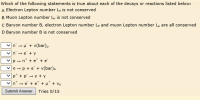 Which of the following statements is true about each of the decays or reactions listed below: A Electron Lepton number L_e is not conserved B Muon Lepton number L_mu is not conserved C Baryon number B, electron L_e and number and muon Lepton number L_mu are all conserved D Baryon number B is not conserved
Consider the reactions listed below and state which of the reactions conserve the lepton number specified....
 Consider the reactions listed below and state which of the reactions conserve the lepton number specified. (Select all that apply.) + → un Electron-lepton number, Le Muon-lepton number, Tau-lepton number, TM + Electron-lepton number, Muon-lepton number, Tau-lepton number, n-p+e+ve Electron-lepton number, Le Muon-lepton number, L Tau-lepton number, Additional Materials
State which of the following reactions are allowed by conservation laws and which is forbidden, and...
 State which of the following reactions are allowed by
conservation laws and which is forbidden, and give the reasons in
either case:
1-
2-
3-
4-
State which of the following reactions are allowed by conservation laws and which is forbidden, and give the reasons in either case: 1- pi^0 arrow e^++e^- 2- P arrow n+e^++ve 3- mu^+ arrow e^++e^-+e^+ 4- mu^+ arrow e^+ + gamma
State which of the following reactions are allowed by
conservation laws and which is forbidden, and give the reasons in
either case:
1-
2-
3-
4-
State which of the following reactions are allowed by conservation laws and which is forbidden, and give the reasons in either case: 1- pi^0 arrow e^++e^- 2- P arrow n+e^++ve 3- mu^+ arrow e^++e^-+e^+ 4- mu^+ arrow e^+ + gamma
could you please answer all parts of this question. like and comment are rewarded. Compulsory question:...
 could you please answer all
parts of this question. like and comment are rewarded.
Compulsory question: [8] A1. (a) Consider the following processes (i) + +n+p+et te (ii) H+ e + e + D (iii) + +et+ve (iv) K+ + + + V Use conservation laws to determine which of these processes are allowed. For processes that are not allowed, state which conservation laws are violated. For processes that are allowed, specify by which interaction (electromagnetic, weak or strong) they...
could you please answer all
parts of this question. like and comment are rewarded.
Compulsory question: [8] A1. (a) Consider the following processes (i) + +n+p+et te (ii) H+ e + e + D (iii) + +et+ve (iv) K+ + + + V Use conservation laws to determine which of these processes are allowed. For processes that are not allowed, state which conservation laws are violated. For processes that are allowed, specify by which interaction (electromagnetic, weak or strong) they...
Part A State the law of conservation of energy The law of conservation of energy states...
 Part A State the law of conservation of energy The law of conservation of energy states that energy can neither be created or destroyed. Energy can be transferred from one object to another, and it can assume different forms. The law of conservation of energy states that energy can not be created but it can be destroyed. Energy can be transferred from one object to another can be destroyed in a chemical reaction, and it can assumo different forms The...
Be sure to answer all parts. Select the correct definition for each of the following terms:...
Be sure to answer all parts. Select the correct definition for each of the following terms: (a) law of conservation of energy states that energy can neither be created nor destroyed states that energy cannot be created or destroyed, and cannot change from one form to another states that energy cannot be created or destroyed, but it can be changed from one form to another (b) thermochemistry the study of the conversions among different types of...
For each of the following unbalanced half-reactions, determine whether an oxidation or reduction is occurring: 1)...
 For each of the following unbalanced half-reactions, determine
whether an oxidation or reduction is occurring:
1) Mn2+ ⟶ MnO2
2) NO3 − ⟶ NO
the answer for 1 is
and for b is
so I want to know for b how the oxidation state on Mn was
+4?
and for d how you the oxidation state on N was +5 and then
+2?
please I need the answeras soon as possible
b) Mn2+→MnO2 The balanced half reaction is as follows:...
For each of the following unbalanced half-reactions, determine
whether an oxidation or reduction is occurring:
1) Mn2+ ⟶ MnO2
2) NO3 − ⟶ NO
the answer for 1 is
and for b is
so I want to know for b how the oxidation state on Mn was
+4?
and for d how you the oxidation state on N was +5 and then
+2?
please I need the answeras soon as possible
b) Mn2+→MnO2 The balanced half reaction is as follows:...
Which of the following is correct regarding the zeroth law of thermodynamics? Select one: O a....
 Which of the following is correct regarding the zeroth law of thermodynamics? Select one: O a. it describes how a system changes its state by only focusing on the initial and final state without regard how the final state is achieved. O b. it deals with all modes of thermodynamic equilibrium between bodies. O c. it is about thermal equilibrium among bodies. O d. it is concerned with energy conservation where essentially energy only changes its form. O e. it...
In photosynthesis, all of the following reactions are directly dependent on light except Select one: a....
In photosynthesis, all of the following reactions are directly dependent on light except Select one: a. carbon fixation b. synthesis of ATP c. electron transport d. removal of electrons from H2O
Question 1 What is the name of the Constitutional doctrine that helps prevent any one branch...
Question 1 What is the name of the Constitutional doctrine that helps prevent any one branch of government from becoming too powerful? A. Reserved powers B. Checks and balances C. Federalism D. Delegated powers 1 points Question 2 What rights are guaranteed under the First Amendment of the U.S. Constitution? (select all that apply) A. Freedom of speech B. Freedom of religion C. Freedom to assemble D. Freedom of the press Question 3 What type of speech is fighting words...
 Which of the following statements is true about each of the decays or reactions listed below: A Electron Lepton number L_e is not conserved B Muon Lepton number L_mu is not conserved C Baryon number B, electron L_e and number and muon Lepton number L_mu are all conserved D Baryon number B is not conserved
 Consider the reactions listed below and state which of the reactions conserve the lepton number specified. (Select all that apply.) + → un Electron-lepton number, Le Muon-lepton number, Tau-lepton number, TM + Electron-lepton number, Muon-lepton number, Tau-lepton number, n-p+e+ve Electron-lepton number, Le Muon-lepton number, L Tau-lepton number, Additional Materials
 State which of the following reactions are allowed by
conservation laws and which is forbidden, and give the reasons in
either case:
1-
2-
3-
4-
State which of the following reactions are allowed by conservation laws and which is forbidden, and give the reasons in either case: 1- pi^0 arrow e^++e^- 2- P arrow n+e^++ve 3- mu^+ arrow e^++e^-+e^+ 4- mu^+ arrow e^+ + gamma
State which of the following reactions are allowed by
conservation laws and which is forbidden, and give the reasons in
either case:
1-
2-
3-
4-
State which of the following reactions are allowed by conservation laws and which is forbidden, and give the reasons in either case: 1- pi^0 arrow e^++e^- 2- P arrow n+e^++ve 3- mu^+ arrow e^++e^-+e^+ 4- mu^+ arrow e^+ + gamma
 could you please answer all
parts of this question. like and comment are rewarded.
Compulsory question: [8] A1. (a) Consider the following processes (i) + +n+p+et te (ii) H+ e + e + D (iii) + +et+ve (iv) K+ + + + V Use conservation laws to determine which of these processes are allowed. For processes that are not allowed, state which conservation laws are violated. For processes that are allowed, specify by which interaction (electromagnetic, weak or strong) they...
could you please answer all
parts of this question. like and comment are rewarded.
Compulsory question: [8] A1. (a) Consider the following processes (i) + +n+p+et te (ii) H+ e + e + D (iii) + +et+ve (iv) K+ + + + V Use conservation laws to determine which of these processes are allowed. For processes that are not allowed, state which conservation laws are violated. For processes that are allowed, specify by which interaction (electromagnetic, weak or strong) they...
 Part A State the law of conservation of energy The law of conservation of energy states that energy can neither be created or destroyed. Energy can be transferred from one object to another, and it can assume different forms. The law of conservation of energy states that energy can not be created but it can be destroyed. Energy can be transferred from one object to another can be destroyed in a chemical reaction, and it can assumo different forms The...
 For each of the following unbalanced half-reactions, determine
whether an oxidation or reduction is occurring:
1) Mn2+ ⟶ MnO2
2) NO3 − ⟶ NO
the answer for 1 is
and for b is
so I want to know for b how the oxidation state on Mn was
+4?
and for d how you the oxidation state on N was +5 and then
+2?
please I need the answeras soon as possible
b) Mn2+→MnO2 The balanced half reaction is as follows:...
For each of the following unbalanced half-reactions, determine
whether an oxidation or reduction is occurring:
1) Mn2+ ⟶ MnO2
2) NO3 − ⟶ NO
the answer for 1 is
and for b is
so I want to know for b how the oxidation state on Mn was
+4?
and for d how you the oxidation state on N was +5 and then
+2?
please I need the answeras soon as possible
b) Mn2+→MnO2 The balanced half reaction is as follows:...
 Which of the following is correct regarding the zeroth law of thermodynamics? Select one: O a. it describes how a system changes its state by only focusing on the initial and final state without regard how the final state is achieved. O b. it deals with all modes of thermodynamic equilibrium between bodies. O c. it is about thermal equilibrium among bodies. O d. it is concerned with energy conservation where essentially energy only changes its form. O e. it...
Most questions answered within 3 hours.
-
Where is the error in this code sequence?
String s1 = "Hello";
String s2 = "ello";...
asked 10 months ago -
Financial data for Joel de Paris, Inc., for last year
follow:
Joel de Paris, Inc.
Balance...
asked 10 months ago -
Consider this reaction:
Al2(SO4)3 (aq)+ BaCl3
(aq) Al2Cl6 (aq)- +
3BaSO4(s) . What is the...
asked 10 months ago -
Suppose that Savneet is considering increasing her
recent random sample from 20 car rentals to 40...
asked 10 months ago -
Trucks arrive at an unloading terminal at an average rate of 120
per hour.
Trucks arrive...
asked 10 months ago -
Why are methanol and ethanol completely soluble in water while
octanol is not very little soluble....
asked 10 months ago -
A facilities manager at a university reads in a research report
that the mean amount of...
asked 10 months ago -
When the CuSO4 is rehydrated by adding water to the anhydrous
compound, is this an endothermic...
asked 10 months ago -
A ray of sunlight is passing from diamond into crown glass; the
angle of incidence is...
asked 10 months ago -
A block of mass 0.249 kg is placed on top of a light, vertical
spring of...
asked 10 months ago -
how do the kidneys compensate in the presences of acidosis
a) trigger hyperventilate
b) reserve acid...
asked 10 months ago -
Question 501 pts
The rental rate of capital to the firm increases. Which of the
following...
asked 10 months ago