
Homework Answers
Add Answer to:
T = 4V The figure shows a pendulum with length L that makes a maximum angle...
The figure shows a pendulum with length L that makes a maximum angle oo with the...
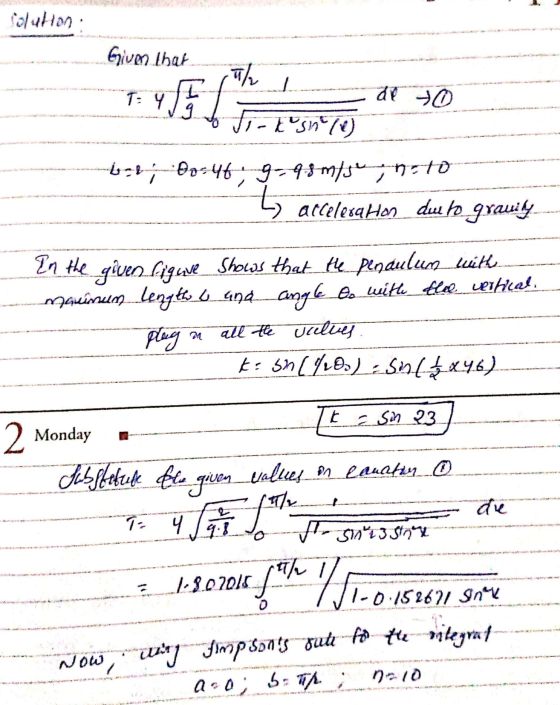
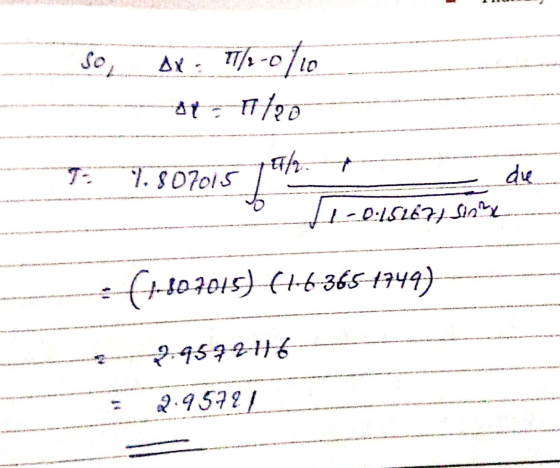
 The figure shows a pendulum with length L that makes a maximum angle oo with the vertical. Using Newton's Second Law, it can be shown that the period T (the time for one complete swing) is given by T = 4 7,6" sin(100) dx 1 - k2 sin2(x) where k = sin and g is the acceleration due to gravity. If L = 5 m and 0. = 46°, use Simpson's Rule with n = 10 to find the period....
The period T of a pendulum with length L meters that makes a maximum angle of...
The period T of a pendulum with length L meters that makes a maximum angle of θ0 with the vertical is The vertical is: T= 4\sqrt{\frac{L}{9}}\int _0^{\frac{\pi }{2}}\frac{dx}{\sqrt{1-k^2sin^2x}} where k=sin((1/2)θ0) and g=9.8 m/sec2 in the acceleration due to gravity. (a) Find the first four terms of a series expansion for T by expanding the integrand using the binomial series and integrating term by term (your answer will include L, g, k). You may use the following integration fact: The integration...
(1 point) Suppose a pendulum of length L meters makes an angle of θ radians with the vertical, as n the figure t can be...
 (1 point) Suppose a pendulum of length L meters makes an angle of θ radians with the vertical, as n the figure t can be shown that as a function of time, θ satisfies the differential equation d20 + sin θ-0, 9.8 m/s2 is the acceleration due to gravity For θ near zero we can use the linear approximation sine where g to get a linear di erential equa on d20 9 0 dt2 L Use the linear differential equation...
This is beyond me right now... 4. Extra Creait: 10 pts The period of a pendulum with length L that makes a maximum angle of 690 with the vertical is dx T/2 1-k2 sin (x) where k =sin (160) and g is...
 This is beyond me right now...
4. Extra Creait: 10 pts The period of a pendulum with length L that makes a maximum angle of 690 with the vertical is dx T/2 1-k2 sin (x) where k =sin (160) and g is the acceleration due to gravity. Expand the integrand as a binomial series to show that 12123212352 224262 2242 1.3.5-....(n-1) . π when n is even Hint: You'll need to use the fact that for/2sin"(x)dx = Note that this...
This is beyond me right now...
4. Extra Creait: 10 pts The period of a pendulum with length L that makes a maximum angle of 690 with the vertical is dx T/2 1-k2 sin (x) where k =sin (160) and g is the acceleration due to gravity. Expand the integrand as a binomial series to show that 12123212352 224262 2242 1.3.5-....(n-1) . π when n is even Hint: You'll need to use the fact that for/2sin"(x)dx = Note that this...
Q12 (5 points) The period of a pendulum with length L that makes a maximum angle...
 Q12 (5 points) The period of a pendulum with length L that makes a maximum angle Bo with the vertical is 1/2 dc T= T=4 9 11 - k2 sinº where k = sino and g is the acceleration due to gravity. When , is small, the approximation T 27 is used. We will see in this 9 exercise, that this is in fact the first term in the series expansion for T and that using the first two terms...
(1 point) Suppose a pendulum with length L (meters) has angle 0 (radians) from the vertical. It can be shown that 0 as...
 (1 point) Suppose a pendulum with length L (meters) has angle 0 (radians) from the vertical. It can be shown that 0 as a function of time satisfies the differential equation: d20 + -sin 0 = 0 dt2 L where g = 9.8 m/sec/sec is the acceleration due to gravity. For small values of 0 we can use the approximation sin(0) ~ 0, and with that substitution, the differential equation becomes linear A. Determine the equation of motion of a...
The period T of a simple pendulum with small oscillations is calculated from the formula T=2pi sqrt(L/g) where L is the...
The period T of a simple pendulum with small oscillations is calculated from the formula T=2pi sqrt(L/g) where L is the length of the pendulum and g is the acceleration due to gravity. suppose that measured values of L and g have errors and are corrected with new values where L is increased from 4m to 4.5m and g is increased from 9 m/s2 to 9.8 m/s2. Use differentials to estimate the change in the period. Does the period increase...
(10 points) Suppose a pendulum with length L (meters) has angle (radians) from the vertical. It...
 (10 points) Suppose a pendulum with length L (meters) has angle (radians) from the vertical. It can be shown that e as a function of time satisfies the differential equation: de 8 + -sin 0 = 0 dt2 L where g = 9.8 m/sec/sec is the acceleration due to gravity. For small values of we can use the approximation sin(0) - 0, and with that substitution, the differential equation becomes linear. A. Determine the equation of motion of a pendulum...
show all steps please (1 point) Suppose a pendulum with length L (meters) has angle 0...
 show all steps please
(1 point) Suppose a pendulum with length L (meters) has angle 0 (radians) from the vertical. It can be shown that 0 as a function of time satisfies the differential equation: d20 +sin0 0 dt2 where g 9.8 m/sec/sec is the acceleration due to gravity. For small values of 0 we can use the approximation sin(0)~0, and with that substitution, the differential equation becomes linear. A. Determine the equation of motion of a pendulum with length...
show all steps please
(1 point) Suppose a pendulum with length L (meters) has angle 0 (radians) from the vertical. It can be shown that 0 as a function of time satisfies the differential equation: d20 +sin0 0 dt2 where g 9.8 m/sec/sec is the acceleration due to gravity. For small values of 0 we can use the approximation sin(0)~0, and with that substitution, the differential equation becomes linear. A. Determine the equation of motion of a pendulum with length...
The period T of a simple pendulum is given by T=2πLg−−√T=2πLg where L is the length of the...
The period T of a simple pendulum is given by T=2πLg−−√T=2πLg where L is the length of the pendulum and g is the acceleration due to gravity. Assume that g = 9.80 m/s2 exactly, and that L, in meters, is lognormal with parameters μL = 0.8 and σ2L=0.05.σL2=0.05. NOTE: This is a multi-part question. Once an answer is submitted, you will be unable to return to this part. Find P(T > 3).
 The figure shows a pendulum with length L that makes a maximum angle oo with the vertical. Using Newton's Second Law, it can be shown that the period T (the time for one complete swing) is given by T = 4 7,6" sin(100) dx 1 - k2 sin2(x) where k = sin and g is the acceleration due to gravity. If L = 5 m and 0. = 46°, use Simpson's Rule with n = 10 to find the period....
 (1 point) Suppose a pendulum of length L meters makes an angle of θ radians with the vertical, as n the figure t can be shown that as a function of time, θ satisfies the differential equation d20 + sin θ-0, 9.8 m/s2 is the acceleration due to gravity For θ near zero we can use the linear approximation sine where g to get a linear di erential equa on d20 9 0 dt2 L Use the linear differential equation...
 This is beyond me right now...
4. Extra Creait: 10 pts The period of a pendulum with length L that makes a maximum angle of 690 with the vertical is dx T/2 1-k2 sin (x) where k =sin (160) and g is the acceleration due to gravity. Expand the integrand as a binomial series to show that 12123212352 224262 2242 1.3.5-....(n-1) . π when n is even Hint: You'll need to use the fact that for/2sin"(x)dx = Note that this...
This is beyond me right now...
4. Extra Creait: 10 pts The period of a pendulum with length L that makes a maximum angle of 690 with the vertical is dx T/2 1-k2 sin (x) where k =sin (160) and g is the acceleration due to gravity. Expand the integrand as a binomial series to show that 12123212352 224262 2242 1.3.5-....(n-1) . π when n is even Hint: You'll need to use the fact that for/2sin"(x)dx = Note that this...
 Q12 (5 points) The period of a pendulum with length L that makes a maximum angle Bo with the vertical is 1/2 dc T= T=4 9 11 - k2 sinº where k = sino and g is the acceleration due to gravity. When , is small, the approximation T 27 is used. We will see in this 9 exercise, that this is in fact the first term in the series expansion for T and that using the first two terms...
 (1 point) Suppose a pendulum with length L (meters) has angle 0 (radians) from the vertical. It can be shown that 0 as a function of time satisfies the differential equation: d20 + -sin 0 = 0 dt2 L where g = 9.8 m/sec/sec is the acceleration due to gravity. For small values of 0 we can use the approximation sin(0) ~ 0, and with that substitution, the differential equation becomes linear A. Determine the equation of motion of a...
 (10 points) Suppose a pendulum with length L (meters) has angle (radians) from the vertical. It can be shown that e as a function of time satisfies the differential equation: de 8 + -sin 0 = 0 dt2 L where g = 9.8 m/sec/sec is the acceleration due to gravity. For small values of we can use the approximation sin(0) - 0, and with that substitution, the differential equation becomes linear. A. Determine the equation of motion of a pendulum...
 show all steps please
(1 point) Suppose a pendulum with length L (meters) has angle 0 (radians) from the vertical. It can be shown that 0 as a function of time satisfies the differential equation: d20 +sin0 0 dt2 where g 9.8 m/sec/sec is the acceleration due to gravity. For small values of 0 we can use the approximation sin(0)~0, and with that substitution, the differential equation becomes linear. A. Determine the equation of motion of a pendulum with length...
show all steps please
(1 point) Suppose a pendulum with length L (meters) has angle 0 (radians) from the vertical. It can be shown that 0 as a function of time satisfies the differential equation: d20 +sin0 0 dt2 where g 9.8 m/sec/sec is the acceleration due to gravity. For small values of 0 we can use the approximation sin(0)~0, and with that substitution, the differential equation becomes linear. A. Determine the equation of motion of a pendulum with length...
Most questions answered within 3 hours.
-
Where is the error in this code sequence?
String s1 = "Hello";
String s2 = "ello";...
asked 11 months ago -
Financial data for Joel de Paris, Inc., for last year
follow:
Joel de Paris, Inc.
Balance...
asked 11 months ago -
Consider this reaction:
Al2(SO4)3 (aq)+ BaCl3
(aq) Al2Cl6 (aq)- +
3BaSO4(s) . What is the...
asked 11 months ago -
Suppose that Savneet is considering increasing her
recent random sample from 20 car rentals to 40...
asked 11 months ago -
Trucks arrive at an unloading terminal at an average rate of 120
per hour.
Trucks arrive...
asked 11 months ago -
Why are methanol and ethanol completely soluble in water while
octanol is not very little soluble....
asked 11 months ago -
A facilities manager at a university reads in a research report
that the mean amount of...
asked 11 months ago -
When the CuSO4 is rehydrated by adding water to the anhydrous
compound, is this an endothermic...
asked 11 months ago -
A ray of sunlight is passing from diamond into crown glass; the
angle of incidence is...
asked 11 months ago -
A block of mass 0.249 kg is placed on top of a light, vertical
spring of...
asked 11 months ago -
how do the kidneys compensate in the presences of acidosis
a) trigger hyperventilate
b) reserve acid...
asked 11 months ago -
Question 501 pts
The rental rate of capital to the firm increases. Which of the
following...
asked 11 months ago