Drive an equation of state for ideal gases that is expressed in terms of specific heat...
Drive an equation of state for ideal gases that is expressed in terms of specific heat and gas constant.
Homework Answers


Add Answer to:
Drive an equation of state for ideal gases that is expressed in
terms of specific heat...
Ideal gas with constant specific heat (static specific heat ??0 , Specific heat ratio ?) per...
Ideal gas with constant specific heat (static specific heat ??0 , Specific heat ratio ?) per unit mass in the polytropic process (index: ?) The amount of micro heat transfer received by the sieve can be calculated by ?? = ?? ∙ ??. Cn is called the polytropic constant. (a) Deduce the polytropic specific heat in terms of exponent ?, specific heat and static specific heat ??0. (? ≠ 1) (Hint: Polytropic course can also be written as ?? ^...
P.V=n.R.T this is the equation used for ideal gases.This equation gives the state of real gases...
P.V=n.R.T this is the equation used for ideal gases.This equation gives the state of real gases approx. The more accurate equation for real gases is by van der Waals ( P+a/v2).(v-b)=R.T v=V/n=molar volume,R=0.08207 lt.atm/mol.K ideal gaz constant,a=3.592,b=0.04267,T=320 K,P=2.2 atm write a program that finds the volume of v (molar volume) of 1 mol of carbon monoxide gas in a container at T = 320 K temperature and P = 2.2 atm pressure and compares the ideal gas equation with p.v...
A mixture of ideal gases has a specific heat ratio of k= 1.35 and an apparent...
 A mixture of ideal gases has a specific heat ratio of k= 1.35 and an apparent molecular weight of M= 26 kg/kmol. Determine the work. in kJ/kg, required to compress this mixture isentropically in a closed system from 100 kPa and 35 C to 700 kPa. The universal gas constant is Ru 8.314 kJ/kmol-K Gas mixture k-1.35 100 kPa, 35°C The work required to compress this mixture is kJ/kg.
The difference for specific heats for an ideal gas, Evaluate the difference in specific heats for...
 The difference for specific heats for an ideal gas,
Evaluate the difference in specific heats for gases obeying (1)
the Van Der Waals and (2) The Dieterici Equations of State. Comment
on the results for the difference in specific heat for these gases
compared with the ideal gas.
The difference for specific heats for an ideal gas,
Evaluate the difference in specific heats for gases obeying (1)
the Van Der Waals and (2) The Dieterici Equations of State. Comment
on the results for the difference in specific heat for these gases
compared with the ideal gas.
2. One mole of a monoatomic van der Waals gas obeys the equation of state and its internal energy is expressed as U-Суг...
 2. One mole of a monoatomic van der Waals gas obeys the equation of state and its internal energy is expressed as U-Суг_ _ where Cv is the molar isochoric heat capacity of an ideal gas. The gas is initially at pressure p and volume V. (i) Explain the physical meaning of the parameters a and b in the equation of state of the gas (ii) Calculate the heat transferred to the gas during reversible isothermic expansion to the volume...
(a) One mole of a monoatomic van der Waals gas obeys the equation of state A3. ) (V-b)=RT (p+ and its internal energy is expressed as U CvT where Cv is the molar isochoric heat capacity of an ideal g...
 (a) One mole of a monoatomic van der Waals gas obeys the equation of state A3. ) (V-b)=RT (p+ and its internal energy is expressed as U CvT where Cv is the molar isochoric heat capacity of an ideal gas. The gas is initially at pressure p and volume V (i) Explain the physical meaning of the parameters a and b in the equation of state of the gas (ii) Write down the equation that defines entropy in thermodynamics. Define...
Find definitions of the terms isothermal, isochoric, isobaric, and adiabatic as they relate to ideal gases...
Find definitions of the terms isothermal, isochoric, isobaric, and adiabatic as they relate to ideal gases and heat engines. On the aces below, sketch the lone or curve connecting the initial state and the final state
Equation 3.40: 5.3-10 a) Show that the Helmholtz potential of a mixture of simple ideal gases...
 Equation 3.40:
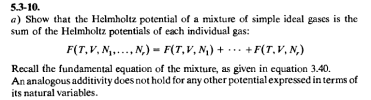
5.3-10 a) Show that the Helmholtz potential of a mixture of simple ideal gases is the sum of the Helmholtz potentials of each individual gas: F(T,V, N,..., N,) = F(T,V, N) F(T,V, N,) Recall the fundamental equation of the mixture, as given in equation 3.40. An analogous additivity does not hold for any other potential expressed in terms of its natural variables. Ν. V Τ RIn - ΑΣN 1 ΣΜ+ΣΝ) knH + NRuΝ S Ν J j (3.40)
Equation 3.40:
5.3-10 a) Show that the Helmholtz potential of a mixture of simple ideal gases is the sum of the Helmholtz potentials of each individual gas: F(T,V, N,..., N,) = F(T,V, N) F(T,V, N,) Recall the fundamental equation of the mixture, as given in equation 3.40. An analogous additivity does not hold for any other potential expressed in terms of its natural variables. Ν. V Τ RIn - ΑΣN 1 ΣΜ+ΣΝ) knH + NRuΝ S Ν J j (3.40)
A constant specific heat ideal gas has a gas constant of 42.92 ft·lbf/(lbm·R) and a constant...
A constant specific heat ideal gas has a gas constant of 42.92 ft·lbf/(lbm·R) and a constant pressure specific heat of 0.200 Btu/(lbm·R). Determine the heat transferred and the change of total entropy if 9.00 lbm of this gas is heated from 40.0 °F to 340 °F in a rigid container.
O GASES Using the ideal equation of state A reaction between liquid reactants takes place at...
 O GASES Using the ideal equation of state A reaction between liquid reactants takes place at 7.0 °C in a sealed, evacuated vessel with a measured volume of 50.0 L, Measurements show that the reaction produced 25. g of carbon dioxide gas. Calculate the pressure of carbon dioxide gas in the reaction vessel after the reaction. You may ignore the volume of the liquid reactants. Round your answer to significant digits. x10 pressure: atm X
 A mixture of ideal gases has a specific heat ratio of k= 1.35 and an apparent molecular weight of M= 26 kg/kmol. Determine the work. in kJ/kg, required to compress this mixture isentropically in a closed system from 100 kPa and 35 C to 700 kPa. The universal gas constant is Ru 8.314 kJ/kmol-K Gas mixture k-1.35 100 kPa, 35°C The work required to compress this mixture is kJ/kg.
 The difference for specific heats for an ideal gas,
Evaluate the difference in specific heats for gases obeying (1)
the Van Der Waals and (2) The Dieterici Equations of State. Comment
on the results for the difference in specific heat for these gases
compared with the ideal gas.
The difference for specific heats for an ideal gas,
Evaluate the difference in specific heats for gases obeying (1)
the Van Der Waals and (2) The Dieterici Equations of State. Comment
on the results for the difference in specific heat for these gases
compared with the ideal gas.
 2. One mole of a monoatomic van der Waals gas obeys the equation of state and its internal energy is expressed as U-Суг_ _ where Cv is the molar isochoric heat capacity of an ideal gas. The gas is initially at pressure p and volume V. (i) Explain the physical meaning of the parameters a and b in the equation of state of the gas (ii) Calculate the heat transferred to the gas during reversible isothermic expansion to the volume...
 (a) One mole of a monoatomic van der Waals gas obeys the equation of state A3. ) (V-b)=RT (p+ and its internal energy is expressed as U CvT where Cv is the molar isochoric heat capacity of an ideal gas. The gas is initially at pressure p and volume V (i) Explain the physical meaning of the parameters a and b in the equation of state of the gas (ii) Write down the equation that defines entropy in thermodynamics. Define...
 Equation 3.40:
5.3-10 a) Show that the Helmholtz potential of a mixture of simple ideal gases is the sum of the Helmholtz potentials of each individual gas: F(T,V, N,..., N,) = F(T,V, N) F(T,V, N,) Recall the fundamental equation of the mixture, as given in equation 3.40. An analogous additivity does not hold for any other potential expressed in terms of its natural variables. Ν. V Τ RIn - ΑΣN 1 ΣΜ+ΣΝ) knH + NRuΝ S Ν J j (3.40)
Equation 3.40:
5.3-10 a) Show that the Helmholtz potential of a mixture of simple ideal gases is the sum of the Helmholtz potentials of each individual gas: F(T,V, N,..., N,) = F(T,V, N) F(T,V, N,) Recall the fundamental equation of the mixture, as given in equation 3.40. An analogous additivity does not hold for any other potential expressed in terms of its natural variables. Ν. V Τ RIn - ΑΣN 1 ΣΜ+ΣΝ) knH + NRuΝ S Ν J j (3.40)
 O GASES Using the ideal equation of state A reaction between liquid reactants takes place at 7.0 °C in a sealed, evacuated vessel with a measured volume of 50.0 L, Measurements show that the reaction produced 25. g of carbon dioxide gas. Calculate the pressure of carbon dioxide gas in the reaction vessel after the reaction. You may ignore the volume of the liquid reactants. Round your answer to significant digits. x10 pressure: atm X
Most questions answered within 3 hours.
-
Where is the error in this code sequence?
String s1 = "Hello";
String s2 = "ello";...
asked 11 months ago -
Financial data for Joel de Paris, Inc., for last year
follow:
Joel de Paris, Inc.
Balance...
asked 11 months ago -
Consider this reaction:
Al2(SO4)3 (aq)+ BaCl3
(aq) Al2Cl6 (aq)- +
3BaSO4(s) . What is the...
asked 11 months ago -
Suppose that Savneet is considering increasing her
recent random sample from 20 car rentals to 40...
asked 11 months ago -
Trucks arrive at an unloading terminal at an average rate of 120
per hour.
Trucks arrive...
asked 11 months ago -
Why are methanol and ethanol completely soluble in water while
octanol is not very little soluble....
asked 11 months ago -
A facilities manager at a university reads in a research report
that the mean amount of...
asked 11 months ago -
When the CuSO4 is rehydrated by adding water to the anhydrous
compound, is this an endothermic...
asked 11 months ago -
A ray of sunlight is passing from diamond into crown glass; the
angle of incidence is...
asked 11 months ago -
A block of mass 0.249 kg is placed on top of a light, vertical
spring of...
asked 11 months ago -
how do the kidneys compensate in the presences of acidosis
a) trigger hyperventilate
b) reserve acid...
asked 11 months ago -
Question 501 pts
The rental rate of capital to the firm increases. Which of the
following...
asked 11 months ago