
Homework Answers
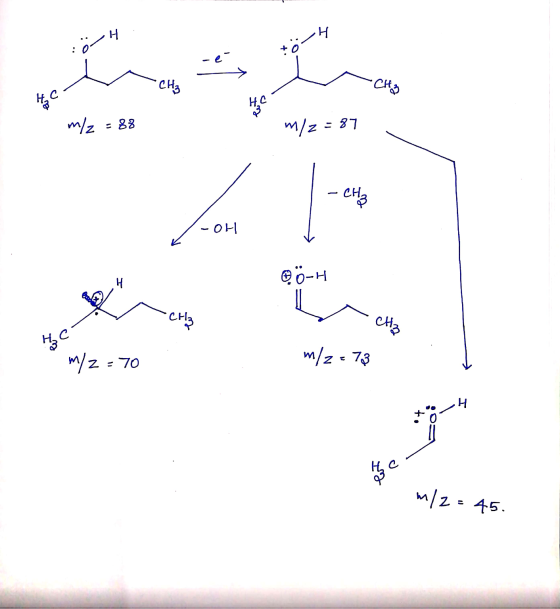
The fragmentation of a 2-pentanol is shown and according to the m/z values the fragments are given in the following picture with their m/z values.
Add Answer to:
4. Analyze the following mass spectrum by showing: molecular ion, base peak, and identify 2 fragmentation...
a) Describe the difference between the base peak and the parent ion (or molecular ion) peak....
 a) Describe the difference between the base peak and the parent
ion (or molecular ion) peak.
b) Identify the base peak and the parent ion (or molecular ion)
peak (if any) according to the mass spectrum.
c) Identify the mass fragments which correspond to m/z = 77,
105, 111, and 139.
d) Identify and give explanations for the magnitude (or
intensity) of the peaks at m/z = 113, 141, and 218.
Mass Spectrum ofp-C hlorobenzophenone 105 100 80 139 CI...
a) Describe the difference between the base peak and the parent
ion (or molecular ion) peak.
b) Identify the base peak and the parent ion (or molecular ion)
peak (if any) according to the mass spectrum.
c) Identify the mass fragments which correspond to m/z = 77,
105, 111, and 139.
d) Identify and give explanations for the magnitude (or
intensity) of the peaks at m/z = 113, 141, and 218.
Mass Spectrum ofp-C hlorobenzophenone 105 100 80 139 CI...
I am not understanding this assignment at all. Any assistance is very much appreciated. Mass Spectrum: Molecular Ion m/z value and structure of the Molecular Ion. Base Peak m/z value and structure of...
 I am not understanding this assignment at all. Any assistance is
very much appreciated.
Mass Spectrum:
Molecular Ion m/z value and structure of the Molecular Ion.
Base Peak m/z value and structure of that ion
One other significant peak m/z value and structure of that
ion
C13 NMR Spectrum-- Draw Structure of Compound
on the C13 NMR spectrum and identify each signal with the
appropriate Carbon.
Proton NMR Spectrum-- Draw Structure of
Compound on the Proton NMR spectrum and identify...
I am not understanding this assignment at all. Any assistance is
very much appreciated.
Mass Spectrum:
Molecular Ion m/z value and structure of the Molecular Ion.
Base Peak m/z value and structure of that ion
One other significant peak m/z value and structure of that
ion
C13 NMR Spectrum-- Draw Structure of Compound
on the C13 NMR spectrum and identify each signal with the
appropriate Carbon.
Proton NMR Spectrum-- Draw Structure of
Compound on the Proton NMR spectrum and identify...
Problem A.1 Label the molecular ion, the base peak, and the M + 1 peak in...
 Problem A.1 Label the molecular ion, the base peak, and the M + 1 peak in the mass spectrum of pentane (CHO). 100 Relative abundance 50 06 0 10 20 30 40 60 70 80 50 m/z 90 100
Draw the structure with the mass spectrum and NMR. 151) (Mass of molecular ion: 100e-1N-7213 80...
 Draw the structure with the mass spectrum and NMR.
151) (Mass of molecular ion: 100e-1N-7213 80 60 2 40- 20- 0 100 150 125 75 25 50 m/z Molecular Weight: 151.1195 Elemental Analysis: C, 55.63; H, 3.33; N, 9.27; O, 31.76 170 160 150 140 130 120 110 100 80 70 30 20 10 10 .5 9.0 8.5 8.0 7.5 70 6.5 6.0 5.5 5.0 4.5 4.0 3.5 3.0 25 2.0 1.5 10 0.5 0.0 0.5 1.0 -15 2.0 2.5...
Draw the structure with the mass spectrum and NMR.
151) (Mass of molecular ion: 100e-1N-7213 80 60 2 40- 20- 0 100 150 125 75 25 50 m/z Molecular Weight: 151.1195 Elemental Analysis: C, 55.63; H, 3.33; N, 9.27; O, 31.76 170 160 150 140 130 120 110 100 80 70 30 20 10 10 .5 9.0 8.5 8.0 7.5 70 6.5 6.0 5.5 5.0 4.5 4.0 3.5 3.0 25 2.0 1.5 10 0.5 0.0 0.5 1.0 -15 2.0 2.5...
The mass spectrum of 3-bromopropanoic acid is shown below. Four peaks are labeled with A, B,...
 The mass spectrum of 3-bromopropanoic acid is shown below. Four peaks are labeled with A, B, C, and D. Select the label for the base peak(s). 45 55 18 26 on 10 20 30 40 50 60 70 80 90 100 MIZ 110 120 130 140 150 160 170 The mass spectrum of 3-bromopropanoic acid is shown below. Four peaks are labeled with A, B, C, and D. Select the label for the M peak(s) (unfragmented parent). 135 27 45...
Label the molecular ion and base peaks on the mass spectrui Delu 100 レase peak ion 1020 3o 40 o ...
 need to fill the boxes
Label the molecular ion and base peaks on the mass spectrui Delu 100 レase peak ion 1020 3o 40 o 6O 70 B0 100 m/z What element does the analyte molecule likely contain? Propose one possible molecular formula for the analyte molecule. ELEMENT: POSSIBLE FORMULA: The mass spectrum of 2.2'-dibromobiphenyl is shown below, along with a proposed structure of the m/z 314 peak. Based on this information, propose structures for the other two peaks indicated....
need to fill the boxes
Label the molecular ion and base peaks on the mass spectrui Delu 100 レase peak ion 1020 3o 40 o 6O 70 B0 100 m/z What element does the analyte molecule likely contain? Propose one possible molecular formula for the analyte molecule. ELEMENT: POSSIBLE FORMULA: The mass spectrum of 2.2'-dibromobiphenyl is shown below, along with a proposed structure of the m/z 314 peak. Based on this information, propose structures for the other two peaks indicated....
5. Draw a structure for and name a compound that is consistent with compound that is...
 5. Draw a structure for and name a compound that is consistent with compound that is consistent with the following MS. abundance 73 M 80 90 100 110 120 130 140 150 160 10 20 30 40 50 60 70 m/z Question 5: Structure and name: Mass Spectrum (include the molecular ion) Observed Fragment & MW Expected MW Fragmentation type Explanation:
Assign a base peak, molecular ion peak (with m/z) and identify the structure. 100- MS-N-0025 Relative...
 Assign a base peak, molecular ion peak (with m/z) and identify
the structure.
100- MS-N-0025 Relative Intensity 10 2030 70 80 90 m /z rse Cha O a OOTW
Assign a base peak, molecular ion peak (with m/z) and identify
the structure.
100- MS-N-0025 Relative Intensity 10 2030 70 80 90 m /z rse Cha O a OOTW
assign the base peak, molecular ion peak (with m/z) and identify the structure? please? :,) MS-NU-5499...
 assign the base peak, molecular ion peak (with m/z) and identify
the structure?
please? :,)
MS-NU-5499 Relative Intensity 10 15 20 25 30 50 55 60 65 70 75 35 1 40 45 m/z
assign the base peak, molecular ion peak (with m/z) and identify
the structure?
please? :,)
MS-NU-5499 Relative Intensity 10 15 20 25 30 50 55 60 65 70 75 35 1 40 45 m/z
2. Draw the structure of the cation responsible for the base peak (m/z=58) in the mass...
 2. Draw the structure of the cation responsible for the base
peak (m/z=58) in the mass spectrum of 3-aminopentane shown
below:
3. Below is given the mass spectrum of a simple alkane. What is
the chemical formula of the alkane? What is the name of the alkane?
Explain how you determined the exact structure of the alkane from
the observed fragments.
4. Below is a mass spectrum of an ester. Identify the ester.
Consider that the dominant fragmentation pathway involves...
2. Draw the structure of the cation responsible for the base
peak (m/z=58) in the mass spectrum of 3-aminopentane shown
below:
3. Below is given the mass spectrum of a simple alkane. What is
the chemical formula of the alkane? What is the name of the alkane?
Explain how you determined the exact structure of the alkane from
the observed fragments.
4. Below is a mass spectrum of an ester. Identify the ester.
Consider that the dominant fragmentation pathway involves...
 a) Describe the difference between the base peak and the parent
ion (or molecular ion) peak.
b) Identify the base peak and the parent ion (or molecular ion)
peak (if any) according to the mass spectrum.
c) Identify the mass fragments which correspond to m/z = 77,
105, 111, and 139.
d) Identify and give explanations for the magnitude (or
intensity) of the peaks at m/z = 113, 141, and 218.
Mass Spectrum ofp-C hlorobenzophenone 105 100 80 139 CI...
a) Describe the difference between the base peak and the parent
ion (or molecular ion) peak.
b) Identify the base peak and the parent ion (or molecular ion)
peak (if any) according to the mass spectrum.
c) Identify the mass fragments which correspond to m/z = 77,
105, 111, and 139.
d) Identify and give explanations for the magnitude (or
intensity) of the peaks at m/z = 113, 141, and 218.
Mass Spectrum ofp-C hlorobenzophenone 105 100 80 139 CI...
 I am not understanding this assignment at all. Any assistance is
very much appreciated.
Mass Spectrum:
Molecular Ion m/z value and structure of the Molecular Ion.
Base Peak m/z value and structure of that ion
One other significant peak m/z value and structure of that
ion
C13 NMR Spectrum-- Draw Structure of Compound
on the C13 NMR spectrum and identify each signal with the
appropriate Carbon.
Proton NMR Spectrum-- Draw Structure of
Compound on the Proton NMR spectrum and identify...
I am not understanding this assignment at all. Any assistance is
very much appreciated.
Mass Spectrum:
Molecular Ion m/z value and structure of the Molecular Ion.
Base Peak m/z value and structure of that ion
One other significant peak m/z value and structure of that
ion
C13 NMR Spectrum-- Draw Structure of Compound
on the C13 NMR spectrum and identify each signal with the
appropriate Carbon.
Proton NMR Spectrum-- Draw Structure of
Compound on the Proton NMR spectrum and identify...
 Problem A.1 Label the molecular ion, the base peak, and the M + 1 peak in the mass spectrum of pentane (CHO). 100 Relative abundance 50 06 0 10 20 30 40 60 70 80 50 m/z 90 100
 Draw the structure with the mass spectrum and NMR.
151) (Mass of molecular ion: 100e-1N-7213 80 60 2 40- 20- 0 100 150 125 75 25 50 m/z Molecular Weight: 151.1195 Elemental Analysis: C, 55.63; H, 3.33; N, 9.27; O, 31.76 170 160 150 140 130 120 110 100 80 70 30 20 10 10 .5 9.0 8.5 8.0 7.5 70 6.5 6.0 5.5 5.0 4.5 4.0 3.5 3.0 25 2.0 1.5 10 0.5 0.0 0.5 1.0 -15 2.0 2.5...
Draw the structure with the mass spectrum and NMR.
151) (Mass of molecular ion: 100e-1N-7213 80 60 2 40- 20- 0 100 150 125 75 25 50 m/z Molecular Weight: 151.1195 Elemental Analysis: C, 55.63; H, 3.33; N, 9.27; O, 31.76 170 160 150 140 130 120 110 100 80 70 30 20 10 10 .5 9.0 8.5 8.0 7.5 70 6.5 6.0 5.5 5.0 4.5 4.0 3.5 3.0 25 2.0 1.5 10 0.5 0.0 0.5 1.0 -15 2.0 2.5...
 The mass spectrum of 3-bromopropanoic acid is shown below. Four peaks are labeled with A, B, C, and D. Select the label for the base peak(s). 45 55 18 26 on 10 20 30 40 50 60 70 80 90 100 MIZ 110 120 130 140 150 160 170 The mass spectrum of 3-bromopropanoic acid is shown below. Four peaks are labeled with A, B, C, and D. Select the label for the M peak(s) (unfragmented parent). 135 27 45...
 need to fill the boxes
Label the molecular ion and base peaks on the mass spectrui Delu 100 レase peak ion 1020 3o 40 o 6O 70 B0 100 m/z What element does the analyte molecule likely contain? Propose one possible molecular formula for the analyte molecule. ELEMENT: POSSIBLE FORMULA: The mass spectrum of 2.2'-dibromobiphenyl is shown below, along with a proposed structure of the m/z 314 peak. Based on this information, propose structures for the other two peaks indicated....
need to fill the boxes
Label the molecular ion and base peaks on the mass spectrui Delu 100 レase peak ion 1020 3o 40 o 6O 70 B0 100 m/z What element does the analyte molecule likely contain? Propose one possible molecular formula for the analyte molecule. ELEMENT: POSSIBLE FORMULA: The mass spectrum of 2.2'-dibromobiphenyl is shown below, along with a proposed structure of the m/z 314 peak. Based on this information, propose structures for the other two peaks indicated....
 5. Draw a structure for and name a compound that is consistent with compound that is consistent with the following MS. abundance 73 M 80 90 100 110 120 130 140 150 160 10 20 30 40 50 60 70 m/z Question 5: Structure and name: Mass Spectrum (include the molecular ion) Observed Fragment & MW Expected MW Fragmentation type Explanation:
 Assign a base peak, molecular ion peak (with m/z) and identify
the structure.
100- MS-N-0025 Relative Intensity 10 2030 70 80 90 m /z rse Cha O a OOTW
Assign a base peak, molecular ion peak (with m/z) and identify
the structure.
100- MS-N-0025 Relative Intensity 10 2030 70 80 90 m /z rse Cha O a OOTW
 assign the base peak, molecular ion peak (with m/z) and identify
the structure?
please? :,)
MS-NU-5499 Relative Intensity 10 15 20 25 30 50 55 60 65 70 75 35 1 40 45 m/z
assign the base peak, molecular ion peak (with m/z) and identify
the structure?
please? :,)
MS-NU-5499 Relative Intensity 10 15 20 25 30 50 55 60 65 70 75 35 1 40 45 m/z
 2. Draw the structure of the cation responsible for the base
peak (m/z=58) in the mass spectrum of 3-aminopentane shown
below:
3. Below is given the mass spectrum of a simple alkane. What is
the chemical formula of the alkane? What is the name of the alkane?
Explain how you determined the exact structure of the alkane from
the observed fragments.
4. Below is a mass spectrum of an ester. Identify the ester.
Consider that the dominant fragmentation pathway involves...
2. Draw the structure of the cation responsible for the base
peak (m/z=58) in the mass spectrum of 3-aminopentane shown
below:
3. Below is given the mass spectrum of a simple alkane. What is
the chemical formula of the alkane? What is the name of the alkane?
Explain how you determined the exact structure of the alkane from
the observed fragments.
4. Below is a mass spectrum of an ester. Identify the ester.
Consider that the dominant fragmentation pathway involves...
Most questions answered within 3 hours.
-
Where is the error in this code sequence?
String s1 = "Hello";
String s2 = "ello";...
asked 10 months ago -
Financial data for Joel de Paris, Inc., for last year
follow:
Joel de Paris, Inc.
Balance...
asked 10 months ago -
Consider this reaction:
Al2(SO4)3 (aq)+ BaCl3
(aq) Al2Cl6 (aq)- +
3BaSO4(s) . What is the...
asked 10 months ago -
Suppose that Savneet is considering increasing her
recent random sample from 20 car rentals to 40...
asked 10 months ago -
Trucks arrive at an unloading terminal at an average rate of 120
per hour.
Trucks arrive...
asked 10 months ago -
Why are methanol and ethanol completely soluble in water while
octanol is not very little soluble....
asked 10 months ago -
A facilities manager at a university reads in a research report
that the mean amount of...
asked 10 months ago -
When the CuSO4 is rehydrated by adding water to the anhydrous
compound, is this an endothermic...
asked 10 months ago -
A ray of sunlight is passing from diamond into crown glass; the
angle of incidence is...
asked 10 months ago -
A block of mass 0.249 kg is placed on top of a light, vertical
spring of...
asked 10 months ago -
how do the kidneys compensate in the presences of acidosis
a) trigger hyperventilate
b) reserve acid...
asked 10 months ago -
Question 501 pts
The rental rate of capital to the firm increases. Which of the
following...
asked 10 months ago