For the first diagram |f| = 30mm, do = 15mm
the second |f| = 30mm , do = 60mm
the third |f| = 30mm , do = 90mm 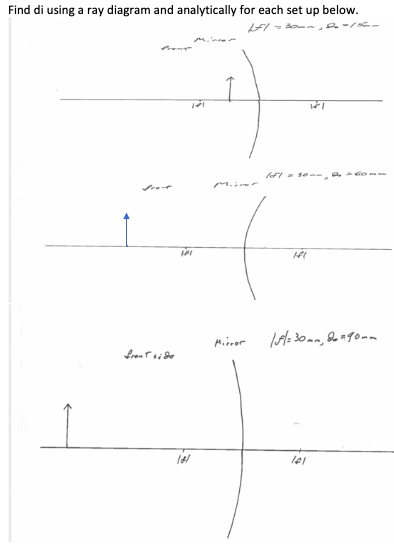
Homework Answers

Add Answer to:
For the first diagram |f| = 30mm, do = 15mm
the second |f| = 30mm ,...
3 of 4 Ifl = 40mm, f. = 60mm HI Mirror l fl=30mm, do=90mm front side...
 3 of 4 Ifl = 40mm, f. = 60mm HI Mirror l fl=30mm, do=90mm front side ial 141
28 Find di diagram (fl = 30mm, do = 45 mm using a rag & analytically...
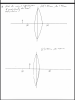 28 Find di diagram (fl = 30mm, do = 45 mm using a rag & analytically for each serup below 141= Homm, do zoom
Find di using a ray diagram and analytically for each set up below. (A- Sanalytier وسه...
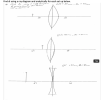 Find di using a ray diagram and analytically for each set up below. (A- Sanalytier وسه T Il-von-, 141 -40m, ,-60 1 امها
Ray Diagrams Concave Mirror (Task 13) G) do > R (R-20) Concave Mirror O C d,...
 Ray Diagrams Concave Mirror (Task 13) G) do > R (R-20) Concave Mirror O C d, by ray diagram d, using equation (1) Percent difference in di- h, by ray diagram M by ray diagram- M using equation (2)- Percent difference in M Gi) do- R-2 Minor d, by ray diagram d, using equation (1) Percent difference in d, h by ray diagram M by ray diagram M using equation (2) Percent difference in M 8- (iii) do -f Concave...
Convex Mirror (Task 14) (G) do >R Convex Mirror d, by ray diagram- d, using equation...
 Convex Mirror (Task 14) (G) do >R Convex Mirror d, by ray diagram- d, using equation (1) Percent difference in d hy by ray diagram M by ray diagram- M using equation (2) Percent difference in M ) do-R-2 Mirror d, by ray diagram d, using equation (1)- Percent difference in d hy by ray diagram M by ray diagram- M using equation (2) Percent difference in M (ii) do-f Convex Mirror do d, by ray diagram- d, using equation...
Can you please help my find the magnification, di by ray diagram, and hi by ray...
 Can
you please help my find the magnification, di by ray diagram, and
hi by ray diagram for each problem.
Ray Diagrams Concave Mirror (Task 13) Concave Mirror h hi ho o C Magnification () object no mis)h d by ray dingram- hy by ray diagram M by ray diagram (ii) do -R-2f Concave Mirror dj by ray diagram d, using equation (1)- Percent difference in d, h by ray diagram - M by ray diagram_ M using equation (2)...
Can
you please help my find the magnification, di by ray diagram, and
hi by ray diagram for each problem.
Ray Diagrams Concave Mirror (Task 13) Concave Mirror h hi ho o C Magnification () object no mis)h d by ray dingram- hy by ray diagram M by ray diagram (ii) do -R-2f Concave Mirror dj by ray diagram d, using equation (1)- Percent difference in d, h by ray diagram - M by ray diagram_ M using equation (2)...
need help and explanation for the second question using the first diagram please (5 Points) A...
 need help and explanation for the second question using the
first diagram please
(5 Points) A light ray travels through three parallel slabs having different indices of refraction. Rank the materials according to the size of their indices of refraction. ni n2 n3 n1 > n2>n3 n2>nl> n3 n1 > n3 > n2 n2 > n3 > n1 n3 > ni >n2 DETAILS MY NOTES ASK YOUR TEACHER (5 Points) Using the diagram from question 5, in what slab is...
need help and explanation for the second question using the
first diagram please
(5 Points) A light ray travels through three parallel slabs having different indices of refraction. Rank the materials according to the size of their indices of refraction. ni n2 n3 n1 > n2>n3 n2>nl> n3 n1 > n3 > n2 n2 > n3 > n1 n3 > ni >n2 DETAILS MY NOTES ASK YOUR TEACHER (5 Points) Using the diagram from question 5, in what slab is...
1-Find the local maximum value of f using both the First and Second Derivative Tests. f(x)...
1-Find the local maximum value of f using both the First and Second Derivative Tests. f(x) = x + √4 - x 2-Consider the equation below. (If you need to use -∞ or ∞, enter -INFINITY or INFINITY.) f(x) = 2x3 + 3x2 − 72x (a) Find the intervals on which f is increasing. (Enter the interval that contains smaller numbers first.) ( , ) ∪ ( , ) Find the interval on which f is decreasing. ( , ) (b) Find the local minimum and...
(x + 1)2 Consider the function f(x) -. The first and second derivatives of f(x) are...
 (x + 1)2 Consider the function f(x) -. The first and second derivatives of f(x) are 1 + x2 2(1 – x2) 4x(x2 - 3) f'(x) = and f" (2) Using this information, (1 + x2) (1 + x2)3 (a) Find all relative extrema. (4 points) Minimum: Maximum: (b) Find the intervals of concavity for f(x) and identify any inflection points for yourself. (5 points) Concave up: Concave down: (c) Using the fact that lim f(x) = 1, and our...
Java servlet Create a multiplication table using a servlet The first request to the page should...
 Java servlet
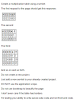
Create a multiplication table using a servlet The first request to the page should get this response: # 2|13||4 123 4 The second: #12345 112345 2246810 The third: #1234 5 1 12345 2 246810 336912 15 And so on and so forth. Do not create a new project. Just add a new servlet to your already created project DO NOT use the application scope Do not use bootstrap to beautify the page I don't even care if the...
Java servlet
Create a multiplication table using a servlet The first request to the page should get this response: # 2|13||4 123 4 The second: #12345 112345 2246810 The third: #1234 5 1 12345 2 246810 336912 15 And so on and so forth. Do not create a new project. Just add a new servlet to your already created project DO NOT use the application scope Do not use bootstrap to beautify the page I don't even care if the...
 3 of 4 Ifl = 40mm, f. = 60mm HI Mirror l fl=30mm, do=90mm front side ial 141
 28 Find di diagram (fl = 30mm, do = 45 mm using a rag & analytically for each serup below 141= Homm, do zoom
 Find di using a ray diagram and analytically for each set up below. (A- Sanalytier وسه T Il-von-, 141 -40m, ,-60 1 امها
 Ray Diagrams Concave Mirror (Task 13) G) do > R (R-20) Concave Mirror O C d, by ray diagram d, using equation (1) Percent difference in di- h, by ray diagram M by ray diagram- M using equation (2)- Percent difference in M Gi) do- R-2 Minor d, by ray diagram d, using equation (1) Percent difference in d, h by ray diagram M by ray diagram M using equation (2) Percent difference in M 8- (iii) do -f Concave...
 Convex Mirror (Task 14) (G) do >R Convex Mirror d, by ray diagram- d, using equation (1) Percent difference in d hy by ray diagram M by ray diagram- M using equation (2) Percent difference in M ) do-R-2 Mirror d, by ray diagram d, using equation (1)- Percent difference in d hy by ray diagram M by ray diagram- M using equation (2) Percent difference in M (ii) do-f Convex Mirror do d, by ray diagram- d, using equation...
 Can
you please help my find the magnification, di by ray diagram, and
hi by ray diagram for each problem.
Ray Diagrams Concave Mirror (Task 13) Concave Mirror h hi ho o C Magnification () object no mis)h d by ray dingram- hy by ray diagram M by ray diagram (ii) do -R-2f Concave Mirror dj by ray diagram d, using equation (1)- Percent difference in d, h by ray diagram - M by ray diagram_ M using equation (2)...
Can
you please help my find the magnification, di by ray diagram, and
hi by ray diagram for each problem.
Ray Diagrams Concave Mirror (Task 13) Concave Mirror h hi ho o C Magnification () object no mis)h d by ray dingram- hy by ray diagram M by ray diagram (ii) do -R-2f Concave Mirror dj by ray diagram d, using equation (1)- Percent difference in d, h by ray diagram - M by ray diagram_ M using equation (2)...
 need help and explanation for the second question using the
first diagram please
(5 Points) A light ray travels through three parallel slabs having different indices of refraction. Rank the materials according to the size of their indices of refraction. ni n2 n3 n1 > n2>n3 n2>nl> n3 n1 > n3 > n2 n2 > n3 > n1 n3 > ni >n2 DETAILS MY NOTES ASK YOUR TEACHER (5 Points) Using the diagram from question 5, in what slab is...
need help and explanation for the second question using the
first diagram please
(5 Points) A light ray travels through three parallel slabs having different indices of refraction. Rank the materials according to the size of their indices of refraction. ni n2 n3 n1 > n2>n3 n2>nl> n3 n1 > n3 > n2 n2 > n3 > n1 n3 > ni >n2 DETAILS MY NOTES ASK YOUR TEACHER (5 Points) Using the diagram from question 5, in what slab is...
 (x + 1)2 Consider the function f(x) -. The first and second derivatives of f(x) are 1 + x2 2(1 – x2) 4x(x2 - 3) f'(x) = and f" (2) Using this information, (1 + x2) (1 + x2)3 (a) Find all relative extrema. (4 points) Minimum: Maximum: (b) Find the intervals of concavity for f(x) and identify any inflection points for yourself. (5 points) Concave up: Concave down: (c) Using the fact that lim f(x) = 1, and our...
 Java servlet
Create a multiplication table using a servlet The first request to the page should get this response: # 2|13||4 123 4 The second: #12345 112345 2246810 The third: #1234 5 1 12345 2 246810 336912 15 And so on and so forth. Do not create a new project. Just add a new servlet to your already created project DO NOT use the application scope Do not use bootstrap to beautify the page I don't even care if the...
Java servlet
Create a multiplication table using a servlet The first request to the page should get this response: # 2|13||4 123 4 The second: #12345 112345 2246810 The third: #1234 5 1 12345 2 246810 336912 15 And so on and so forth. Do not create a new project. Just add a new servlet to your already created project DO NOT use the application scope Do not use bootstrap to beautify the page I don't even care if the...
Most questions answered within 3 hours.
-
Where is the error in this code sequence?
String s1 = "Hello";
String s2 = "ello";...
asked 11 months ago -
Financial data for Joel de Paris, Inc., for last year
follow:
Joel de Paris, Inc.
Balance...
asked 11 months ago -
Consider this reaction:
Al2(SO4)3 (aq)+ BaCl3
(aq) Al2Cl6 (aq)- +
3BaSO4(s) . What is the...
asked 11 months ago -
Suppose that Savneet is considering increasing her
recent random sample from 20 car rentals to 40...
asked 11 months ago -
Trucks arrive at an unloading terminal at an average rate of 120
per hour.
Trucks arrive...
asked 11 months ago -
Why are methanol and ethanol completely soluble in water while
octanol is not very little soluble....
asked 11 months ago -
A facilities manager at a university reads in a research report
that the mean amount of...
asked 11 months ago -
When the CuSO4 is rehydrated by adding water to the anhydrous
compound, is this an endothermic...
asked 11 months ago -
A ray of sunlight is passing from diamond into crown glass; the
angle of incidence is...
asked 11 months ago -
A block of mass 0.249 kg is placed on top of a light, vertical
spring of...
asked 11 months ago -
how do the kidneys compensate in the presences of acidosis
a) trigger hyperventilate
b) reserve acid...
asked 11 months ago -
Question 501 pts
The rental rate of capital to the firm increases. Which of the
following...
asked 11 months ago