
Homework Answers

Add Answer to:
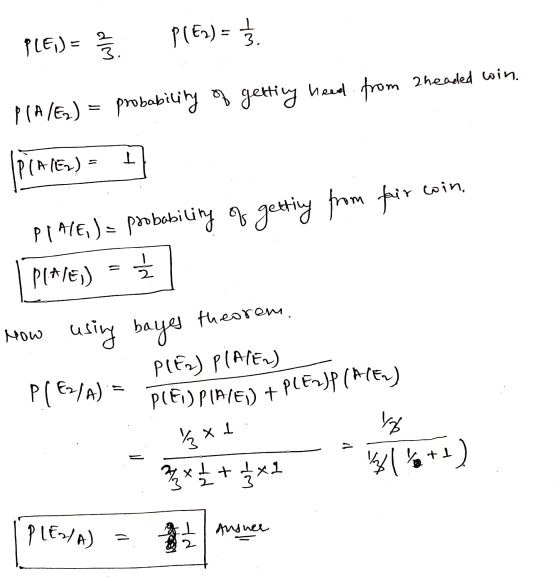
Question 4 (20 points) A box contains three coins, two fair coins and one two-headed coin....
a bag contains one fair coin, two two-headed coins, and three two-tailed coins. each of the...
a bag contains one fair coin, two two-headed coins, and three two-tailed coins. each of the is flipped, but the outcomes of the fice coins are hidden from you, randomly. if the outcome you see is headsm, what is the probability that the fair coin (which may or may not be the coin that was shown to you) panded heads up?
You have 2 fair coins and one coin with heads on both sides. You pick a...
You have 2 fair coins and one coin with heads on both sides. You pick a coin at random and toss it twice. If it lands heads up on both tosses, the probability it also lands heads up on a third toss can be express in the form A/B, where A and B are relatively prime positive integers (i.e. the greatest common divisor is 1). Compute A + B.
A box contains four coins. Three of the coins are fair, but one of them is...
 A box contains four coins. Three of the coins are fair, but one of them is biased, with P(11) = ? (where 11 is the event of flipping heads). You take a coin from the box and flip it. It comes up heads. What is the probability that you have flipped the biased coin?
A jar contains 100 coins, where 99 are fair, but one is double-headed (always landing heads)....
A jar contains 100 coins, where 99 are fair, but one is double-headed (always landing heads). A coin is chosen randomly from the jar. Then, the chosen coin is flipped 5 times. (a) Compute the probability that the coin lands heads all 5 times. (b) Given the coin lands heads all 5 times, what is the probability that the chosen coin is double-headed?
Suppose there are two coins. One is a standard fair coin, so that P(heads)=0.50. The other...
 Suppose there are two coins. One is a standard fair coin, so that P(heads)=0.50. The other one is a two-sided coin, so that P(heads)=1. You draw one of the two coins at random and toss it. It results in heads. Given that observation... (a) Compute the probability that you have selected a fair coin. (1pt) (b) What is the probability that the next toss will result in heads too? (1pt) (c) If the next toss results in heads as well,...
A box has two coins. One has two heads and the other is a fair coin...
A box has two coins. One has two heads and the other is a fair coin with one head and one tail. Now you flip both coins at the same time. a.) How many sample points are there in the sample space? List all the sample points. b.) What is the probability that you come up with two heads?
Suppose you have two coins. One coin is fair and other is a coin with heads...
Suppose you have two coins. One coin is fair and other is a coin with heads on both sides. Now you choose a coin at random and flip the coin. If the coin lands head, what is the probability that it was the fair coin?
A box contains five coins. For each coin there is a different probability that a head...
A box contains five coins. For each coin there is a different probability that a head will be obtained when the coin is tossed. (Some of the coins are not fair coins!) Let pi denote the probability of a head when the i th coin is tossed (i = 1, . . . , 5), and suppose that p1 = 0, p2 =1/4, p3 =1/2, p4 =3/4, p5 =1. The experiment we are interested in consists in selecting at random...
Tom has three coins. Two are fair and one is unfair coin weighted so that heads...
Tom has three coins. Two are fair and one is unfair coin weighted so that heads is three times as likely as tails. He selects one of the coins at random and flips it. What is the probability it comes up heads? If it does come up heads, what is the probability it was the unfair coin?
Problem 6 A box contains 4 coins: • coin 1 has both sides heads. • coin...
 Problem 6 A box contains 4 coins: • coin 1 has both sides heads. • coin 2 has both sides tails. • coin 3 has both sides tails. • coin 4 is a regular coin (1 side head, other side tails). (a)(3 points) If we randomly choose one coin from the box and flip, what is the probability we get heads? (b)(3 points) If we randomly choose one coin, flip, and it comes up heads, what is the probability it...
 A box contains four coins. Three of the coins are fair, but one of them is biased, with P(11) = ? (where 11 is the event of flipping heads). You take a coin from the box and flip it. It comes up heads. What is the probability that you have flipped the biased coin?
 Suppose there are two coins. One is a standard fair coin, so that P(heads)=0.50. The other one is a two-sided coin, so that P(heads)=1. You draw one of the two coins at random and toss it. It results in heads. Given that observation... (a) Compute the probability that you have selected a fair coin. (1pt) (b) What is the probability that the next toss will result in heads too? (1pt) (c) If the next toss results in heads as well,...
 Problem 6 A box contains 4 coins: • coin 1 has both sides heads. • coin 2 has both sides tails. • coin 3 has both sides tails. • coin 4 is a regular coin (1 side head, other side tails). (a)(3 points) If we randomly choose one coin from the box and flip, what is the probability we get heads? (b)(3 points) If we randomly choose one coin, flip, and it comes up heads, what is the probability it...
Most questions answered within 3 hours.
-
Where is the error in this code sequence?
String s1 = "Hello";
String s2 = "ello";...
asked 10 months ago -
Financial data for Joel de Paris, Inc., for last year
follow:
Joel de Paris, Inc.
Balance...
asked 10 months ago -
Consider this reaction:
Al2(SO4)3 (aq)+ BaCl3
(aq) Al2Cl6 (aq)- +
3BaSO4(s) . What is the...
asked 10 months ago -
Suppose that Savneet is considering increasing her
recent random sample from 20 car rentals to 40...
asked 10 months ago -
Trucks arrive at an unloading terminal at an average rate of 120
per hour.
Trucks arrive...
asked 10 months ago -
Why are methanol and ethanol completely soluble in water while
octanol is not very little soluble....
asked 10 months ago -
A facilities manager at a university reads in a research report
that the mean amount of...
asked 10 months ago -
When the CuSO4 is rehydrated by adding water to the anhydrous
compound, is this an endothermic...
asked 10 months ago -
A ray of sunlight is passing from diamond into crown glass; the
angle of incidence is...
asked 10 months ago -
A block of mass 0.249 kg is placed on top of a light, vertical
spring of...
asked 10 months ago -
how do the kidneys compensate in the presences of acidosis
a) trigger hyperventilate
b) reserve acid...
asked 10 months ago -
Question 501 pts
The rental rate of capital to the firm increases. Which of the
following...
asked 10 months ago