


Homework Answers
Solution:
Total height of three peaks = 125 + 72 + 10 = 207 mm
Percent composition of A = (125/207) x 100% = 60.38%
Percent composition of B = (72/207)x 100% = 34.78%
Percent composition of C = (10/207)x 100% = 4.8 %
NMR analysis:

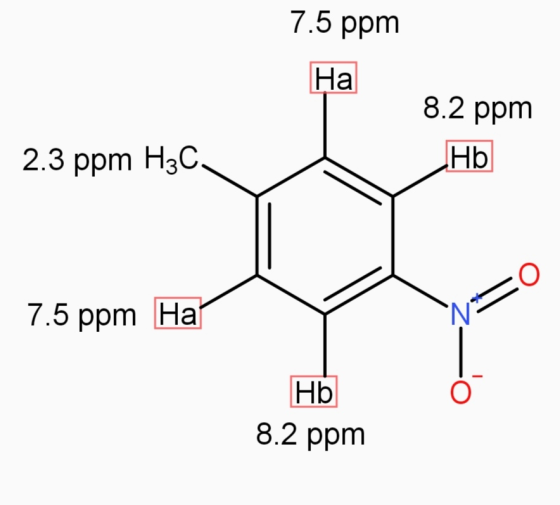
Peak B is para nitro Toluene:
Para isomer has two doublets only due to two identical set of protons having J= 8 Hz. This spectra can used to decide the position of nitro group.
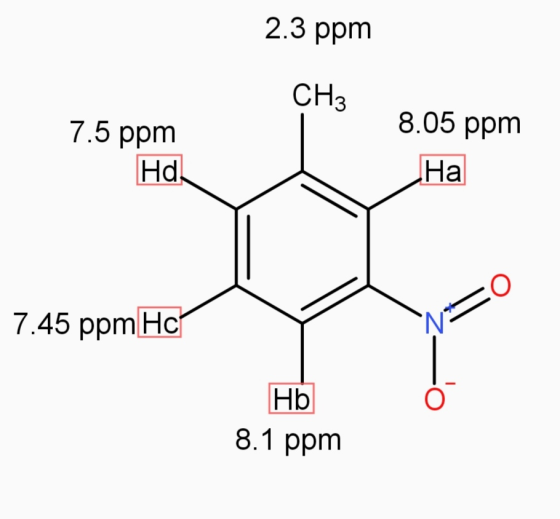
Peak C is meta nitro Toluene
Add Answer to:
5. Using the GC mentioned in question 4 and the values listed on the chromatogram for...
c) Using your answers to question 5 and 6a, what percent of the mixture obtained in...
 c) Using your answers to question 5 and 6a, what percent of the
mixture obtained in reaction 1 is the ortho isomer?
d) What percent of the mixture obtained in reaction 1 is the
meta isomer?
e) What percent of the mixture obtained in reaction 1 is the
para isomer?
f) Could we have used Mass Spectrometry after the GC analysis
(GC-MS) to identify which peak on the GC was which isomer? Why or
why not?
g) Could we have...
c) Using your answers to question 5 and 6a, what percent of the
mixture obtained in reaction 1 is the ortho isomer?
d) What percent of the mixture obtained in reaction 1 is the
meta isomer?
e) What percent of the mixture obtained in reaction 1 is the
para isomer?
f) Could we have used Mass Spectrometry after the GC analysis
(GC-MS) to identify which peak on the GC was which isomer? Why or
why not?
g) Could we have...
b) Which area of the spectrum did you focus on and which key piece of information...
 b) Which area of the spectrum did you focus on and which
key piece of information (chemical shift, integration, or splitting
pattern) helped you decide which spectrum belonged to which isomer?
Please explain your responses.
Reaction 1: Nitration HNO3 NO2 + + H2SO4, H20 NO2 toluene NO2 ortho meta para Spectrum For Peak A on GC For Peak B on GC For Peak Con GC Isomer Ortho Nitro Toluene Para Nitro Toluene Meta Nitro Toluene Proton NMR Spectrum for Peak...
b) Which area of the spectrum did you focus on and which
key piece of information (chemical shift, integration, or splitting
pattern) helped you decide which spectrum belonged to which isomer?
Please explain your responses.
Reaction 1: Nitration HNO3 NO2 + + H2SO4, H20 NO2 toluene NO2 ortho meta para Spectrum For Peak A on GC For Peak B on GC For Peak Con GC Isomer Ortho Nitro Toluene Para Nitro Toluene Meta Nitro Toluene Proton NMR Spectrum for Peak...
b) Which area of the spectrum did you focus on and which key piece of information...
 b) Which area of the spectrum did you focus on and which key
piece of information (chemical shift, integration, or splitting
pattern) helped you decide which spectrum belonged to which isomer?
Please explain your responses.
Reaction 1: Nitration HNO3 NO2 + + H2SO4, H20 NO2 toluene NO2 ortho meta para Spectrum For Peak A on GC For Peak B on GC For Peak Con GC Isomer Ortho Nitro Toluene Para Nitro Toluene Meta Nitro Toluene Proton NMR Spectrum for Peak...
b) Which area of the spectrum did you focus on and which key
piece of information (chemical shift, integration, or splitting
pattern) helped you decide which spectrum belonged to which isomer?
Please explain your responses.
Reaction 1: Nitration HNO3 NO2 + + H2SO4, H20 NO2 toluene NO2 ortho meta para Spectrum For Peak A on GC For Peak B on GC For Peak Con GC Isomer Ortho Nitro Toluene Para Nitro Toluene Meta Nitro Toluene Proton NMR Spectrum for Peak...
NEED HELP WITH B) C) D) E) F) and G) that apply to the spectra below....
 NEED HELP WITH B) C) D) E) F) and G) that apply to the
spectra below.
OTHER ANSWERS ARE THERE TO SUPPLEMENT
Thank you!
5. Using the GC mentioned in question 4 and the values listed on
the chromatogram for the height and width (at half height) of each
peak, calculate the percent composition for each product (A, B and
C). Be sure to show your work.
Area of peak A = 125 x 8 =
1000mm2
Area of peak...
NEED HELP WITH B) C) D) E) F) and G) that apply to the
spectra below.
OTHER ANSWERS ARE THERE TO SUPPLEMENT
Thank you!
5. Using the GC mentioned in question 4 and the values listed on
the chromatogram for the height and width (at half height) of each
peak, calculate the percent composition for each product (A, B and
C). Be sure to show your work.
Area of peak A = 125 x 8 =
1000mm2
Area of peak...
H NMR Spectrum: For each signal: 1.) Identify its environment 2.) Identify its spin-spin coupling...
 H NMR Spectrum:
For each signal:
1.) Identify its environment
2.) Identify its spin-spin coupling (identify how many protons
are 3 bonds away, causing the coupling)
3.) Identify its integration value
Why is the peak at 6.3 ppm broadened?
Explain why there are 2 doublets in the aromatic region, but 4
aromatic protons on benzocaine
Why is the quartet at ~4.3 ppm so far downfield compared to the
triplet at ~ 1.3 ppm?
What is the purpose of using sulfuric...
H NMR Spectrum:
For each signal:
1.) Identify its environment
2.) Identify its spin-spin coupling (identify how many protons
are 3 bonds away, causing the coupling)
3.) Identify its integration value
Why is the peak at 6.3 ppm broadened?
Explain why there are 2 doublets in the aromatic region, but 4
aromatic protons on benzocaine
Why is the quartet at ~4.3 ppm so far downfield compared to the
triplet at ~ 1.3 ppm?
What is the purpose of using sulfuric...
6) Identify the CHCl isomer using the following proton NMR data: doublet 81.04 (6H) A) (CH3)3CCI...
 6) Identify the CHCl isomer using the following proton NMR data: doublet 81.04 (6H) A) (CH3)3CCI multiplet 8 1.95 (17) doublet 8 3.35 (2H) B) CH2CH2CH2CH2C1 C) CH2CH2CHCH ĆI D) (CH3),CHCH,CI 7) Which compound below has only three peaks in its C-NMR spectrum? a) ortho-dichlorobenzene c) para-dichlorobenzene b) meta-dichlorobenzene d) chlorobenzene 8) Which one of the following isomers of CsHis has only two peaks in its C NMR? A) CH3(CH2).CH B) CH3CHCHCHÖCHCH; CH, CHz CH, C) CH3CHCHCHCH CH3 CH3 D)...
5 pts] Raw integration values are never the nice round numbers you are typically given in...
 5 pts] Raw integration values are never the nice round numbers you are typically given in lab, and are often imprecise because of subtle differences in the way that the spins of different nuclei 1. interact with the magnetic field. Raw integration values are given in red below. One common strategy for confirming the presence of protic hydrogen atoms is to add D20, which will replace moderately acidic hydrogens (up to about pKa 18) with NMR-silent D atoms. Determine the...
Fill out the tables below of the starting material and pure product by using the given...
 Fill out the tables below of the starting material and pure
product by using the given NMR spectrums. Identify if the pure
isomer of methyl nitrobenzoate as ortho, meta, or para.
Complete the table below using your proton NMR spectrum of your starting material. Be sure to include all peaks. Note: The table is expandable. Use the structure below for the letter assignments in your table. Splitting Integration Assignment Peak (ppm) Other Notes -7.95 -7.92 0627 -787 785 7.30 751...
Fill out the tables below of the starting material and pure
product by using the given NMR spectrums. Identify if the pure
isomer of methyl nitrobenzoate as ortho, meta, or para.
Complete the table below using your proton NMR spectrum of your starting material. Be sure to include all peaks. Note: The table is expandable. Use the structure below for the letter assignments in your table. Splitting Integration Assignment Peak (ppm) Other Notes -7.95 -7.92 0627 -787 785 7.30 751...
1-Iodo-3-methylbutane has how many signals in its 1H NMR spectrum? Question 1 options: 3 4 5...
1-Iodo-3-methylbutane has how many signals in its 1H NMR spectrum? Question 1 options: 3 4 5 6 How many doublets are in the proton NMR spectrum of 1-iodo-3-methylbutane? Question 2 options: 0 1 2 3 What is the index of hydrogen deficiency for a compound with the formula C9H16? Question 3 options: 0 1 2 3 The addition of Br2 to which compound will NOT result in the formation of a racemic mixture? Question 4 options: 2-methyl-1-propene cyclobutene 1-butene 2-methyl-2-butene
Problem #23: When compound X (C,H,Br) is reacted with sodium cyanide (NaCN) forms compound Y (C,H...
 Problem #23: When compound X (C,H,Br) is reacted with sodium cyanide (NaCN) forms compound Y (C,H,N). Compound Y, upon reduction with H over a Ni catalyst, yields compound Z (C,HIN. The 'H NMR spectrum of X gives two signals, a multiplet at δ = 7.3 ppm (5H) and a singlet at δ 4.25 ppm (2H). The 'H NMR spectrum of Y is similar to that of X in that it shows a multiplet at ö-7.3 ppm (5H) and a singlet...
 c) Using your answers to question 5 and 6a, what percent of the
mixture obtained in reaction 1 is the ortho isomer?
d) What percent of the mixture obtained in reaction 1 is the
meta isomer?
e) What percent of the mixture obtained in reaction 1 is the
para isomer?
f) Could we have used Mass Spectrometry after the GC analysis
(GC-MS) to identify which peak on the GC was which isomer? Why or
why not?
g) Could we have...
c) Using your answers to question 5 and 6a, what percent of the
mixture obtained in reaction 1 is the ortho isomer?
d) What percent of the mixture obtained in reaction 1 is the
meta isomer?
e) What percent of the mixture obtained in reaction 1 is the
para isomer?
f) Could we have used Mass Spectrometry after the GC analysis
(GC-MS) to identify which peak on the GC was which isomer? Why or
why not?
g) Could we have...
 b) Which area of the spectrum did you focus on and which
key piece of information (chemical shift, integration, or splitting
pattern) helped you decide which spectrum belonged to which isomer?
Please explain your responses.
Reaction 1: Nitration HNO3 NO2 + + H2SO4, H20 NO2 toluene NO2 ortho meta para Spectrum For Peak A on GC For Peak B on GC For Peak Con GC Isomer Ortho Nitro Toluene Para Nitro Toluene Meta Nitro Toluene Proton NMR Spectrum for Peak...
b) Which area of the spectrum did you focus on and which
key piece of information (chemical shift, integration, or splitting
pattern) helped you decide which spectrum belonged to which isomer?
Please explain your responses.
Reaction 1: Nitration HNO3 NO2 + + H2SO4, H20 NO2 toluene NO2 ortho meta para Spectrum For Peak A on GC For Peak B on GC For Peak Con GC Isomer Ortho Nitro Toluene Para Nitro Toluene Meta Nitro Toluene Proton NMR Spectrum for Peak...
 b) Which area of the spectrum did you focus on and which key
piece of information (chemical shift, integration, or splitting
pattern) helped you decide which spectrum belonged to which isomer?
Please explain your responses.
Reaction 1: Nitration HNO3 NO2 + + H2SO4, H20 NO2 toluene NO2 ortho meta para Spectrum For Peak A on GC For Peak B on GC For Peak Con GC Isomer Ortho Nitro Toluene Para Nitro Toluene Meta Nitro Toluene Proton NMR Spectrum for Peak...
b) Which area of the spectrum did you focus on and which key
piece of information (chemical shift, integration, or splitting
pattern) helped you decide which spectrum belonged to which isomer?
Please explain your responses.
Reaction 1: Nitration HNO3 NO2 + + H2SO4, H20 NO2 toluene NO2 ortho meta para Spectrum For Peak A on GC For Peak B on GC For Peak Con GC Isomer Ortho Nitro Toluene Para Nitro Toluene Meta Nitro Toluene Proton NMR Spectrum for Peak...
 NEED HELP WITH B) C) D) E) F) and G) that apply to the
spectra below.
OTHER ANSWERS ARE THERE TO SUPPLEMENT
Thank you!
5. Using the GC mentioned in question 4 and the values listed on
the chromatogram for the height and width (at half height) of each
peak, calculate the percent composition for each product (A, B and
C). Be sure to show your work.
Area of peak A = 125 x 8 =
1000mm2
Area of peak...
NEED HELP WITH B) C) D) E) F) and G) that apply to the
spectra below.
OTHER ANSWERS ARE THERE TO SUPPLEMENT
Thank you!
5. Using the GC mentioned in question 4 and the values listed on
the chromatogram for the height and width (at half height) of each
peak, calculate the percent composition for each product (A, B and
C). Be sure to show your work.
Area of peak A = 125 x 8 =
1000mm2
Area of peak...
 H NMR Spectrum:
For each signal:
1.) Identify its environment
2.) Identify its spin-spin coupling (identify how many protons
are 3 bonds away, causing the coupling)
3.) Identify its integration value
Why is the peak at 6.3 ppm broadened?
Explain why there are 2 doublets in the aromatic region, but 4
aromatic protons on benzocaine
Why is the quartet at ~4.3 ppm so far downfield compared to the
triplet at ~ 1.3 ppm?
What is the purpose of using sulfuric...
H NMR Spectrum:
For each signal:
1.) Identify its environment
2.) Identify its spin-spin coupling (identify how many protons
are 3 bonds away, causing the coupling)
3.) Identify its integration value
Why is the peak at 6.3 ppm broadened?
Explain why there are 2 doublets in the aromatic region, but 4
aromatic protons on benzocaine
Why is the quartet at ~4.3 ppm so far downfield compared to the
triplet at ~ 1.3 ppm?
What is the purpose of using sulfuric...
 6) Identify the CHCl isomer using the following proton NMR data: doublet 81.04 (6H) A) (CH3)3CCI multiplet 8 1.95 (17) doublet 8 3.35 (2H) B) CH2CH2CH2CH2C1 C) CH2CH2CHCH ĆI D) (CH3),CHCH,CI 7) Which compound below has only three peaks in its C-NMR spectrum? a) ortho-dichlorobenzene c) para-dichlorobenzene b) meta-dichlorobenzene d) chlorobenzene 8) Which one of the following isomers of CsHis has only two peaks in its C NMR? A) CH3(CH2).CH B) CH3CHCHCHÖCHCH; CH, CHz CH, C) CH3CHCHCHCH CH3 CH3 D)...
 5 pts] Raw integration values are never the nice round numbers you are typically given in lab, and are often imprecise because of subtle differences in the way that the spins of different nuclei 1. interact with the magnetic field. Raw integration values are given in red below. One common strategy for confirming the presence of protic hydrogen atoms is to add D20, which will replace moderately acidic hydrogens (up to about pKa 18) with NMR-silent D atoms. Determine the...
 Fill out the tables below of the starting material and pure
product by using the given NMR spectrums. Identify if the pure
isomer of methyl nitrobenzoate as ortho, meta, or para.
Complete the table below using your proton NMR spectrum of your starting material. Be sure to include all peaks. Note: The table is expandable. Use the structure below for the letter assignments in your table. Splitting Integration Assignment Peak (ppm) Other Notes -7.95 -7.92 0627 -787 785 7.30 751...
Fill out the tables below of the starting material and pure
product by using the given NMR spectrums. Identify if the pure
isomer of methyl nitrobenzoate as ortho, meta, or para.
Complete the table below using your proton NMR spectrum of your starting material. Be sure to include all peaks. Note: The table is expandable. Use the structure below for the letter assignments in your table. Splitting Integration Assignment Peak (ppm) Other Notes -7.95 -7.92 0627 -787 785 7.30 751...
 Problem #23: When compound X (C,H,Br) is reacted with sodium cyanide (NaCN) forms compound Y (C,H,N). Compound Y, upon reduction with H over a Ni catalyst, yields compound Z (C,HIN. The 'H NMR spectrum of X gives two signals, a multiplet at δ = 7.3 ppm (5H) and a singlet at δ 4.25 ppm (2H). The 'H NMR spectrum of Y is similar to that of X in that it shows a multiplet at ö-7.3 ppm (5H) and a singlet...
Most questions answered within 3 hours.
-
Where is the error in this code sequence?
String s1 = "Hello";
String s2 = "ello";...
asked 10 months ago -
Financial data for Joel de Paris, Inc., for last year
follow:
Joel de Paris, Inc.
Balance...
asked 10 months ago -
Consider this reaction:
Al2(SO4)3 (aq)+ BaCl3
(aq) Al2Cl6 (aq)- +
3BaSO4(s) . What is the...
asked 10 months ago -
Suppose that Savneet is considering increasing her
recent random sample from 20 car rentals to 40...
asked 10 months ago -
Trucks arrive at an unloading terminal at an average rate of 120
per hour.
Trucks arrive...
asked 10 months ago -
Why are methanol and ethanol completely soluble in water while
octanol is not very little soluble....
asked 10 months ago -
A facilities manager at a university reads in a research report
that the mean amount of...
asked 10 months ago -
When the CuSO4 is rehydrated by adding water to the anhydrous
compound, is this an endothermic...
asked 10 months ago -
A ray of sunlight is passing from diamond into crown glass; the
angle of incidence is...
asked 10 months ago -
A block of mass 0.249 kg is placed on top of a light, vertical
spring of...
asked 10 months ago -
how do the kidneys compensate in the presences of acidosis
a) trigger hyperventilate
b) reserve acid...
asked 10 months ago -
Question 501 pts
The rental rate of capital to the firm increases. Which of the
following...
asked 10 months ago