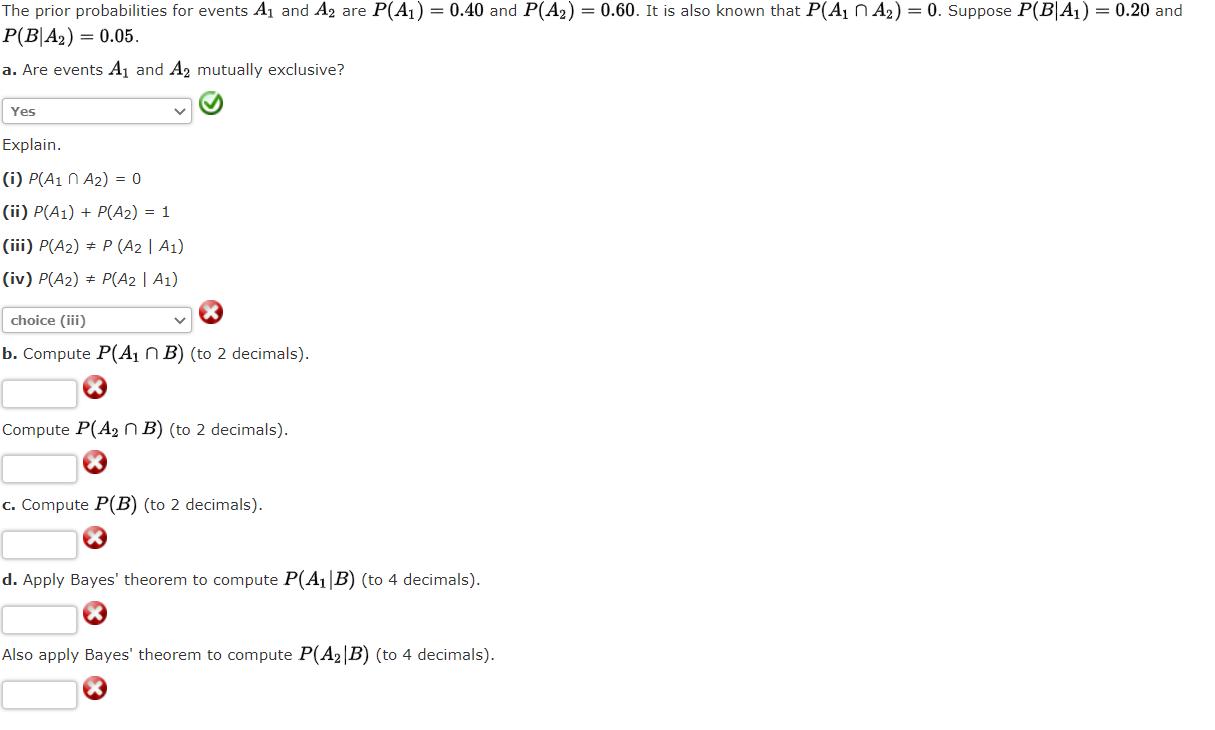
The prior probabilities for events and are and . It is also known that . Suppose and . a. Are events and mutually exclusive?

Homework Answers
Request Answer!
We need at least 10 more requests to produce the answer.
0 / 10 have requested this problem solution
The more requests, the faster the answer.
Add Answer to:
The prior probabilities for events and are and . It is also known that . Suppose and . a. Are events and mutually exclusive?
O PROBABILITY Probabilities involving two mutually exclusive events Events A and B are mutually exclusive. Suppose...
 O PROBABILITY Probabilities involving two mutually exclusive events Events A and B are mutually exclusive. Suppose event A occurs with probability 0.03 and event B occurs with probability 0.02. a. Compute the probability that A does not occur or B does not occur (or both). b. Compute the probability that neither the event A nor the event B occurs. (If necessary, consult a list of formulas.) 6 2
Two events with nonzero probabilities can be both mutually exclusive and independent cannot be both mutually exclusi...
Two events with nonzero probabilities can be both mutually exclusive and independent cannot be both mutually exclusive and independent are always mutually exclusive cannot be both mutually exclusive and independent and are always mutually exclusive
Events A and B are mutually exclusive. Which of the following statements is also true? a....
Events A and B are mutually exclusive. Which of the following statements is also true? a. P(A ∩ B) = P(A) + P(B) b. A and B are also independent c. P(A U B) = P(A)P(B) d. P(A U B) = P(A) + P(B)
Question 13 (2 points) If two events are mutually exclusive, then their probabilities can be added...
 Question 13 (2 points) If two events are mutually exclusive, then their probabilities can be added all of the choices are correct they may also be collectively exhaustive if one occurs, the other cannot occur the joint probability is equal to O Question 14 (1 point) The area under the normal distribution to the left of the mean is always 0.5 or 50 percent. True False
Suppose the events B and B2 are mutually exclusive and complementary events, such that P(B) =...
 Suppose the events B and B2 are mutually exclusive and complementary events, such that P(B) = 0.12 and P(B2) = (1 – 0.12). Consider another event A such that P(AB) = 0.49 and P(A|B2) = 0.46 Complete parts (a) through (d) below. • Find P(Bin A). • Find P(B2n A) • Find P(A) using the results in parts (a) and (b). • Find P(B1A). (Round the result to 4 decimal places.) a. P(Bin A) b. P(B2N A) c. P(A) DID...
Events A and B are mutually exclusive
Events A and B are mutually exclusive. Suppose event A occurs with probability 0.66 and event B occurs with probability 0.28.a. Compute the probability that A occurs or B does not occur (or both).b. Compute the probablity that neither the event A nor the event B occurs.
Understand mutually exclusive events Question Which of the following shows mutually exclusive events? Select the correct...
 Understand mutually exclusive events Question Which of the following shows mutually exclusive events? Select the correct answer below: rolling a sum of 9 from two rolls of a standard die and rolling 2 for the first roll drawing a red card and then drawing a black card with replacement from a standard deck of cards drawing a jack and then drawing a 7 without reprement from a standard deck of cards drawing a 7 and then drawing another 7 with...
S) Suppose that A and B are mutually exclusive events for which P(A) = 0.3 and...
 S) Suppose that A and B are mutually exclusive events for which P(A) = 0.3 and P(B) = 0.5 What is the probability that (a) either A or B occurs? (b) A occurs and B does not occur? (c) both A and B occur? 4.) A forest contains twenty elk, of which five are captured, tagged and then released. Some time later, four elk are captured from this population. What is the probability that exactly two of these are tagged?...
Suppose that A and B are mutually exclusive events. Complete parts (a) and (b) below a....
 Suppose that A and B are mutually exclusive events. Complete parts (a) and (b) below a. Use the special addition rule to express PiA or B) in terms of PIA) and P(B) Complete the equation below P(A or B) b. Show that the general addition rule gives the same answer as that in part (a) Select the correct answer below. O A. Since A and B are mutually exclusive events, then the probability that both A and Boccur is a...
a. The events A and B are mutually exclusive. Suppose P(A) = .37 and P(B) =...
 a. The events A and B are mutually exclusive. Suppose P(A) = .37 and P(B) = .38. What is the probability of either A or B occuring? (Round your answer to 2 decimal places.) Probability of either A or B b. What is the probability that neither A nor B will happen? (Round your answer to 2 decimal places.) Probability of neither A nor B
 O PROBABILITY Probabilities involving two mutually exclusive events Events A and B are mutually exclusive. Suppose event A occurs with probability 0.03 and event B occurs with probability 0.02. a. Compute the probability that A does not occur or B does not occur (or both). b. Compute the probability that neither the event A nor the event B occurs. (If necessary, consult a list of formulas.) 6 2
 Question 13 (2 points) If two events are mutually exclusive, then their probabilities can be added all of the choices are correct they may also be collectively exhaustive if one occurs, the other cannot occur the joint probability is equal to O Question 14 (1 point) The area under the normal distribution to the left of the mean is always 0.5 or 50 percent. True False
 Suppose the events B and B2 are mutually exclusive and complementary events, such that P(B) = 0.12 and P(B2) = (1 – 0.12). Consider another event A such that P(AB) = 0.49 and P(A|B2) = 0.46 Complete parts (a) through (d) below. • Find P(Bin A). • Find P(B2n A) • Find P(A) using the results in parts (a) and (b). • Find P(B1A). (Round the result to 4 decimal places.) a. P(Bin A) b. P(B2N A) c. P(A) DID...
 Understand mutually exclusive events Question Which of the following shows mutually exclusive events? Select the correct answer below: rolling a sum of 9 from two rolls of a standard die and rolling 2 for the first roll drawing a red card and then drawing a black card with replacement from a standard deck of cards drawing a jack and then drawing a 7 without reprement from a standard deck of cards drawing a 7 and then drawing another 7 with...
 S) Suppose that A and B are mutually exclusive events for which P(A) = 0.3 and P(B) = 0.5 What is the probability that (a) either A or B occurs? (b) A occurs and B does not occur? (c) both A and B occur? 4.) A forest contains twenty elk, of which five are captured, tagged and then released. Some time later, four elk are captured from this population. What is the probability that exactly two of these are tagged?...
 Suppose that A and B are mutually exclusive events. Complete parts (a) and (b) below a. Use the special addition rule to express PiA or B) in terms of PIA) and P(B) Complete the equation below P(A or B) b. Show that the general addition rule gives the same answer as that in part (a) Select the correct answer below. O A. Since A and B are mutually exclusive events, then the probability that both A and Boccur is a...
 a. The events A and B are mutually exclusive. Suppose P(A) = .37 and P(B) = .38. What is the probability of either A or B occuring? (Round your answer to 2 decimal places.) Probability of either A or B b. What is the probability that neither A nor B will happen? (Round your answer to 2 decimal places.) Probability of neither A nor B
Most questions answered within 3 hours.
-
Where is the error in this code sequence?
String s1 = "Hello";
String s2 = "ello";...
asked 11 months ago -
Financial data for Joel de Paris, Inc., for last year
follow:
Joel de Paris, Inc.
Balance...
asked 11 months ago -
Consider this reaction:
Al2(SO4)3 (aq)+ BaCl3
(aq) Al2Cl6 (aq)- +
3BaSO4(s) . What is the...
asked 11 months ago -
Suppose that Savneet is considering increasing her
recent random sample from 20 car rentals to 40...
asked 11 months ago -
Trucks arrive at an unloading terminal at an average rate of 120
per hour.
Trucks arrive...
asked 11 months ago -
Why are methanol and ethanol completely soluble in water while
octanol is not very little soluble....
asked 11 months ago -
A facilities manager at a university reads in a research report
that the mean amount of...
asked 11 months ago -
When the CuSO4 is rehydrated by adding water to the anhydrous
compound, is this an endothermic...
asked 11 months ago -
A ray of sunlight is passing from diamond into crown glass; the
angle of incidence is...
asked 11 months ago -
A block of mass 0.249 kg is placed on top of a light, vertical
spring of...
asked 11 months ago -
how do the kidneys compensate in the presences of acidosis
a) trigger hyperventilate
b) reserve acid...
asked 11 months ago -
Question 501 pts
The rental rate of capital to the firm increases. Which of the
following...
asked 11 months ago