
Homework Answers
Correct Answer : a) Public companies must follow IFRS and nonpublic companies may follow IFRS.
Reason : ASPE is useful for small businesses and private companies as it is having lesser compliance and is easily understandable to all. IFRS is comprised of Accounting standards which are followed internationally and therefore it is comparitively more compliance with the standards and guideance notes.
For a public company it is mandatory to follow IFRS , however non-public ( Private ) companies can choose apply IFRS over ASPE as per their needs.
Hope it helps. In case of any doubts or issues, please do comment below..
Add Answer to:
Which of the following statements is true? O Public companies must follow IFRS and nonpublic companies...
Which of the following is true regarding the statement of cash flows and IFRS? Cash and...
Which of the following is true regarding the statement of cash flows and IFRS? Cash and cash equivalents are defined differently under IFRS than under GAAP. Under IFRS most companies choose to use the direct method of reporting cash flows from operating activities. Companies preparing a complete set of financial statements under IFRS may exclude the statement of cash flows if the cash flow activity is reported in the notes to the financial statements. Under IFRS noncash investing and financing...
The financial statements of companies listed on the US stock market must comply with International Financial...
 The
financial statements of companies listed on the US stock market
must comply with International Financial Reporting Standards.
True or False
The financial statements of companies listed on the US stock market must comply with International Financial Reporting Standards. True False
The
financial statements of companies listed on the US stock market
must comply with International Financial Reporting Standards.
True or False
The financial statements of companies listed on the US stock market must comply with International Financial Reporting Standards. True False
Match the items below by entering the appropriate code letter. A. Internal users B. Proprietorship C....
 Match the items below by entering the appropriate code
letter.
A.
Internal users
B.
Proprietorship
C.
Expenses
D.
Investing activities
E.
Financing activities
F.
Assets
G.
Liabilities
H.
Private corporation
I.
Dividends
J.
Public corporation
1.
Consumed assets or services.
2.
Ownership is limited to one
person.
3.
Officers and others who manage the
business.
4.
Creditor claims against the assets
of the company.
5.
A separate legal entity under
provincial or federal laws that is...
Match the items below by entering the appropriate code
letter.
A.
Internal users
B.
Proprietorship
C.
Expenses
D.
Investing activities
E.
Financing activities
F.
Assets
G.
Liabilities
H.
Private corporation
I.
Dividends
J.
Public corporation
1.
Consumed assets or services.
2.
Ownership is limited to one
person.
3.
Officers and others who manage the
business.
4.
Creditor claims against the assets
of the company.
5.
A separate legal entity under
provincial or federal laws that is...
Read each of the following statements carefully and indicate whether each is true or false. 2...
 Read each of the following statements carefully and indicate whether each is true or false. 2 1. The Sarbanes-Oxley Act places great emphasis on internal controls and fraud prevention The FASB and the IASB are working toward full convergence of U.S. financial reporting standards and those of the International Accounting Standards Board. 3. Because of the Sarbanes-Oxley Act, it is probable that the FASB/IASB conceptual framework will become less important in developing accounting principles and standards 4. The FASB Standards...
1) The New York Stock Exchange requires all listed companies to: Multiple Choice a. Use IFRS...
1) The New York Stock Exchange requires all listed companies to: Multiple Choice a. Use IFRS (International Financial Reporting Standards) for financial statement reporting purposes. b. Maintain an internal audit function. c. Register with the PCAOB (Public Company Accounting Oversight Board). d. Send financial statements directly to investors, creditors, and other users of financial information. 2. Investors may be described as: Multiple Choice a. Individuals and enterprises that have ownership interest in a reporting entity. b. Individuals and enterprises that...
1) [True or False] Financial statements are the principal means through which financial information is communicated...
1) [True or False] Financial statements are the principal means through which financial information is communicated to those outside an enterprise. 2) [True or False] One weakness of accrual accounting is that it does not provide a good indication of the enterprise's present and continuing ability to generate favorable cash flows. 3) [True or False] The International Accounting Standards Board issues International Accounting Standards. 4) [True or False] The two major standard-setting organizations in the world are the International Accounting...
Fast Ltd. is a public company that prepares its consolidated financial statements in accordance with IFRS....
 Fast Ltd. is a public company that prepares its consolidated financial statements in accordance with IFRS. Its net income in Year 2 was $200,000, and shareholders' equity at December 31, Year 2, was $1,800,000. Mr. Lombardi, the major shareholder, has made an offer to buy out the other shareholders, delist the company, and take it private. Thereafter, the company will report under ASPE. You have identified the following two areas in which Fast's accounting principles differ between IFRS and ASPE....
For the following statements, determine which word or phrase from the list below will best complete...
 For the following statements, determine which word or phrase from the list below will best complete it. Note: Some words or phrases could be used more than once, and some might not be used.must give information about the changes in economic resources and claims on the economic resources.should not be used when liquidation is likely. ensures that the benefits of providing more information are greater than the cost of providing it.when applied, financial statement users will find it useful to...
b. Which of the following provides authoritative guidance for the auditor of a nonpublic company? O...
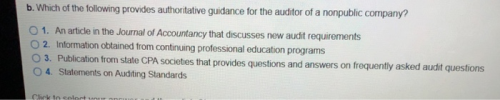 b. Which of the following provides authoritative guidance for the auditor of a nonpublic company? O 1. An article in the Journal of Accountancy that discusses new audit requirements O 2. Information obtained from continuing professional education programs O 3. Publication from state CPA societies that provides quest O 4. Statements on Auditing Standards tions and answers on frequently asked audit questions
Fast Ltd. is a public company that prepares its consolidated financial statements in accordance with IFRS....
Fast Ltd. is a public company that prepares its consolidated financial statements in accordance with IFRS. Its net income in Year 2 was $215,000, and shareholders’ equity at December 31, Year 2, was $1,950,000. Mr. Lombardi, the major shareholder, has made an offer to buy out the other shareholders, delist the company, and take it private. Thereafter, the company will report under ASPE. You have identified the following two areas in which Fast’s accounting principles differ between IFRS and ASPE....
 The
financial statements of companies listed on the US stock market
must comply with International Financial Reporting Standards.
True or False
The financial statements of companies listed on the US stock market must comply with International Financial Reporting Standards. True False
The
financial statements of companies listed on the US stock market
must comply with International Financial Reporting Standards.
True or False
The financial statements of companies listed on the US stock market must comply with International Financial Reporting Standards. True False
 Match the items below by entering the appropriate code
letter.
A.
Internal users
B.
Proprietorship
C.
Expenses
D.
Investing activities
E.
Financing activities
F.
Assets
G.
Liabilities
H.
Private corporation
I.
Dividends
J.
Public corporation
1.
Consumed assets or services.
2.
Ownership is limited to one
person.
3.
Officers and others who manage the
business.
4.
Creditor claims against the assets
of the company.
5.
A separate legal entity under
provincial or federal laws that is...
Match the items below by entering the appropriate code
letter.
A.
Internal users
B.
Proprietorship
C.
Expenses
D.
Investing activities
E.
Financing activities
F.
Assets
G.
Liabilities
H.
Private corporation
I.
Dividends
J.
Public corporation
1.
Consumed assets or services.
2.
Ownership is limited to one
person.
3.
Officers and others who manage the
business.
4.
Creditor claims against the assets
of the company.
5.
A separate legal entity under
provincial or federal laws that is...
 Read each of the following statements carefully and indicate whether each is true or false. 2 1. The Sarbanes-Oxley Act places great emphasis on internal controls and fraud prevention The FASB and the IASB are working toward full convergence of U.S. financial reporting standards and those of the International Accounting Standards Board. 3. Because of the Sarbanes-Oxley Act, it is probable that the FASB/IASB conceptual framework will become less important in developing accounting principles and standards 4. The FASB Standards...
 Fast Ltd. is a public company that prepares its consolidated financial statements in accordance with IFRS. Its net income in Year 2 was $200,000, and shareholders' equity at December 31, Year 2, was $1,800,000. Mr. Lombardi, the major shareholder, has made an offer to buy out the other shareholders, delist the company, and take it private. Thereafter, the company will report under ASPE. You have identified the following two areas in which Fast's accounting principles differ between IFRS and ASPE....
 For the following statements, determine which word or phrase from the list below will best complete it. Note: Some words or phrases could be used more than once, and some might not be used.must give information about the changes in economic resources and claims on the economic resources.should not be used when liquidation is likely. ensures that the benefits of providing more information are greater than the cost of providing it.when applied, financial statement users will find it useful to...
 b. Which of the following provides authoritative guidance for the auditor of a nonpublic company? O 1. An article in the Journal of Accountancy that discusses new audit requirements O 2. Information obtained from continuing professional education programs O 3. Publication from state CPA societies that provides quest O 4. Statements on Auditing Standards tions and answers on frequently asked audit questions
Most questions answered within 3 hours.
-
Where is the error in this code sequence?
String s1 = "Hello";
String s2 = "ello";...
asked 11 months ago -
Financial data for Joel de Paris, Inc., for last year
follow:
Joel de Paris, Inc.
Balance...
asked 11 months ago -
Consider this reaction:
Al2(SO4)3 (aq)+ BaCl3
(aq) Al2Cl6 (aq)- +
3BaSO4(s) . What is the...
asked 11 months ago -
Suppose that Savneet is considering increasing her
recent random sample from 20 car rentals to 40...
asked 11 months ago -
Trucks arrive at an unloading terminal at an average rate of 120
per hour.
Trucks arrive...
asked 11 months ago -
Why are methanol and ethanol completely soluble in water while
octanol is not very little soluble....
asked 11 months ago -
A facilities manager at a university reads in a research report
that the mean amount of...
asked 11 months ago -
When the CuSO4 is rehydrated by adding water to the anhydrous
compound, is this an endothermic...
asked 11 months ago -
A ray of sunlight is passing from diamond into crown glass; the
angle of incidence is...
asked 11 months ago -
A block of mass 0.249 kg is placed on top of a light, vertical
spring of...
asked 11 months ago -
how do the kidneys compensate in the presences of acidosis
a) trigger hyperventilate
b) reserve acid...
asked 11 months ago -
Question 501 pts
The rental rate of capital to the firm increases. Which of the
following...
asked 11 months ago