Meghan, a calendar year taxpayer, is the owner of a sole proprietorship that uses the cash...
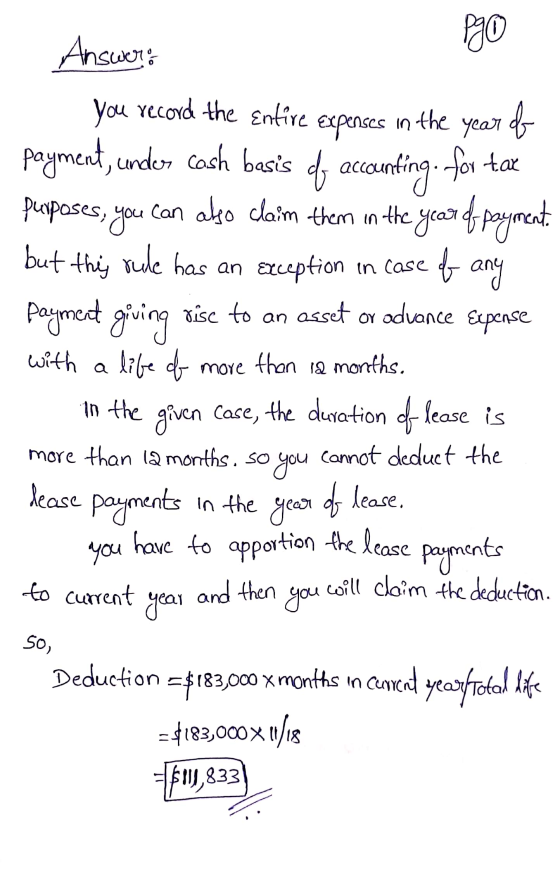
Meghan, a calendar year taxpayer, is the owner of a sole proprietorship that uses the cash method. On February 1, 2020, she leases an office building to use in her business for $183,000 for an 18-month period. To obtain this favorable lease rate, she pays the $183,000 at the inception of the lease.
How much rent expense may Meghan deduct on her 2020 tax return? Round any calculations to two decimal places and round the final answer to the nearest dollar.
Homework Answers
Add Answer to:
Meghan, a calendar year taxpayer, is the owner of a sole
proprietorship that uses the cash...
please show work Maud, a calendar year taxpayer, is the owner of a sole proprietorship that...
please show work Maud, a calendar year taxpayer, is the owner of a sole proprietorship that uses the cash method. On February 1, 2018, she leases an office building to use in her business for $120,000 for an 18-month period. To obtain this favorable lease rate, she pays the $120,000 at the inception of the lease. How much rent expense may Maud deduct on her 2018 tax return?
Isabel, a calendar-year taxpayer, uses the cash method of accounting for her sole proprietorship. In late...
 Isabel, a calendar-year taxpayer, uses the cash method of accounting for her sole proprietorship. In late December she received a $20,000 bill from her accountant for consulting services related to her small business. Isabel can pay the $20,000 bill anytime before January 30 of next year without penalty. Assume her marginal tax rate is 37 percent this year and next year, and that she can earn an after-tax rate of return of 12 percent on her investments. a. What is...
Isabel, a calendar-year taxpayer, uses the cash method of accounting for her sole proprietorship. In late...
 Isabel, a calendar-year taxpayer, uses the cash method of accounting for her sole proprietorship. In late December she received a $28,000 bill from her accountant for consulting services related to her small business. Isabel can pay the $28,000 bill anytime before January 30 of next year without penalty. Assume her marginal tax rate is 40 percent this year and next year, and that she can earn an after-tax rate of return of 11 percent on her investments. o. What is...
Isabel, a calendar-year taxpayer, uses the cash method of accounting for her sole proprietorship. In late...
Isabel, a calendar-year taxpayer, uses the cash method of accounting for her sole proprietorship. In late December she received a $80,000 bill from her accountant for consulting services related to her small business. Isabel can pay the $80,000 bill anytime before January 30 of next year without penalty. Assume her marginal tax rate is 37 percent this year and next year, and that she can earn an after-tax rate of return of 6 percent on her investments. a. What is...
Isabel, a calendar-year taxpayer, uses the cash method of accounting for her sole proprietorship. In late...
Isabel, a calendar-year taxpayer, uses the cash method of accounting for her sole proprietorship. In late December she received a $90,000 bill from her accountant for consulting services related to her small business. Isabel can pay the $90,000 bill anytime before January 30 of next year without penalty. Assume her marginal tax rate is 37 percent this year and next year, and that she can earn an after-tax rate of return of 8 percent on her investments. a. What is...
Reese, a calendar-year taxpayer, uses the cash method of accounting for her sole proprietorship. In late...
 Reese, a calendar-year taxpayer, uses the cash method of accounting for her sole proprietorship. In late December, she received a $25,000 bill from her accountant for consulting services related to her small business. Reese can pay the $25,000 bill anytime before January 30 of next year without penalty. Assume Reese's marginal tax rate is 32 percent this year and will be 37 percent next year, and that she can earn an after-tax rate of return of 9 percent on her...
Reese, a calendar-year taxpayer, uses the cash method of accounting for her sole proprietorship. In late...
 Reese, a calendar-year taxpayer, uses the cash method of accounting for her sole proprietorship. In late December, she received a $21,000 bill from her accountant for consulting services related to her small business. Reese can pay the $21,000 bill anytime before January 30 of next year without penalty. Assume Reese's marginal tax rate is 32 percent this year and 35 percent next year, and that she can earn an after-tax rate of return of 10 percent on her investments. a....
Isabel, a calendar-year taxpayer, uses the cash method of accounting for her sole proprietorship. In late...
 Isabel, a calendar-year taxpayer, uses the cash method of accounting for her sole proprietorship. In late December she received a $41,000 bill from her accountant for consulting services related to her small business. Isabel can pay the $41,000 bill anytime before January 30 of next year without penalty. Assume her marginal tax rate is 37 percent this year and next year, and that she can earn an after-tax rate of return of 6 percent on her investments. a. What is...
Isabel, a calendar-year taxpayer, uses the cash method of accounting for her sole proprietorship. In late...
 Isabel, a calendar-year taxpayer, uses the cash method of accounting for her sole proprietorship. In late December she received a $35,000 bill from her accountant for consulting services related to her small business. Isabel can pay the $35,000 bill anytime before January 30 of next year without penalty. Assume her marginal tax rate is 37 percent this year and next year, and that she can earn an after-tax rate of return of 8 percent on her investments. a. What is...
Isabel, a calendar-year taxpayer, uses the cash method of accounting for her sole proprietorship. In late...
Isabel, a calendar-year taxpayer, uses the cash method of accounting for her sole proprietorship. In late December she received a $80,000 bill from her accountant for consulting services related to her small business. Isabel can pay the $80,000 bill anytime before January 30 of next year without penalty. Assume her marginal tax rate is 37 percent this year and next year, and that she can earn an after-tax rate of return of 6 percent on her investments. b. What is...
 Isabel, a calendar-year taxpayer, uses the cash method of accounting for her sole proprietorship. In late December she received a $20,000 bill from her accountant for consulting services related to her small business. Isabel can pay the $20,000 bill anytime before January 30 of next year without penalty. Assume her marginal tax rate is 37 percent this year and next year, and that she can earn an after-tax rate of return of 12 percent on her investments. a. What is...
 Isabel, a calendar-year taxpayer, uses the cash method of accounting for her sole proprietorship. In late December she received a $28,000 bill from her accountant for consulting services related to her small business. Isabel can pay the $28,000 bill anytime before January 30 of next year without penalty. Assume her marginal tax rate is 40 percent this year and next year, and that she can earn an after-tax rate of return of 11 percent on her investments. o. What is...
 Reese, a calendar-year taxpayer, uses the cash method of accounting for her sole proprietorship. In late December, she received a $25,000 bill from her accountant for consulting services related to her small business. Reese can pay the $25,000 bill anytime before January 30 of next year without penalty. Assume Reese's marginal tax rate is 32 percent this year and will be 37 percent next year, and that she can earn an after-tax rate of return of 9 percent on her...
 Reese, a calendar-year taxpayer, uses the cash method of accounting for her sole proprietorship. In late December, she received a $21,000 bill from her accountant for consulting services related to her small business. Reese can pay the $21,000 bill anytime before January 30 of next year without penalty. Assume Reese's marginal tax rate is 32 percent this year and 35 percent next year, and that she can earn an after-tax rate of return of 10 percent on her investments. a....
 Isabel, a calendar-year taxpayer, uses the cash method of accounting for her sole proprietorship. In late December she received a $41,000 bill from her accountant for consulting services related to her small business. Isabel can pay the $41,000 bill anytime before January 30 of next year without penalty. Assume her marginal tax rate is 37 percent this year and next year, and that she can earn an after-tax rate of return of 6 percent on her investments. a. What is...
 Isabel, a calendar-year taxpayer, uses the cash method of accounting for her sole proprietorship. In late December she received a $35,000 bill from her accountant for consulting services related to her small business. Isabel can pay the $35,000 bill anytime before January 30 of next year without penalty. Assume her marginal tax rate is 37 percent this year and next year, and that she can earn an after-tax rate of return of 8 percent on her investments. a. What is...
Most questions answered within 3 hours.
-
Where is the error in this code sequence?
String s1 = "Hello";
String s2 = "ello";...
asked 11 months ago -
Financial data for Joel de Paris, Inc., for last year
follow:
Joel de Paris, Inc.
Balance...
asked 11 months ago -
Consider this reaction:
Al2(SO4)3 (aq)+ BaCl3
(aq) Al2Cl6 (aq)- +
3BaSO4(s) . What is the...
asked 11 months ago -
Suppose that Savneet is considering increasing her
recent random sample from 20 car rentals to 40...
asked 11 months ago -
Trucks arrive at an unloading terminal at an average rate of 120
per hour.
Trucks arrive...
asked 11 months ago -
Why are methanol and ethanol completely soluble in water while
octanol is not very little soluble....
asked 11 months ago -
A facilities manager at a university reads in a research report
that the mean amount of...
asked 11 months ago -
When the CuSO4 is rehydrated by adding water to the anhydrous
compound, is this an endothermic...
asked 11 months ago -
A ray of sunlight is passing from diamond into crown glass; the
angle of incidence is...
asked 11 months ago -
A block of mass 0.249 kg is placed on top of a light, vertical
spring of...
asked 11 months ago -
how do the kidneys compensate in the presences of acidosis
a) trigger hyperventilate
b) reserve acid...
asked 11 months ago -
Question 501 pts
The rental rate of capital to the firm increases. Which of the
following...
asked 11 months ago