Asymmetric U.S. GAAP: Under U.S. GAAP, long-lived assets, such as real estate are reported on the...
Asymmetric U.S. GAAP:
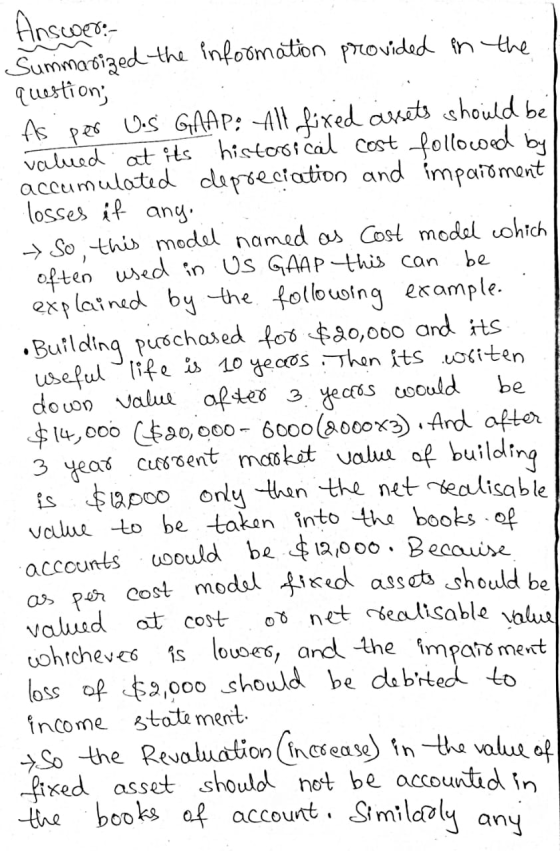
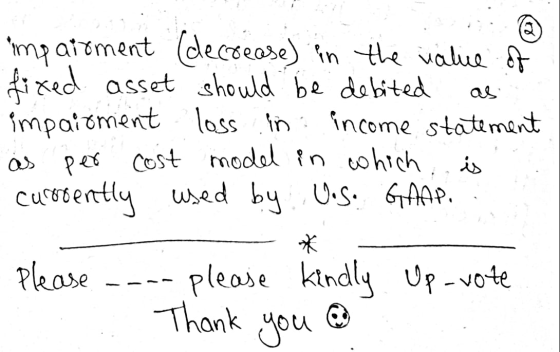
Under U.S. GAAP, long-lived assets, such as real estate are
reported on the balance sheet at the original purchase price of the
asset. In the event that the value of a real estate becomes
“impaired”—that is, the current market value of the real estate
falls below its original purchase price and is unlikely to recover
the lost value in the foreseeable future—the asset’s book value is
written down to the lower current value and a loss is recorded on
the firm’s income statement. Under no circumstances, however, can a
firm write up the value of its real estate assets in the vent that
current market value exceeds original purchase price. Discuss
whether U.S. GAAP should be changed to allow a symmetric treatment
of asset value increases and decreases. What are the implications
of this asymmetry in the accounting treatment of assets (such as
real estate) for U.S. financial statement users?
Homework Answers
Add Answer to:
Asymmetric U.S. GAAP:
Under U.S. GAAP, long-lived assets, such as real estate are
reported on the...
Under U.S. GAAP, which of the following is not an acceptable way to report plant assets? a with detailed informati...
Under U.S. GAAP, which of the following is not an acceptable way to report plant assets? a with detailed information on the face of the balance sheet b as a single amount, with a note to the financial statements that provides detailed information c at fair market value d at book value
Under the United States Generally Accepted Accounting Standards (U.S. GAAP), property, plant and Equipment are reported...
Under the United States Generally Accepted Accounting Standards (U.S. GAAP), property, plant and Equipment are reported at historical cost net of accumulated depreciation. These assets are written down to fair value when it is determined that they have been impaired.Several other countries, including Australia, Brazil, England, Mexico and Singapore, permit the revaluation of property, plant and equipment to their current cost as of the balance sheet date. The primary argument in favor of revaluation is that the historical cost of...
Answer Team 1 ROOM FOl DEBATE . Debate 9-2 Donated Assets Under current U.S. GAAP, assets...
 Answer Team 1
ROOM FOl DEBATE . Debate 9-2 Donated Assets Under current U.S. GAAP, assets that have been donated to a company are recorded at fair value. Team Debate: Team Argue that donated assets should not be reported in a company's balance sheet. Base your arguments on the conceptual framework. You might find the historical cost principle useful in your discussion.
Answer Team 1
ROOM FOl DEBATE . Debate 9-2 Donated Assets Under current U.S. GAAP, assets that have been donated to a company are recorded at fair value. Team Debate: Team Argue that donated assets should not be reported in a company's balance sheet. Base your arguments on the conceptual framework. You might find the historical cost principle useful in your discussion.
Indicate whether each of the following describes an accounting treatment that is acceptable under IFRS, U.S....
 Indicate whether each of the following describes an accounting treatment that is acceptable under IFRS, U.S. GAAP, both, or neither. A company takes out a loan to finance the construction of a building that will be used by the company. The interest on the loan is capitalized as part of the cost of the building. Inventory is reported on the balance sheet using the last-in, first-out (LIFO) cost flow assumption. ,The gain on a sale and leaseback transaction classified as...
Required: 1. What are the classifications of long-lived assets? Explain their differences. 2. Record the purchase...
 Required: 1. What are the classifications of long-lived assets? Explain their differences. 2. Record the purchase on January 2 and the subsequent payment on January 12. Show computations. 3. Indicate the accounts, amounts, and effects (+ for increase and for decrease) of the purchase and subsequent cash payment on the accounting equation. Use the following structure: Date Assets Liabilities + Stockholders' Equity 4. Explain the basis you used for any questionable items. Explaining the Nature of a Long-Lived Asset and...
Which of the following would not be considered an intangible asset? goodwill patent copyright inventory Which...
Which of the following would not be considered an intangible asset? goodwill patent copyright inventory Which of the following statements about capitalizing costs is correct? Capitalizing costs refers to the process of converting assets to expenses. Only the purchase price of the asset is capitalized. Capitalizing a cost means to record it as an asset. Capitalizing costs results in an immediate decrease in net income. If a company capitalizes costs that should be expensed, how is its income statement for...
P8-1 (Algo) Explaining the Nature of a Long-Lived Asset and Determining and Recording the Financial Statement...
P8-1 (Algo) Explaining the Nature of a Long-Lived Asset and Determining and Recording the Financial Statement Effects of Its Purchase LO8-1, 8-2 [The following information applies to the questions displayed below.] On January 2, Summers Company received a machine that the company had ordered with an invoice price of $102,000. Freight costs of $720 were paid by the vendor per the sales agreement. The company exchanged the following on January 2 to acquire the machine: a. Issued 1,900 shares of...
1.A balance sheet prepared in accordance with U.S. GAAP typically: Multiple Choice reports common stock at...
1.A balance sheet prepared in accordance with U.S. GAAP typically: Multiple Choice reports common stock at the current market price of the stock. provides critical information for understanding a firm’s capital structure. helps to determine the proper mix of debt and equity financing. provides critical information for understanding a firm’s profitability. 2.In a common-size balance sheet, each balance sheet account is expressed as a percentage of total: Multiple Choice liabilities. assets. shareholders’ equity. assets plus shareholders’ equity. 3.Accrued liabilities represent:...
1) The traditional accounting model delays the recognition of value changes of assets and liabilities until...
1) The traditional accounting model delays the recognition of value changes of assets and liabilities until what event occurs? a. A change in value. b. A market transaction. c. A balance sheet date. d. Cash is received or cash is paid. 2)Which of the following is not one of methods used by GAAP for treating value changes? a. Recognize value changes on the balance sheet and income statement when they are realized in a market transaction b. Recognize value changes...
Please summarize this article in a summary. For Pensions, Valuing Real Estate Is Tough. Covid-19 Brings...
Please summarize this article in a summary. For Pensions, Valuing Real Estate Is Tough. Covid-19 Brings New Hurdles With Covid-19 and the dramatic slowdown in deal making, investors are finding it more difficult to calculate the value of real-estate holdings Public pension funds invested in malls, apartments and offices over the last decade in search of higher returns. Now they are grappling with how much those real-estate investments are worth in a world transformed by Covid-19. Pension giant California Public...
 Answer Team 1
ROOM FOl DEBATE . Debate 9-2 Donated Assets Under current U.S. GAAP, assets that have been donated to a company are recorded at fair value. Team Debate: Team Argue that donated assets should not be reported in a company's balance sheet. Base your arguments on the conceptual framework. You might find the historical cost principle useful in your discussion.
Answer Team 1
ROOM FOl DEBATE . Debate 9-2 Donated Assets Under current U.S. GAAP, assets that have been donated to a company are recorded at fair value. Team Debate: Team Argue that donated assets should not be reported in a company's balance sheet. Base your arguments on the conceptual framework. You might find the historical cost principle useful in your discussion.
 Indicate whether each of the following describes an accounting treatment that is acceptable under IFRS, U.S. GAAP, both, or neither. A company takes out a loan to finance the construction of a building that will be used by the company. The interest on the loan is capitalized as part of the cost of the building. Inventory is reported on the balance sheet using the last-in, first-out (LIFO) cost flow assumption. ,The gain on a sale and leaseback transaction classified as...
 Required: 1. What are the classifications of long-lived assets? Explain their differences. 2. Record the purchase on January 2 and the subsequent payment on January 12. Show computations. 3. Indicate the accounts, amounts, and effects (+ for increase and for decrease) of the purchase and subsequent cash payment on the accounting equation. Use the following structure: Date Assets Liabilities + Stockholders' Equity 4. Explain the basis you used for any questionable items. Explaining the Nature of a Long-Lived Asset and...
Most questions answered within 3 hours.
-
Where is the error in this code sequence?
String s1 = "Hello";
String s2 = "ello";...
asked 10 months ago -
Financial data for Joel de Paris, Inc., for last year
follow:
Joel de Paris, Inc.
Balance...
asked 10 months ago -
Consider this reaction:
Al2(SO4)3 (aq)+ BaCl3
(aq) Al2Cl6 (aq)- +
3BaSO4(s) . What is the...
asked 10 months ago -
Suppose that Savneet is considering increasing her
recent random sample from 20 car rentals to 40...
asked 10 months ago -
Trucks arrive at an unloading terminal at an average rate of 120
per hour.
Trucks arrive...
asked 10 months ago -
Why are methanol and ethanol completely soluble in water while
octanol is not very little soluble....
asked 10 months ago -
A facilities manager at a university reads in a research report
that the mean amount of...
asked 10 months ago -
When the CuSO4 is rehydrated by adding water to the anhydrous
compound, is this an endothermic...
asked 10 months ago -
A ray of sunlight is passing from diamond into crown glass; the
angle of incidence is...
asked 10 months ago -
A block of mass 0.249 kg is placed on top of a light, vertical
spring of...
asked 10 months ago -
how do the kidneys compensate in the presences of acidosis
a) trigger hyperventilate
b) reserve acid...
asked 10 months ago -
Question 501 pts
The rental rate of capital to the firm increases. Which of the
following...
asked 10 months ago