
REQUIREMENTS
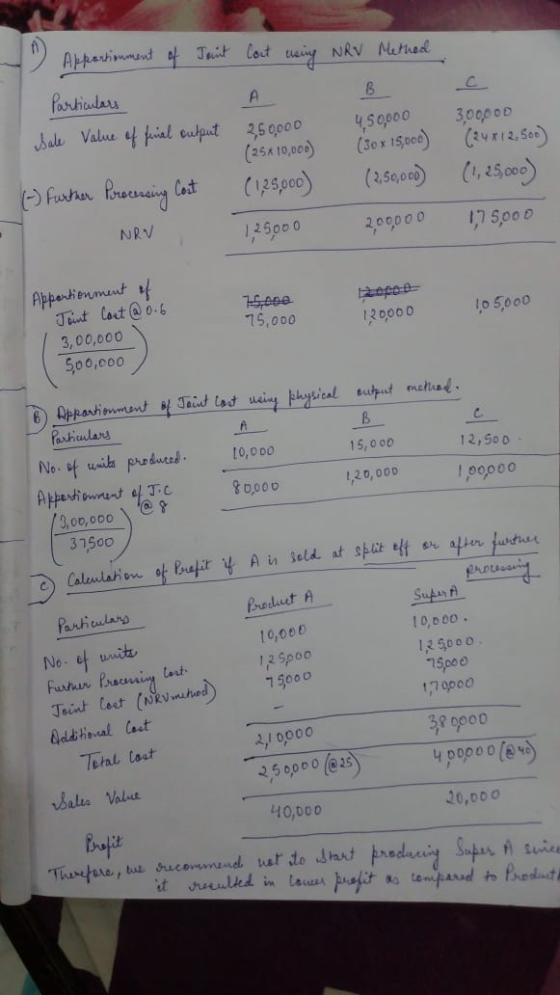
A. Determine the amount of joint cost allocated to each product if
the NRV method is used
B. determine the amount of joint costs allocated to each product if
the physical output method is used
C. There is a new process that could convert Product A into Super
A. Super A sells for $40 per unit. The additional costs of Super A
are $170000. Should Calamata start producing Super A- why or why
not?
PLEASE SHOW UR WORK
Homework Answers

Add Answer to:
REQUIREMENTS
A. Determine the amount of joint cost allocated to each product if
the NRV method...
all parts please Kalamata Corporation processes a single material into three separate products A B, and...
 all parts please
Kalamata Corporation processes a single material into three separate products A B, and C. During September, the joint costs of processing were 530 Production and sales value information for the month were as follows: Product A B Units Produced 10,000 15,000 12,500 Final Sales Value per Unit $25 30 24 Separable Costs $125,000 250,000 125,000 C Required: 2. Determine the amount of joint cost allocated to each product if the NRV method is used. . Determine the...
all parts please
Kalamata Corporation processes a single material into three separate products A B, and C. During September, the joint costs of processing were 530 Production and sales value information for the month were as follows: Product A B Units Produced 10,000 15,000 12,500 Final Sales Value per Unit $25 30 24 Separable Costs $125,000 250,000 125,000 C Required: 2. Determine the amount of joint cost allocated to each product if the NRV method is used. . Determine the...
Purple Paper Company processes wood pulp into two products. During July the joint costs of processing...
Purple Paper Company processes wood pulp into two products. During July the joint costs of processing were $50,000. Production and sales value information for the month were as follows: Sales Value at Product Kilograms Produced splitoff Point Separable Costs Paper 125,000 $63,000 $221,000 Cardboard 96,000 46,000 262,000 Paper sells for $2.71 a kilogram and cardboard sells for $3.10 a kilogram. There were no beginning or ending inventories for July QUESTION: Determine the amounts to be allocated to paper using...
UU PUNIS) Red Sauce Canning Company processes tomatoes into two joint products: Catsup and Tomato Juice....
 UU PUNIS) Red Sauce Canning Company processes tomatoes into two joint products: Catsup and Tomato Juice. During the summer of 2018, the joint costs of processing the tomatoes were $4,200,000. There was no beginning or ending inventories for the summer. Production and sales information for the summer is as follows: Product Catsup Juice Production Units at Splitoff Point 100,000 cases 150,000 cases Separable Costs $300,000 $750,000 Final Sales Units 50,000 cases 100,000 cases Final Selling Price S28 per case 25...
b. Now allocate the joint cost to the cookies and the Soyola using the NRV method....
 b. Now allocate the joint cost to the cookies and the Soyola using the NRV method. (Round the weights to three decimal places and joint costs to the nearest dollar.) Cookies Soyola Total Final sales value of total production Deduct separable costs Net realizable value Weighting Joint costs allocated Requirement 2. Should ISP have processed each of the products further? What effect does the allocation method have on this decision? Begin by calculating the profit or loss that would occur...
The joint cost of processing all the products were $725,000. The separable costs are not traceable....
 The joint cost of processing all the products were $725,000. The separable costs are not traceable. There is no beginning or ending inventory. Product Units 250000 kg 300000 kg 300000 Litres Sales Value at split off point $10/ kg $4.5 per kg $7.5 per Litres Determine the amount allocated to each product if the sales value at split off method is used and compute the cost per appropriate unit for each product.
Constant gross margin percentage NRV method applies the following steps: a) 1) compute overall gross margin percentage; 2) compute total production costs for each product; 3) compute allocated joint c...
Constant gross margin percentage NRV method applies the following steps: a) 1) compute overall gross margin percentage; 2) compute total production costs for each product; 3) compute allocated joint costs b) 1) compute overall sales value; 2) compute total production cost for each product; 3) compute allocated joint costs c) 1) COMPUTE OVERALL NRV; 2) compute total production costs for each product 3) compute allocated joint costs d) none of these
BELOW ARE SOME NOTES THAT MAY HELP FOR THIS COSTING QUESTION Problem 7-48 Joint Products; By-Products...
 BELOW ARE SOME NOTES THAT MAY HELP FOR THIS COSTING
QUESTION
Problem 7-48 Joint Products; By-Products (Appendix) [LO 7-6, 7-7] The Marshall Company has a joint production process that produces two joint products and a by-product. The joint products are Ying and Yang, and the by-product is Bit. Marshall accounts for the costs of its products using the net realizable value method. The two joint products are processed beyond the split-off point, incurring separable processing costs. There is a $1,300...
BELOW ARE SOME NOTES THAT MAY HELP FOR THIS COSTING
QUESTION
Problem 7-48 Joint Products; By-Products (Appendix) [LO 7-6, 7-7] The Marshall Company has a joint production process that produces two joint products and a by-product. The joint products are Ying and Yang, and the by-product is Bit. Marshall accounts for the costs of its products using the net realizable value method. The two joint products are processed beyond the split-off point, incurring separable processing costs. There is a $1,300...
The Stenback Company produces two products, turpentine and methanol (wood alcohol), by a joint process. Joint...
 The Stenback Company produces two products, turpentine and methanol (wood alcohol), by a joint process. Joint costs amount to $144,000 per batch of output. Each batch totals 40,000 litres: 25% methanol and 75% turpentine. Both products are processed further without gain or loss in volume. Separable processing costs are methanol, $0.90 per litre; turpentine, $0.60 per litre. Methanol sells for $6.30 per litre; turpentine sells for $4.20 per litre. Required Methanol Turpentine Total Physical measure of total production 10,000 30,000...
Restaurant Products produces two products, X and Y, in a single process. In 2011, the joint...
Restaurant Products produces two products, X and Y, in a single process. In 2011, the joint costs of this process were $25,000. In addition, 4,000 units of X and 6,000 units of Y were produced. Separable processing costs beyond the split-off point were X - $10,000; Y - $20,000. X sells for $10.00 per unit; Y sells for $7.50 per unit. What amount of joint costs will be allocated to Product X using the physical units method? a. $25,000 b....
The Stenback Company produces two products, turpentine and methanol (wood alcohol), by a joint process. Joint...
 The Stenback Company produces two products, turpentine and methanol (wood alcohol), by a joint process. Joint costs amount to $144,000 per batch of output. Each batch totals 40,000 litres: 25% methanol and 75% turpentine. Both products are processed further without gain or loss in volume. Separable processing costs are methanol, $0.90 per litre; turpentine, $0.60 per litre. Methanol sells for $6.30 per litre; turpentine sells for $4.20 per litre Required Requirement 1. How much joint costs per batch should be...
 all parts please
Kalamata Corporation processes a single material into three separate products A B, and C. During September, the joint costs of processing were 530 Production and sales value information for the month were as follows: Product A B Units Produced 10,000 15,000 12,500 Final Sales Value per Unit $25 30 24 Separable Costs $125,000 250,000 125,000 C Required: 2. Determine the amount of joint cost allocated to each product if the NRV method is used. . Determine the...
all parts please
Kalamata Corporation processes a single material into three separate products A B, and C. During September, the joint costs of processing were 530 Production and sales value information for the month were as follows: Product A B Units Produced 10,000 15,000 12,500 Final Sales Value per Unit $25 30 24 Separable Costs $125,000 250,000 125,000 C Required: 2. Determine the amount of joint cost allocated to each product if the NRV method is used. . Determine the...
 UU PUNIS) Red Sauce Canning Company processes tomatoes into two joint products: Catsup and Tomato Juice. During the summer of 2018, the joint costs of processing the tomatoes were $4,200,000. There was no beginning or ending inventories for the summer. Production and sales information for the summer is as follows: Product Catsup Juice Production Units at Splitoff Point 100,000 cases 150,000 cases Separable Costs $300,000 $750,000 Final Sales Units 50,000 cases 100,000 cases Final Selling Price S28 per case 25...
 b. Now allocate the joint cost to the cookies and the Soyola using the NRV method. (Round the weights to three decimal places and joint costs to the nearest dollar.) Cookies Soyola Total Final sales value of total production Deduct separable costs Net realizable value Weighting Joint costs allocated Requirement 2. Should ISP have processed each of the products further? What effect does the allocation method have on this decision? Begin by calculating the profit or loss that would occur...
 The joint cost of processing all the products were $725,000. The separable costs are not traceable. There is no beginning or ending inventory. Product Units 250000 kg 300000 kg 300000 Litres Sales Value at split off point $10/ kg $4.5 per kg $7.5 per Litres Determine the amount allocated to each product if the sales value at split off method is used and compute the cost per appropriate unit for each product.
 BELOW ARE SOME NOTES THAT MAY HELP FOR THIS COSTING
QUESTION
Problem 7-48 Joint Products; By-Products (Appendix) [LO 7-6, 7-7] The Marshall Company has a joint production process that produces two joint products and a by-product. The joint products are Ying and Yang, and the by-product is Bit. Marshall accounts for the costs of its products using the net realizable value method. The two joint products are processed beyond the split-off point, incurring separable processing costs. There is a $1,300...
BELOW ARE SOME NOTES THAT MAY HELP FOR THIS COSTING
QUESTION
Problem 7-48 Joint Products; By-Products (Appendix) [LO 7-6, 7-7] The Marshall Company has a joint production process that produces two joint products and a by-product. The joint products are Ying and Yang, and the by-product is Bit. Marshall accounts for the costs of its products using the net realizable value method. The two joint products are processed beyond the split-off point, incurring separable processing costs. There is a $1,300...
 The Stenback Company produces two products, turpentine and methanol (wood alcohol), by a joint process. Joint costs amount to $144,000 per batch of output. Each batch totals 40,000 litres: 25% methanol and 75% turpentine. Both products are processed further without gain or loss in volume. Separable processing costs are methanol, $0.90 per litre; turpentine, $0.60 per litre. Methanol sells for $6.30 per litre; turpentine sells for $4.20 per litre. Required Methanol Turpentine Total Physical measure of total production 10,000 30,000...
 The Stenback Company produces two products, turpentine and methanol (wood alcohol), by a joint process. Joint costs amount to $144,000 per batch of output. Each batch totals 40,000 litres: 25% methanol and 75% turpentine. Both products are processed further without gain or loss in volume. Separable processing costs are methanol, $0.90 per litre; turpentine, $0.60 per litre. Methanol sells for $6.30 per litre; turpentine sells for $4.20 per litre Required Requirement 1. How much joint costs per batch should be...
Most questions answered within 3 hours.
-
Where is the error in this code sequence?
String s1 = "Hello";
String s2 = "ello";...
asked 11 months ago -
Financial data for Joel de Paris, Inc., for last year
follow:
Joel de Paris, Inc.
Balance...
asked 11 months ago -
Consider this reaction:
Al2(SO4)3 (aq)+ BaCl3
(aq) Al2Cl6 (aq)- +
3BaSO4(s) . What is the...
asked 11 months ago -
Suppose that Savneet is considering increasing her
recent random sample from 20 car rentals to 40...
asked 11 months ago -
Trucks arrive at an unloading terminal at an average rate of 120
per hour.
Trucks arrive...
asked 11 months ago -
Why are methanol and ethanol completely soluble in water while
octanol is not very little soluble....
asked 11 months ago -
A facilities manager at a university reads in a research report
that the mean amount of...
asked 11 months ago -
When the CuSO4 is rehydrated by adding water to the anhydrous
compound, is this an endothermic...
asked 11 months ago -
A ray of sunlight is passing from diamond into crown glass; the
angle of incidence is...
asked 11 months ago -
A block of mass 0.249 kg is placed on top of a light, vertical
spring of...
asked 11 months ago -
how do the kidneys compensate in the presences of acidosis
a) trigger hyperventilate
b) reserve acid...
asked 11 months ago -
Question 501 pts
The rental rate of capital to the firm increases. Which of the
following...
asked 11 months ago