physics question
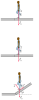
A 22.5 kg block is sliding down the plane shown in the figure above. The plane is inclined from level at angle θ = 31.9°. The coefficient of static friction between the block and the surface is μs = 0.498, and the coefficient of kinetic friction is μk = 0.397. What is the magnitude of the frictional force acting on the block?
Homework Answers
Request Answer!
We need at least 10 more requests to produce the answer.
0 / 10 have requested this problem solution
The more requests, the faster the answer.
Physics question
A 22.5 kg block sits on the plane shown in the figure above. The plane is inclined from level at angle θ = 18.4°. The coefficient of static friction between the block and the surface is μs = 0.498, and the coefficient of kinetic friction is μk = 0.397. The block remains at rest on the plane. What is the magnitude of the frictional force acting on the block?
The coefficients of friction between a 1.5 kg block and a surface are μs = 0.50...
The coefficients of friction between a 1.5 kg block and a surface are μs = 0.50 and μk = 0.40. Assume the only other force acting on the block is that due to gravity. What is the magnitude of the frictional force (in newtons) on the block if the block is moving and the surface is inclined at 30o? Use g = 9.79 m/s2.
High school physics problem
You are lowering two boxes, one on top of the other, down a ramp by pulling on a rope parallel to the surface of the ramp. Both blocks move with constant velocity of 15 ?/?. The coefficient of kinetic friction between the ramp and the lower box is 0.444 and the coefficient of static friction between the two boxes is 0.800. What is the magnitude and direction of the frictional force on the upper box? Magnitue of the applied force?...
A box of mass m = 2.00 kg is positioned on a ramp at an angle...
A box of mass m = 2.00 kg is positioned on a ramp at an angle θ. The length of the ramp (minus the width of the base of the box) is d = 3.00 m. The surface of the ramp has a coefficient of static friction μs = 0.500 and a coefficient of kinetic friction μk = 0.350. The angle θ is slowly increased until the box starts to slide down the ramp. Calculate the angle θmax at which...
Questions 1&2 FP 1. A sliding block of mass m 0.25 kg is subject to a...
 Questions 1&2
FP 1. A sliding block of mass m 0.25 kg is subject to a force of magnitude 4 N that makes an angle of ф-30 with the horizontal surface. If the coefficient of kinetic friction between block and surface is 0.5, what is the resulting acceleration of the block along the surface Figure 1: Block on incline. 2. A block of mass m - 5 kg is subject to a force of magnitude 20 N that makes an...
Questions 1&2
FP 1. A sliding block of mass m 0.25 kg is subject to a force of magnitude 4 N that makes an angle of ф-30 with the horizontal surface. If the coefficient of kinetic friction between block and surface is 0.5, what is the resulting acceleration of the block along the surface Figure 1: Block on incline. 2. A block of mass m - 5 kg is subject to a force of magnitude 20 N that makes an...
A block with mass m1 = 9.4 kg is on an incline with an angle θ = 26° with respect to the horizontal
 A block with mass m1 = 9.4 kg is on an incline with an angle θ = 26° with respect to the horizontal. For the first question there is no friction, but for the rest of this problem the coefficients of friction are: μk = 0.24 and μs = 0.264. 1) When there is no friction, what is the magnitude of the acceleration of the block? 2) Now with friction, what is the magnitude of the acceleration of the block after it...
A box of weight w=2.0N accelerates down a rough plane that is inclined at an angle...
A box of weight w=2.0N accelerates down a rough plane that is inclined at an angle ϕ=30∘ above the horizontal, as shown (Figure 6) . The normal force acting on the box has a magnitude n=1.7N, the coefficient of kinetic friction between the box and the plane is μk=0.30, and the displacement d⃗ of the box is 1.8 m down the inclined plane. What is the work Wfk done on the box by the force of kinetic friction?
A 7.75 kg block is sent up a ramp inclined at an angle θ=36.5° from the...
A 7.75 kg block is sent up a ramp inclined at an angle θ=36.5° from the horizontal. It is given an initial velocity of v0=15.0 m/s up the ramp. Between the block and the ramp, the coefficient of kinetic friction is μk=0.444 and the coefficient of static friction is μs=0.790. How far up the ramp in the direction along the ramp does the block go before it comes to a stop?
A dancer is standing on one leg on a drawbridgethat is about to open. The coefficients of stati...
 A dancer is standing on one leg on a drawbridge that is about to open. The coefficients of static and kinetic friction between the drawbridge and the dancer's foot are μs and μk, respectively. n represents the normal force exerted on the dancer by the bridge, and Fg represents the gravitational force exerted on the dancer, as shown in the drawing. (Intro1 figure) For all the questions, we can assume that the bridge is a perfectly flat surface and lacks the curvature characteristic...
1) Consider a box of mass m sitting on an inclined plane. The inclined plane makes...
1) Consider a box of mass m sitting on an inclined plane. The inclined plane makes an angle θ with the horizontal and the coefficient of static friction between the box and the surface is μ. What minimal condition must exist if the box is to accelerate down the incline? A) mgsinθ < μFn B) mgsinθ = μFn C) mgsinθ > μFn D) mgcosθ > π 2) You observe a packing crate sliding down a long, inclined ramp at constant...
 Questions 1&2
FP 1. A sliding block of mass m 0.25 kg is subject to a force of magnitude 4 N that makes an angle of ф-30 with the horizontal surface. If the coefficient of kinetic friction between block and surface is 0.5, what is the resulting acceleration of the block along the surface Figure 1: Block on incline. 2. A block of mass m - 5 kg is subject to a force of magnitude 20 N that makes an...
Questions 1&2
FP 1. A sliding block of mass m 0.25 kg is subject to a force of magnitude 4 N that makes an angle of ф-30 with the horizontal surface. If the coefficient of kinetic friction between block and surface is 0.5, what is the resulting acceleration of the block along the surface Figure 1: Block on incline. 2. A block of mass m - 5 kg is subject to a force of magnitude 20 N that makes an...
Most questions answered within 3 hours.
-
Where is the error in this code sequence?
String s1 = "Hello";
String s2 = "ello";...
asked 1 year ago -
Financial data for Joel de Paris, Inc., for last year
follow:
Joel de Paris, Inc.
Balance...
asked 1 year ago -
Consider this reaction:
Al2(SO4)3 (aq)+ BaCl3
(aq) Al2Cl6 (aq)- +
3BaSO4(s) . What is the...
asked 1 year ago -
Suppose that Savneet is considering increasing her
recent random sample from 20 car rentals to 40...
asked 1 year ago -
Trucks arrive at an unloading terminal at an average rate of 120
per hour.
Trucks arrive...
asked 1 year ago -
Why are methanol and ethanol completely soluble in water while
octanol is not very little soluble....
asked 1 year ago -
A facilities manager at a university reads in a research report
that the mean amount of...
asked 1 year ago -
When the CuSO4 is rehydrated by adding water to the anhydrous
compound, is this an endothermic...
asked 1 year ago -
A ray of sunlight is passing from diamond into crown glass; the
angle of incidence is...
asked 1 year ago -
A block of mass 0.249 kg is placed on top of a light, vertical
spring of...
asked 1 year ago -
how do the kidneys compensate in the presences of acidosis
a) trigger hyperventilate
b) reserve acid...
asked 1 year ago -
Question 501 pts
The rental rate of capital to the firm increases. Which of the
following...
asked 1 year ago