Calculate the following ratios for 2016 and show the steps involved:
a) Inventory turnover ratio
b) average days in inventory
c) receivables turnover ratio
d) average collection period
e) asset turnover ratio
f) profit margin on sales
g) return on assets
h) return on shareholders equity
i) equity multiplier
j) return on shareholders equity using the Du Port framework
Note: See attached balance sheet and income statement below as reference
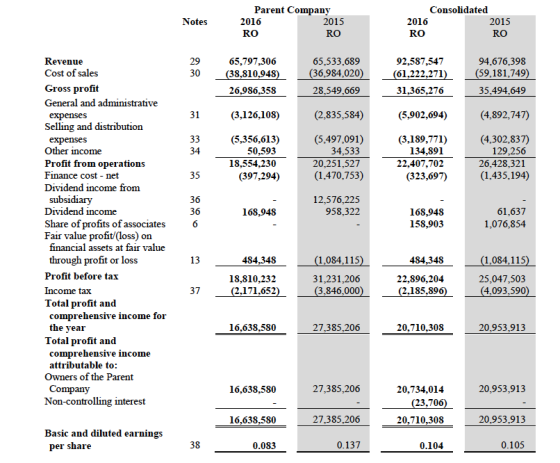
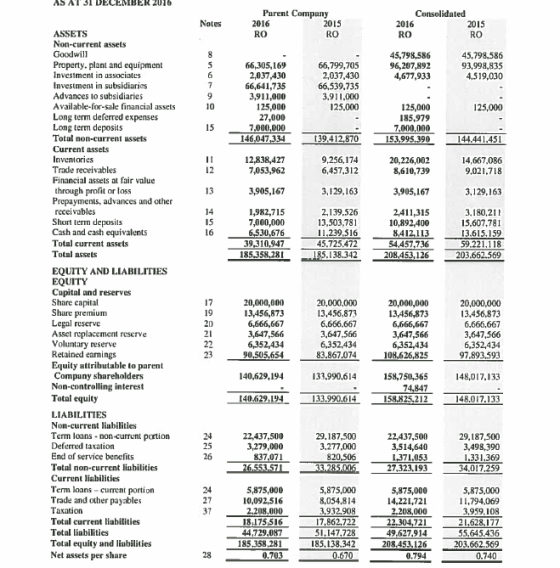
Homework Answers
| Inventory turnover ratio = Sales / Average inventory | |||||
| Parent Company | Consolidated | ||||
| Sales | 65,797,306 | 92,587,547 | |||
| Opening inventory | 9,256,174 | 14,667,086 | |||
| Closing inventory | 12,838,427 | 20,226,082 | |||
| Avergage inventory = (Opening inventory + closing inventory) / 2 | 11,047,301 | 17,446,584 | |||
| Inventory turnover ratio | 5.96 | 5.31 | |||
| Average days in inventory = Number of days in the period / inventory turnover ratio | |||||
| No. of days | 365 | 365 | |||
| Inventory turnover ratio | 5.96 | 5.31 | |||
| Average inventory in days | 61.28 | 68.78 | |||
| Rounded off | 61 days | 69 days | |||
| Receivables turnover ratio = Sales / Average receivables | |||||
| Sales | 65,797,306 | 92,587,547 | |||
| Opening receivables | 6,457,312 | 9,021,718 | |||
| Closing receivables | 7,053,962 | 8,610,739 | |||
| Avergage receivables = (Opening receivables + closing receivables) / 2 | 6,755,637 | 8,816,229 | |||
| Receivable turnover ratio | 9.74 | 10.50 | |||
| Average collection period = Number of days in the period / receivables turnover ratio | |||||
| No. of days | 365 | 365 | |||
| Receivable turnover ratio | 9.74 | 10.50 | |||
| Average collection period | 37.48 | 34.76 | |||
| Rounded off | 37 days | 35 days | |||
| Asset turnover ratio = Sales / Average Total assets | |||||
| Sales | 65,797,306 | 92,587,547 | |||
| Opening assets | 185,138,342 | 203,662,569 | |||
| Closing assets | 185,358,281 | 208,453,126 | |||
| Average assets = (Opening assets + closing assets) / 2 | 185,248,312 | 206,057,848 | |||
| Asset turnover ratio | 0.36 | 0.45 | |||
| Profit margin on sales = Net income / Sales | |||||
| Net income | 16,638,580 | 20,710,308 | |||
| Sales | 65,797,306 | 92,587,547 | |||
| Profit margin on sales | 0.2529 | 0.2237 | |||
| Profit margin on sales % | 25.29% | 22.37% | |||
| Return on assets = Net income / Average Total assets | |||||
| Net income | 16,638,580 | 20,710,308 | |||
| Average Total assets | 185,248,312 | 206,057,848 | |||
| Return on assets | 0.09 | 0.10 | |||
| Return on assets % | 8.98% | 10.05% | |||
| OR | |||||
| Return on assets = Asset turnover ratio * Profit margin on sales | |||||
| Asset turnover ratio | 0.36 | 0.45 | |||
| Profit margin on sales | 0.2529 | 0.2237 | |||
| Return on assets | 0.09 | 0.10 | |||
| Return on assets % | 8.98% | 10.05% | |||
| Return on shareholder equity = Profit after tax / Average shareholders' equity | |||||
| Profit after tax | 16,638,580 | 20,710,308 | |||
| Opening shareholders' equity | 133,990,614 | 148,017,133 | |||
| Closing shareholders' equity | 140,629,194 | 158,825,212 | |||
| Avergage shareholders' equity = (Opening equity + closing equity) / 2 | 137,309,904 | 153,421,173 | |||
| Return on shareholder equity | 0.1212 | 0.1350 | |||
| Return on shareholder equity % | 12.12% | 13.50% | |||
| Equity multiplier = Total assets / Shareholders' equity |
 Calculate the following ratios for 2015 and show the steps
involved:
a) Inventory turnover ratio
b) average days in inventory
c) receivables turnover ratio
d) average collection period
e) asset turnover ratio
f) profit margin on sales
g) return on assets
h) return on shareholders equity
i) equity multiplier
j) return on shareholders equity using the Du Port framework
Note: See attached balance sheet and income statement below as
reference
We were unable to transcribe this imageAS AT 31 DECEMBER...
Calculate the following ratios for 2015 and show the steps
involved:
a) Inventory turnover ratio
b) average days in inventory
c) receivables turnover ratio
d) average collection period
e) asset turnover ratio
f) profit margin on sales
g) return on assets
h) return on shareholders equity
i) equity multiplier
j) return on shareholders equity using the Du Port framework
Note: See attached balance sheet and income statement below as
reference
We were unable to transcribe this imageAS AT 31 DECEMBER...
 Calculate the following ratios for 2014 and show the steps
involved:
a) Inventory turnover ratio
b) average days in inventory
c) receivables turnover ratio
d) average collection period
e) asset turnover ratio
f) profit margin on sales
g) return on assets
h) return on shareholders equity
i) equity multiplier
j) return on shareholders equity using the Du Port framework
Note: See attached balance sheet and income statement below as
reference
Notes Parent Company 2014 2013 RO RO Consolidated 2014 2013...
Calculate the following ratios for 2014 and show the steps
involved:
a) Inventory turnover ratio
b) average days in inventory
c) receivables turnover ratio
d) average collection period
e) asset turnover ratio
f) profit margin on sales
g) return on assets
h) return on shareholders equity
i) equity multiplier
j) return on shareholders equity using the Du Port framework
Note: See attached balance sheet and income statement below as
reference
Notes Parent Company 2014 2013 RO RO Consolidated 2014 2013...
 Calculate the following ratios for 2012 and show the steps
involved:
a) Inventory turnover ratio
b) average days in inventory
c) receivables turnover ratio
d) average collection period
e) asset turnover ratio
f) profit margin on sales
g) return on assets
h) return on shareholders equity
i) equity multiplier
j) return on shareholders equity using the Du Port framework
Note: See attached balance sheet and income statement below as
reference
Parent Company 2012 RO Consolidated 2012 Notes 2011 2011 RO...
Calculate the following ratios for 2012 and show the steps
involved:
a) Inventory turnover ratio
b) average days in inventory
c) receivables turnover ratio
d) average collection period
e) asset turnover ratio
f) profit margin on sales
g) return on assets
h) return on shareholders equity
i) equity multiplier
j) return on shareholders equity using the Du Port framework
Note: See attached balance sheet and income statement below as
reference
Parent Company 2012 RO Consolidated 2012 Notes 2011 2011 RO...
 Calculate the following ratios for 2013 and show the steps
involved:
a) Inventory turnover ratio
b) average days in inventory
c) receivables turnover ratio
d) average collection period
e) asset turnover ratio
f) profit margin on sales
g) return on assets
h) return on shareholders equity
i) equity multiplier
j) return on shareholders equity using the Du Port framework
Note: See attached balance sheet and income statement below as
reference
Statement of financial position at 31 December 2013 Consolidated Notes...
Calculate the following ratios for 2013 and show the steps
involved:
a) Inventory turnover ratio
b) average days in inventory
c) receivables turnover ratio
d) average collection period
e) asset turnover ratio
f) profit margin on sales
g) return on assets
h) return on shareholders equity
i) equity multiplier
j) return on shareholders equity using the Du Port framework
Note: See attached balance sheet and income statement below as
reference
Statement of financial position at 31 December 2013 Consolidated Notes...
 1. Using the attached information, calculate for 2015
and 2016 the following:
a) Receivables turnover,Inventory turnover, and
Payable turnover.
b)Receivables period,Inventory period,and Payable
period.
c)Operating Cycle and Cash Conversion cycle
2. Discuss the changes that took place from 2015 to
2016 and suggest the ways how the company could improve its
performance
Balance Sheets for Years Ended 2014, 2015, and 2016 ASSETS 2014 2015 2016 Cash and marketable securities Receivables Inventories Total current assets Grass plant and equipment less accumulated...
1. Using the attached information, calculate for 2015
and 2016 the following:
a) Receivables turnover,Inventory turnover, and
Payable turnover.
b)Receivables period,Inventory period,and Payable
period.
c)Operating Cycle and Cash Conversion cycle
2. Discuss the changes that took place from 2015 to
2016 and suggest the ways how the company could improve its
performance
Balance Sheets for Years Ended 2014, 2015, and 2016 ASSETS 2014 2015 2016 Cash and marketable securities Receivables Inventories Total current assets Grass plant and equipment less accumulated...
 h. Days of inventory. 1. Inventory turnover ratio. J. Average collection period Based on these ratios, did Macy's financial performance improve, weaken, or remain about the same from 2015 to 2016? (479) 198 Consolidated Statements of Income for Macy's, Inc., 2015-2016 (in millions, except per share amounts) 2016 2015 Net sales $25,778 $27,079 Cost of sales (15,621) (16,496 Gross margin 10,157 10,583 Selling, general and administrative expenses (8,265) (8,256) Impairments, store closing and other costs (288) Settlement charges Operating income...
 Part 1: Ratio Analysis calculate the following ratios
Part 2: Perform a vertical analysis of statement of financial
position & Income statement
Part 3: Perform a Horizontal Analysis of statement of
Financial Position for 2015 and 2014 & Income statement for
2015
Instructions: 1. On pages three and four, you will find condensed statement of financial position and income statement data for Waterloo Corporation. 2. Use the same information to answer all the three parts. 3. Part 1: a. In...
Part 1: Ratio Analysis calculate the following ratios
Part 2: Perform a vertical analysis of statement of financial
position & Income statement
Part 3: Perform a Horizontal Analysis of statement of
Financial Position for 2015 and 2014 & Income statement for
2015
Instructions: 1. On pages three and four, you will find condensed statement of financial position and income statement data for Waterloo Corporation. 2. Use the same information to answer all the three parts. 3. Part 1: a. In...
 A.
Required:
1. Please calculate the following ratios and amounts: a) working
capital, b)
current ratio, c) acid-test ratio, d) cash to current liabilities
ratio, e) days’ sales
in receivables (based on ending accounts receivables), f) days’
sales in
inventory (based on cost of goods and ending inventory), g)
operating cycle,
h) total debt to equity ratio and i) times interest earned. For
your calculations,
assume that a year amounts for 360 days
The balance sheet and the income statement...
A.
Required:
1. Please calculate the following ratios and amounts: a) working
capital, b)
current ratio, c) acid-test ratio, d) cash to current liabilities
ratio, e) days’ sales
in receivables (based on ending accounts receivables), f) days’
sales in
inventory (based on cost of goods and ending inventory), g)
operating cycle,
h) total debt to equity ratio and i) times interest earned. For
your calculations,
assume that a year amounts for 360 days
The balance sheet and the income statement...
 Using the following information:
Calculate the following ratios for Urban Outfitters for
both 2016 and
2017 (show calculations):
a. Gross profit margin
b. Operating profit margin
c. Net profit margin
d. Times interest earned coverage
e. Return on shareholders’ equity
f. Return on assets
g. Debt-to-equity ratio
h. Days of inventory
i. Inventory turnover ratio
j. Average collection period
Consolidated Income Statements for Urban ters, Inc. 2016 2017 $3.545.794 $3,445,134 Net sales (total revenue) 2,301,181 2,243,232 Cost of sales 906,086...
Using the following information:
Calculate the following ratios for Urban Outfitters for
both 2016 and
2017 (show calculations):
a. Gross profit margin
b. Operating profit margin
c. Net profit margin
d. Times interest earned coverage
e. Return on shareholders’ equity
f. Return on assets
g. Debt-to-equity ratio
h. Days of inventory
i. Inventory turnover ratio
j. Average collection period
Consolidated Income Statements for Urban ters, Inc. 2016 2017 $3.545.794 $3,445,134 Net sales (total revenue) 2,301,181 2,243,232 Cost of sales 906,086...
 Required: 1. Calculate the following six (6) ratios: Current Ratio, Quick Ratio, Receivables Turnover Ratio, Inventory Turnover Ratio, Profit Margin Ratio and Debt to Assets Ratio. Be sure to show the actual calculation as well as your final answer You are only required to calculate the ratios for 2017, however, for two of the ratios (Receivables Turnover Ratio and Inventory Turnover Ratio), you will need data from 2016 for the formula When calculating the Quick Ratio, please note that Short-Term...