
Homework Answers
Add Answer to:
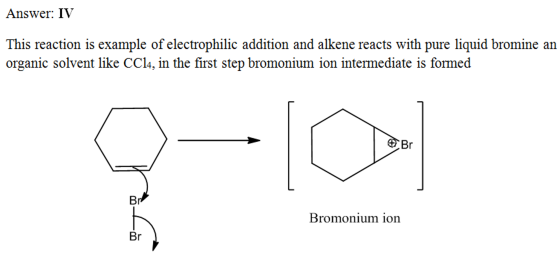
Which reaction intermediate is formed when Br2/CCl4 reacts with cyclohexene?
When cyclohexene reacts with chlorine in carbon tetrachloride the trans-dihalide is formed. Draw the product and...
 When cyclohexene reacts with chlorine in carbon tetrachloride
the trans-dihalide is formed. Draw the product and write the
complete stepwise mechanism for this reaction. Be sure to show all
intermediate structures and all electron flow using arrows.
Cl2 CCl4
When cyclohexene reacts with chlorine in carbon tetrachloride
the trans-dihalide is formed. Draw the product and write the
complete stepwise mechanism for this reaction. Be sure to show all
intermediate structures and all electron flow using arrows.
Cl2 CCl4
7. Which reaction intermediate is formed when 4-methylcyclohexene reacts with Bez dissolved in CCL? [ Br...
 7. Which reaction intermediate is formed when 4-methylcyclohexene reacts with Bez dissolved in CCL? [ Br Ho HC Hac Br 8. Which reaction is not stereospecific? trans-2-Butene_ Bra/CCIA cis-2-Pentene Pentene Bry/H20 trans-2-Hexene — HBr 1-Methylcyclohexene Da/Pd IV TV 9. Predict the product for the following reaction. OTS 1. Nal/acetone 2. NaCN/DMF - CN
Show the mechanism for the following reaction conducted at ?5 ?C in CCl4: cyclohexene bromine yields...
 Show the mechanism for the following reaction conducted at ?5 ?C
in CCl4: cyclohexene bromine yields a dibromocyclohexane Draw
structures ? including charges and electrons ? and add curved
arrows. Details count.
Show the mechanism for the following reaction conducted at - 5 degree C in CCl4: cyclohexene bromine yields a dibromocyclohexane Draw structures ? including charges and electrons ? and add curved arrows. Details count.
Show the mechanism for the following reaction conducted at ?5 ?C
in CCl4: cyclohexene bromine yields a dibromocyclohexane Draw
structures ? including charges and electrons ? and add curved
arrows. Details count.
Show the mechanism for the following reaction conducted at - 5 degree C in CCl4: cyclohexene bromine yields a dibromocyclohexane Draw structures ? including charges and electrons ? and add curved arrows. Details count.
b. 3-methylbutene reacts with aqueous acid (H,0 True or False? c. The 3-membered bridge intermediate formed in the...
 b. 3-methylbutene reacts with aqueous acid (H,0 True or False? c. The 3-membered bridge intermediate formed in the oxymercuration of alkenes has a large resonance contribution from ring-opened carbocation structures that lead to rearrangement reactions. True or False? d. The reaction of ozone (0,) with cyclohexene which is then treated with dimethysulfide or Zn dust as a reductant yields two carboxylic acid groups. True or False?
b. 3-methylbutene reacts with aqueous acid (H,0 True or False? c. The 3-membered bridge...
b. 3-methylbutene reacts with aqueous acid (H,0 True or False? c. The 3-membered bridge intermediate formed in the oxymercuration of alkenes has a large resonance contribution from ring-opened carbocation structures that lead to rearrangement reactions. True or False? d. The reaction of ozone (0,) with cyclohexene which is then treated with dimethysulfide or Zn dust as a reductant yields two carboxylic acid groups. True or False?
b. 3-methylbutene reacts with aqueous acid (H,0 True or False? c. The 3-membered bridge...
Draw the structures of the three doubly brominated isomers formed when 2-methylpropane reacts with Br2 in the presence of light.
Draw the structures of the three doubly brominated isomers formed when 2-methylpropane reacts with Br2 in the presence of light.
Draw the product formed when the compound shown below undergoes a reaction with Br2 in MeOH....
 Draw the product formed when the compound shown below undergoes
a reaction with Br2 in MeOH.
Draw the product formed when the compound shown below undergoes a reaction with Br2 in MeOH.
Draw the product formed when the compound shown below undergoes
a reaction with Br2 in MeOH.
Draw the product formed when the compound shown below undergoes a reaction with Br2 in MeOH.
Show the mechanism for the following reaction conducted at –5 °C in CCl4: cyclohexene bromine yields...
 Show the mechanism for the following reaction conducted at –5 °C
in CCl4: cyclohexene bromine yields a dibromocyclohexane Draw
structures – including charges and electrons – and add curved
arrows. Details count.
Map do cyclohexene + bromine yields a dibromocyclohexane Draw structures - including charges and electrons - and add curved arrows. Details count. Add curved arrows to the first step. 1l Draw each species (organic and inorganic) resulting from the previous step. Include charges and nonbonding electrons. Add curved...
Show the mechanism for the following reaction conducted at –5 °C
in CCl4: cyclohexene bromine yields a dibromocyclohexane Draw
structures – including charges and electrons – and add curved
arrows. Details count.
Map do cyclohexene + bromine yields a dibromocyclohexane Draw structures - including charges and electrons - and add curved arrows. Details count. Add curved arrows to the first step. 1l Draw each species (organic and inorganic) resulting from the previous step. Include charges and nonbonding electrons. Add curved...
When butadiene reacts with ethyne in a Diels-Alder reaction, what product is formed? O A. cyclohexa-1,4-diene...
 When butadiene reacts with ethyne in a Diels-Alder reaction, what product is formed? O A. cyclohexa-1,4-diene OB. cyclohexyne OC. cyclohexene OD. cyclohexa-1,3-diene E. cyclohexane Reset Selection Question 4 of 10 1 Points How many nodes are in the highest energy MO for the allylic anion? OA. 1 OB.O OC. 2 OD. 3 Reset Selection
References) Draw the structure of the bromohydrin formed when (E)-3-methyl-3-hexene reacts with Br2/H20. Use the we...
 References) Draw the structure of the bromohydrin formed when (E)-3-methyl-3-hexene reacts with Br2/H20. Use the wedge/hash bond tools to indicate stereochemistry where it exists. If the reaction produces a racemic mixture, draw both stereoisomers. Separate multiple products using the + sign from the drop-down menu. е CH3 H,с Br CHy ChemDoodle ChemDoodle"
At 25 °C, Kc= 0.145 for the following reaction in the solvent CCl4. 2BrCl Br2+Cl2 If...
At 25 °C, Kc= 0.145 for the following reaction in the solvent CCl4. 2BrCl Br2+Cl2 If the initial concentrations of Br2 and Cl2 are each 0.0233 M, what will their equilibrium concentrations be?
 When cyclohexene reacts with chlorine in carbon tetrachloride
the trans-dihalide is formed. Draw the product and write the
complete stepwise mechanism for this reaction. Be sure to show all
intermediate structures and all electron flow using arrows.
Cl2 CCl4
When cyclohexene reacts with chlorine in carbon tetrachloride
the trans-dihalide is formed. Draw the product and write the
complete stepwise mechanism for this reaction. Be sure to show all
intermediate structures and all electron flow using arrows.
Cl2 CCl4
 7. Which reaction intermediate is formed when 4-methylcyclohexene reacts with Bez dissolved in CCL? [ Br Ho HC Hac Br 8. Which reaction is not stereospecific? trans-2-Butene_ Bra/CCIA cis-2-Pentene Pentene Bry/H20 trans-2-Hexene — HBr 1-Methylcyclohexene Da/Pd IV TV 9. Predict the product for the following reaction. OTS 1. Nal/acetone 2. NaCN/DMF - CN
 Show the mechanism for the following reaction conducted at ?5 ?C
in CCl4: cyclohexene bromine yields a dibromocyclohexane Draw
structures ? including charges and electrons ? and add curved
arrows. Details count.
Show the mechanism for the following reaction conducted at - 5 degree C in CCl4: cyclohexene bromine yields a dibromocyclohexane Draw structures ? including charges and electrons ? and add curved arrows. Details count.
Show the mechanism for the following reaction conducted at ?5 ?C
in CCl4: cyclohexene bromine yields a dibromocyclohexane Draw
structures ? including charges and electrons ? and add curved
arrows. Details count.
Show the mechanism for the following reaction conducted at - 5 degree C in CCl4: cyclohexene bromine yields a dibromocyclohexane Draw structures ? including charges and electrons ? and add curved arrows. Details count.
 b. 3-methylbutene reacts with aqueous acid (H,0 True or False? c. The 3-membered bridge intermediate formed in the oxymercuration of alkenes has a large resonance contribution from ring-opened carbocation structures that lead to rearrangement reactions. True or False? d. The reaction of ozone (0,) with cyclohexene which is then treated with dimethysulfide or Zn dust as a reductant yields two carboxylic acid groups. True or False?
b. 3-methylbutene reacts with aqueous acid (H,0 True or False? c. The 3-membered bridge...
b. 3-methylbutene reacts with aqueous acid (H,0 True or False? c. The 3-membered bridge intermediate formed in the oxymercuration of alkenes has a large resonance contribution from ring-opened carbocation structures that lead to rearrangement reactions. True or False? d. The reaction of ozone (0,) with cyclohexene which is then treated with dimethysulfide or Zn dust as a reductant yields two carboxylic acid groups. True or False?
b. 3-methylbutene reacts with aqueous acid (H,0 True or False? c. The 3-membered bridge...
 Draw the product formed when the compound shown below undergoes
a reaction with Br2 in MeOH.
Draw the product formed when the compound shown below undergoes a reaction with Br2 in MeOH.
Draw the product formed when the compound shown below undergoes
a reaction with Br2 in MeOH.
Draw the product formed when the compound shown below undergoes a reaction with Br2 in MeOH.
 Show the mechanism for the following reaction conducted at –5 °C
in CCl4: cyclohexene bromine yields a dibromocyclohexane Draw
structures – including charges and electrons – and add curved
arrows. Details count.
Map do cyclohexene + bromine yields a dibromocyclohexane Draw structures - including charges and electrons - and add curved arrows. Details count. Add curved arrows to the first step. 1l Draw each species (organic and inorganic) resulting from the previous step. Include charges and nonbonding electrons. Add curved...
Show the mechanism for the following reaction conducted at –5 °C
in CCl4: cyclohexene bromine yields a dibromocyclohexane Draw
structures – including charges and electrons – and add curved
arrows. Details count.
Map do cyclohexene + bromine yields a dibromocyclohexane Draw structures - including charges and electrons - and add curved arrows. Details count. Add curved arrows to the first step. 1l Draw each species (organic and inorganic) resulting from the previous step. Include charges and nonbonding electrons. Add curved...
 When butadiene reacts with ethyne in a Diels-Alder reaction, what product is formed? O A. cyclohexa-1,4-diene OB. cyclohexyne OC. cyclohexene OD. cyclohexa-1,3-diene E. cyclohexane Reset Selection Question 4 of 10 1 Points How many nodes are in the highest energy MO for the allylic anion? OA. 1 OB.O OC. 2 OD. 3 Reset Selection
 References) Draw the structure of the bromohydrin formed when (E)-3-methyl-3-hexene reacts with Br2/H20. Use the wedge/hash bond tools to indicate stereochemistry where it exists. If the reaction produces a racemic mixture, draw both stereoisomers. Separate multiple products using the + sign from the drop-down menu. е CH3 H,с Br CHy ChemDoodle ChemDoodle"
Most questions answered within 3 hours.
-
Where is the error in this code sequence?
String s1 = "Hello";
String s2 = "ello";...
asked 10 months ago -
Financial data for Joel de Paris, Inc., for last year
follow:
Joel de Paris, Inc.
Balance...
asked 10 months ago -
Consider this reaction:
Al2(SO4)3 (aq)+ BaCl3
(aq) Al2Cl6 (aq)- +
3BaSO4(s) . What is the...
asked 10 months ago -
Suppose that Savneet is considering increasing her
recent random sample from 20 car rentals to 40...
asked 10 months ago -
Trucks arrive at an unloading terminal at an average rate of 120
per hour.
Trucks arrive...
asked 10 months ago -
Why are methanol and ethanol completely soluble in water while
octanol is not very little soluble....
asked 10 months ago -
A facilities manager at a university reads in a research report
that the mean amount of...
asked 10 months ago -
When the CuSO4 is rehydrated by adding water to the anhydrous
compound, is this an endothermic...
asked 10 months ago -
A ray of sunlight is passing from diamond into crown glass; the
angle of incidence is...
asked 10 months ago -
A block of mass 0.249 kg is placed on top of a light, vertical
spring of...
asked 10 months ago -
how do the kidneys compensate in the presences of acidosis
a) trigger hyperventilate
b) reserve acid...
asked 10 months ago -
Question 501 pts
The rental rate of capital to the firm increases. Which of the
following...
asked 10 months ago